
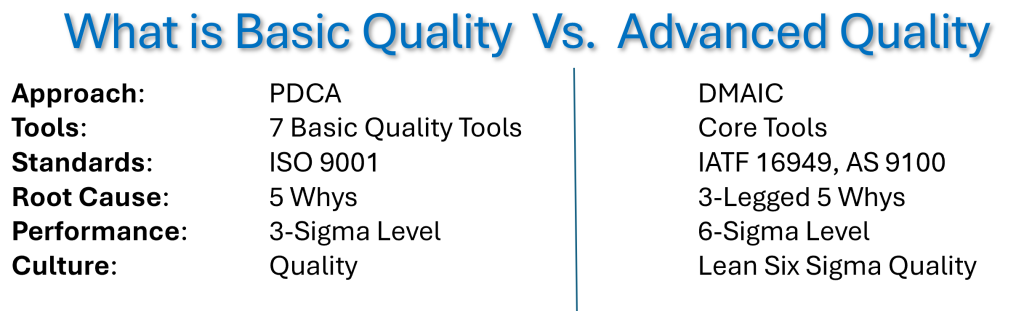
A significant distinction between basic and advanced quality impacts your understanding of product standards. Recognizing these differences can enhance your decision-making process as you navigate various products and services. Basic quality usually refers to meeting minimum requirements and standards, while advanced quality involves exceeding expectations through greater attention to detail, preventive action, and innovative features.
Understanding these levels can prevent potential issues and allow you to make more informed choices that align with your needs and preferences. This results in building a better quality management system.

Key Takeaways:
- Basic Quality focuses on meeting the minimum requirements and standards, like ISO 9001, necessary to ensure product functionality and safety.
- Advanced Quality involves a more comprehensive approach emphasizing core tools, continuous improvement, customer satisfaction, and incorporating innovative practices and technologies found in IATF 16949 or AS 9100.
- While Basic Quality ensures compliance and defect prevention of at least 3 sigma, Advanced Quality aims to exceed expectations, drive competitive advantage, and foster long-term relationships with stakeholders up to a 6 sigma level or even greater.
Defining Quality
A clear definition of quality is vital as it sets the foundation for understanding its different levels. Quality, at its core, refers to the degree to which a product or service meets specified requirements or customer expectations. It encompasses a range of attributes, including performance, reliability, and durability, which ultimately guide your decision-making in both personal and professional contexts.
What is Basic Quality?
A vital aspect of any product or service is its basic quality. This level of quality signifies that the item meets minimum standards and functions as intended. PDCA is basic quality that ensures safety and operational capability but does not usually exceed customer expectations or provide additional value.
It’s often characterized by:
- Meets minimum specifications
- Functional and safe
- Cost-effective
What is Advanced Quality?

With advanced quality, your experience elevates significantly as it focuses on exceeding ordinary expectations. Enhanced features, attention to detail, and preventive, risk-based thinking mark this category. Advanced quality manifests in aspects such as:
- Superior world-class performance
- Exceptional customer support
- Innovative features
| Basic Quality | Advanced Quality |
| Meets minimum standards | Exceeds customer expectations |
| Functional | Highly efficient and effective |
| Cost-conscious | Value-driven |
Defining advanced quality involves recognizing its profound impact on your experience. It engages you by providing functionality, pleasure, and satisfaction in ways you may not have anticipated. You encounter products and services that are reliable and designed with your needs in mind, leading to a sense of luxury and exclusivity. This quality aspect encourages brand loyalty and can significantly influence your purchasing decisions.
- Longer lifespan
- Enhanced user experience
- Higher customer satisfaction
| Characteristic | Definition |
| Innovative Design | Creative and appealing aesthetics |
| Robust Testing | Thorough evaluations before release |
| Customer Feedback | Incorporates insights for continuous improvement |
Characteristics of Basic Quality

Some key characteristics of basic quality include using the process approach (PDCA) to deliver imperative functionality, reliability, and compliance with standard requirements. Products or services that meet basic quality levels are typically satisfactory, providing the foundational performance customers expect.
This basic level ensures that your expectations are met without bells and whistles, ultimately serving the primary purpose without unnecessary complications. Basic quality often uses the 7 Quality Tools to meet the customer’s requirements.
Standards and Specifications
Basic quality is often defined by adhering to minimum standards and specifications set by industry benchmarks. These parameters provide a framework that ensures the product or service performs its intended function adequately, making it fit. By ensuring compliance with these standards, you can trust that your offerings meet fundamental quality requirements without exceeding them.
Customer Expectations
Specifications play a crucial role in shaping customer expectations regarding basic quality. When you establish clear and concise specifications, your customers know what to anticipate from your products or services. Quality often translates to basic performance, reliability, and safety, so it’s imperative to communicate these aspects effectively to avoid misalignment in expectations.
Understanding customer expectations regarding basic quality is vital for your success. Clients generally expect dependability, safety, and the capacity for the product or service to perform its intended function efficiently. Falling short in meeting these expectations can lead to customer dissatisfaction and potential loss of trust in your brand. Therefore, understanding what your customers consider imperative is crucial in ensuring you deliver products that align with their core needs while maintaining a competitive edge.
Characteristics of Advanced Quality
For those striving to achieve advanced quality, it is crucial to focus on specific characteristics that differentiate it from basic quality. These characteristics include:
- Consistency: Delivering results that meet or exceed expectations consistently.
- Customer Focus: Prioritizing customer needs and feedback.
- Process Optimization: Streamlining processes to enhance efficiency.
- Data-Driven Decisions: Utilizing analytics to inform quality improvements.
- Collaboration: Engaging teams across all levels for input and implementation.
Table of Characteristics
| Characteristic | Description |
|---|---|
| Consistency | Ensuring reliable outcomes over time. |
| Customer Focus | Adapting products/services based on customer feedback. |
| Process Optimization | Improving efficiency through method enhancements. |
| Data-Driven Decisions | Using data insights to inform quality management. |
| Collaboration | Engaging all team members in the quality process. |

Preventive Action
Risk-based thinking is the foundation of preventive action. Organizations can deploy advanced quality core tools to reduce risks, including advanced product quality planning (APQP), the production part approval process, failure modes and effects analysis (FMEA combined with exact control plans), measurement systems analysis (MSA), and statistical process control (SPC). The tools of advanced quality typically require training found in Six Sigma methodologies.
Continuous Improvement
One crucial aspect of advanced quality is the commitment to continuous improvement. This means utilizing advanced tools like Lean and Six Sigma for process improvement to consistently assess and refine processes and products, ensuring they adapt to changing demands and expectations.
Innovation and Adaptability
To attain advanced quality, you must embrace innovation and adaptability. This involves fostering a culture that effectively encourages creative solutions and responsive changes to meet consumer needs.
Improvement in innovation and adaptability is vital as it allows your organization to remain relevant and competitive. By fostering an environment that encourages creative thinking and embracing change, you can swiftly pivot in response to market trends. This enhances your products and improves customer satisfaction, increasing loyalty and long-term success. Note that the more you innovate and adapt, the more robust your quality management practices become, paving the way for a sustainable future.
Key Differences Between Basic and Advanced Quality
Once again, understanding the differences between basic and advanced quality is imperative in enhancing your organization’s performance. The following list highlights some of these key differences:
- Focus: Basic quality emphasizes meeting minimum standards, while advanced quality seeks continuous improvement.
- Tools: Basic quality uses simple tools like PDCA, whereas advanced quality employs sophisticated techniques like Six Sigma DMAIC.
- Culture: A basic quality approach has limited organizational culture, while an advanced quality approach fosters a Lean culture of excellence.
- Customer Involvement: Basic quality often lacks customer feedback, while advanced quality integrates customer insights into implied requirements.
- Risk-based Thinking: Basic quality works to understand risk, while advanced quality uses core tools to mitigate and prevent risks actively.
| Basic Quality | Advanced Quality |
|---|---|
| PDCA focuses on compliance. | DMAIC promotes innovation and continual improvement. |
| Minimal employee training. | Extensive training in Lean Six Sigma process improvement programs. |
| Reactive approach to problems using 5 Whys. | Proactive problem-solving and preventive measures with 3-legged 5 Whys and 8D |
Approach to Quality Management
In a basic approach, quality management often revolves around meeting set standards, with limited engagement from employees and stakeholders. In contrast, advanced quality management promotes a systemic method that integrates flexibility, employee involvement, and continuous improvement strategies to drive your organization’s success.
Impact on Organization
The impact on your organization profoundly depends on the quality approach you adopt. A basic quality system may yield short-term compliance benefits yet often lacks the adaptability needed for sustainable growth. When you implement advanced quality practices, you create an environment that fosters innovation and collaboration, positioning your organization for long-term success.
Quality systems shape your company’s processes and influence employee morale and customer satisfaction. You can enhance operational efficiency and reduce costs by prioritizing advanced quality methodologies. This leads to a positive transformation in organizational reputation and market competitiveness. Failing to implement these advanced measures may result in missed opportunities and increased risks, jeopardizing your organization’s future success.
Benefits of Advanced Quality

Many organizations experience significant advantages by implementing advanced quality management systems. These benefits manifest in various ways:
- Enhanced product consistency and reliability.
- Improved operational efficiency and reduced waste.
- Better compliance with industry standards and regulations.
- Increased customer satisfaction and loyalty.
Competitive Advantage
Benefits of advanced quality include gaining a competitive edge in your industry, as you can consistently deliver superior products. Your ability to meet customer expectations elevates your market position and fosters brand loyalty.
Long-term Sustainability
Any organization striving for growth must focus on long-term sustainability. Advanced quality practices enable you to maintain robust supply chains and minimize risks associated with quality failures.
Quality management ensures a strong foundation for your organization. Advanced quality fosters a culture of continuous improvement and protects against potential financial losses from non-compliance and reputation damage from product recalls. Investing in advanced quality management, you proactively secure your organization’s future success and foster a resilient business model.
Challenges in Implementing Advanced Quality
To successfully implement advanced quality practices, you may face several challenges that can hinder progress. These challenges include:
- Inadequate training and skills
- Resistance to change among staff
- Insufficient resources and budget constraints
- Complexity of advanced quality systems
- Misalignment with business goals
| Key Challenges | Impact |
|---|---|
| Inadequate training | Limits team effectiveness |
| Resistance to change | Stalls implementation efforts |
| Budget constraints | Reduces investment in tools |
Resource Allocation
Implementing advanced quality requires careful resource allocation to ensure all necessary tools and personnel are in place. You must assess current resources and determine where additional investment is imperative to support your quality initiatives.
Cultural Shift
Allocating your resources alone won’t suffice; a cultural shift within your organization is crucial for successful adoption. It would be best to prioritize building a quality-focused mindset among your team. The need for a cultural shift cannot be overstated, as it directly influences your success in implementing advanced quality.
For you, this means promoting quality at every level of your organization. Entrenched attitudes and practices may resist you, but fostering a positive, quality-oriented culture will pave the way for long-term benefits, such as improved customer satisfaction and enhanced team collaboration. Emphasizing open communication and continuous improvement will help align your team with the principles of advanced quality, ultimately driving better results.
Basic and Advanced Quality
Understanding the difference between basic and advanced quality is crucial for effectively assessing and enhancing your processes. Basic quality meets standard requirements and ensures consistency, while advanced quality emphasizes innovation and continuous improvement to exceed expectations.
By recognizing where your products or services stand within this spectrum, you can better tailor your strategies to achieve higher customer satisfaction and operational excellence. This knowledge will empower you to make informed decisions that drive your business forward.
FAQ
Q: What is the main difference between Basic Quality and Advanced Quality?
A: Basic Quality refers to the fundamental standards that ensure a product or service meets fundamental criteria and requirements. This includes aspects like functionality, safety, and basic performance metrics. Advanced Quality, on the other hand, involves additional features and greater attention to critical-to-quality (CTQ) specifications or customer-specific requirements that enhance the overall experience and reliability of the product or service, such as premium materials, enhanced performance capabilities, and superior customer service.
Q: How are Basic Quality metrics measured compared to Advanced Quality metrics?
A: Basic Quality metrics are typically measured using straightforward quantitative methods, such as pass/fail tests, compliance checks, and basic performance evaluations. In contrast, Advanced Quality metrics may involve more complex evaluations such as customer satisfaction scores, long-term reliability studies, and performance benchmarks against industry leaders. Advanced Quality metrics often incorporate user feedback, supplier scorecards, and advanced testing methodologies.
Q: Can a product with Basic Quality still be considered good?
A: Yes, a product with Basic Quality can still be considered good if it meets its users’ primary needs and expectations. Basic Quality products can offer great value, especially for budget-conscious consumers or specific applications with unnecessary high-end features. However, consumers seeking enhanced performance and features may find Advanced Quality products better suit their requirements.
Q: In what scenarios should a business invest in Advanced Quality?
A: Businesses should consider investing in Advanced Quality when targeting markets that demand superiority, such as luxury goods, highly technical applications, or competitive industries. If the target demographic values premium features, longer durability, and exceptional service, investing in Advanced Quality can increase customer loyalty, higher profit margins, and improve brand reputation.
Q: Are there any cost implications when choosing between Basic and Advanced Quality?
A: Yes, there are significant cost implications when choosing between Basic and Advanced Quality. Basic Quality products generally have lower production costs, making them more affordable for consumers. In contrast, Advanced Quality products are often more expensive due to higher-quality materials, extensive research and development, and additional features. Considering their target market and competitive landscape, companies must weigh these costs against potential returns.


