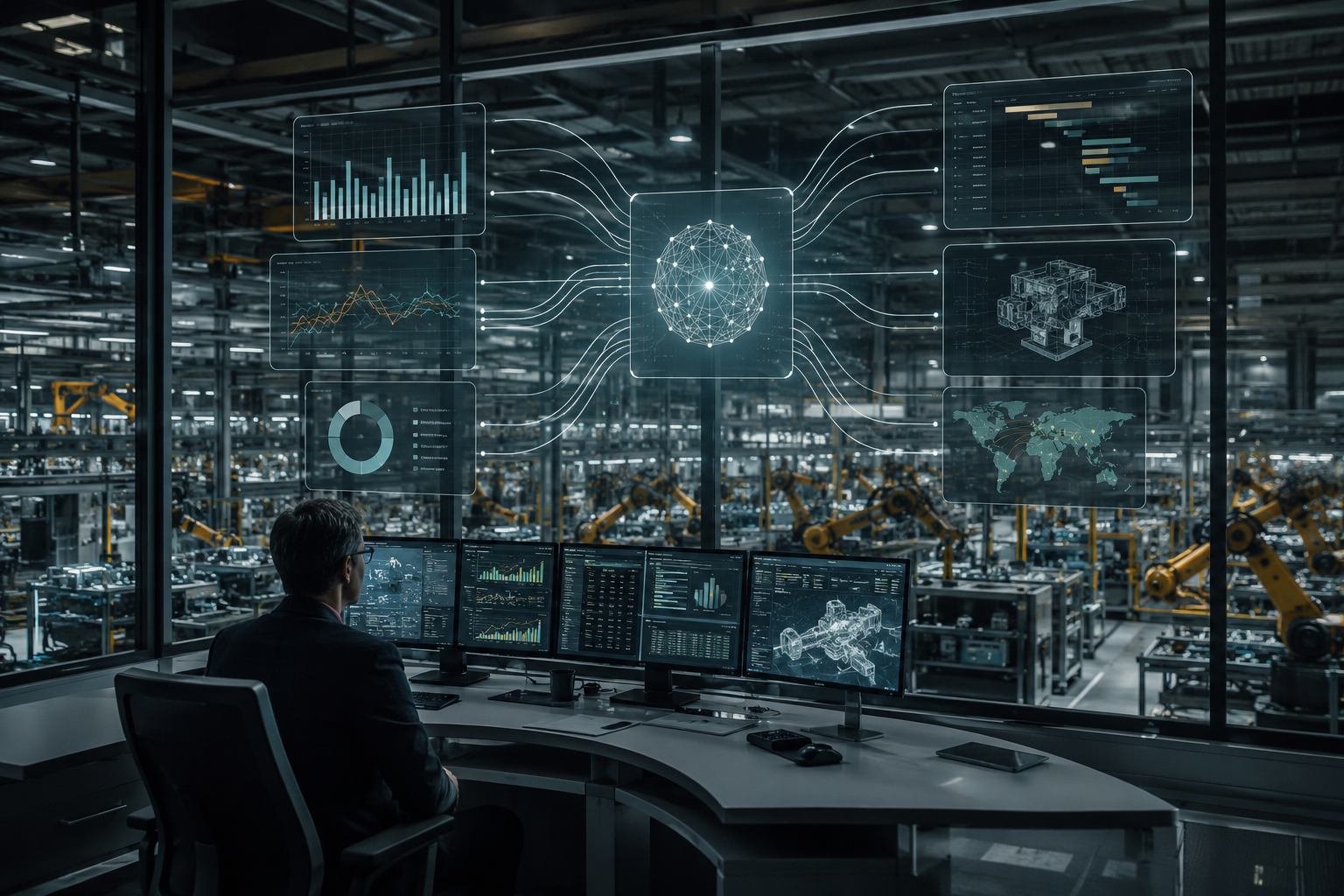
The Quality Strategy Hidden in Plain Sight
Most discussions of Elon Musk’s business strategy focus on personality, risk appetite, capital intensity, or technological ambition. That framing is understandable, but it misses the more useful lesson for quality professionals, operations leaders, and systems engineers.
The more interesting interpretation is not that Musk “moves fast,” breaks conventions, or pursues impossible goals. The more useful interpretation is that his companies repeatedly attack systemic waste at the architecture level. He uses modern industrial intelligence to redesign the product, process, supply chain, feedback loop, and economic model simultaneously. In quality language, the strategy is not simply innovation. It is prevention, control, and learning velocity at enterprise scale.
This matters because many organizations still treat quality as a compliance function or an inspection activity. They audit the process after it exists. They correct defects after they escape. They improve operations after waste has already been institutionalized. The Musk-company pattern suggests a different logic: quality strategy begins when the business model is still being designed.
That does not mean every decision made by Tesla, SpaceX, Starlink, The Boring Company, Neuralink, or PayPal should be copied. It also does not mean speed automatically creates quality. In fact, uncontrolled speed can accelerate risk. The point is more disciplined: if an organization can eliminate structural waste and instrument failures, shorten learning loops, and convert field evidence into design and process control, it can build a powerful competitive advantage.
For quality engineers, auditors, Six Sigma practitioners, reliability engineers, and standards professionals, this is a valuable case study. It shows how familiar concepts such as prevention, CTQs, APQP, DFMEA, PFMEA, control plans, FRACAS, CAPA, supplier control, and reliability growth can be interpreted not merely as technical tools, but as business strategy.
The central argument is this: Musk’s strongest business pattern can be read as quality engineering at enterprise scale. The companies are not the lesson by themselves. The professional translation is the lesson.
Quality as Strategy, Not Compliance
Traditional business commentary often separates strategy from quality. Strategy is treated as market choice, product positioning, capital allocation, or competitive advantage. Quality is treated as conformance, inspection, audit readiness, or customer satisfaction. In modern industrial systems, that separation is increasingly obsolete.
Quality determines whether the strategy can scale.
A product may be visionary, but if it cannot be manufactured repeatedly, serviced economically, validated objectively, and improved through controlled learning, it remains fragile. A technology may be impressive, but if its failure modes are not understood, if its suppliers cannot produce consistent inputs, or if its field data does not feed back into design and process control, it remains a prototype rather than an industrial system.
This distinction is especially important in advanced manufacturing, aerospace, AI-enabled operations, and space industrialization. In these environments, quality is not an after-the-fact discipline. It is the mechanism by which possibility becomes repeatable capability.
A quality-centered view of strategy asks different questions:
- What structural waste is built into the current system?
- Which design choices create downstream defects, service burden, or cycle-time drag?
- Which processes are being controlled by inspection rather than prevention?
- Where are learning loops too slow?
- What evidence is required to prove that the system is capable?
- Which risks must be designed out before scale?
These are not narrow quality questions. They are enterprise strategy questions.
The Common Pattern Across Musk Companies
The companies associated with Musk operate in different sectors: payments, electric vehicles, rockets, satellites, tunneling, neurotechnology, and orbital infrastructure. On the surface, they appear unrelated. But through a quality engineering lens, a consistent pattern emerges.
 Musk company examples through a QE lens
Each company attacks a form of systemic waste
Elon Musk applies a classic Quality Engineering mindset to the business strategy. His competitive advantage is using advanced manufacturing methods to surpass the competition.
- Vertical integration to control cycle time, lead time, and costs.
- Used software to digitize processes
- Rapid test-learning cycles
- Increased cadence from one-off to repeatable cycles
- Eliminated waste, parts, handoffs, steps, and bottlenecks to increase material flow
- Reduced friction, communication, and handoffs to streamline information flow
Specific examples include:
- PayPal and X.com attacked payment friction. The quality problem was not simply transaction speed; it was trust architecture. Users needed confidence that money could move reliably through a digital system. In this context, quality meant system confidence.
- Tesla attacked mechanical friction, service friction, and the legacy architecture of vehicles. Electric powertrains reduced part count. Software-enabled vehicles made field data central to product improvement. Over-the-air updates shifted some aspects of correction and enhancement from physical service to digital control. The lesson from quality is that it can shift upstream into architecture.
- SpaceX attacked expendable launch systems, slow development cycles, and high access cost. Reusability changed the launch model from a one-time event into a measurable lifecycle. Launch, recovery, inspection, refurbishment, and relaunch became part of a repeating production-service cycle. The quality lesson is that iteration must be instrumented.
- Starlink attacked the idea that space hardware must always be bespoke, low-volume, and slow. A satellite constellation requires repeatable production, standardization, software release control, supplier discipline, and field performance data across thousands of units. The quality lesson is that space hardware can become volume manufacturing.
- The Boring Company attacked tunneling cycle time and infrastructure process friction. The strategic idea was to remove bottlenecks, simplify steps, and increase throughput. Whether or not every business objective is achieved, the quality lesson is familiar: attack waste at the process level, not just at the labor level.
- Neuralink operates in an extreme-consequence environment where procedure variability, verification, sterility, reliability, and human safety dominate the quality equation. In such a system, prevention-first design is not optional. The quality lesson is that extreme consequence demands automation, validation, and disciplined risk control.
Across these examples, the pattern is not “move fast and break things.” That phrase is inadequate and often misleading. The more accurate interpretation of quality is: move fast only when failure is bounded, instrumented, and converted into learning.
Waste Reduction Before Inspection
The strongest quality lesson from these companies is that they often attack waste before the traditional inspection point.
This is a core operational excellence principle. Lean teaches that waste should be removed from the value stream rather than inspected around. Six Sigma teaches that variation should be reduced at the source rather than sorted at the end. APQP teaches that customer requirements, CTQs, design risk, process risk, control plans, and validation evidence must be integrated before launch.
In many organizations, however, quality systems are implemented after strategic decisions have already created structural waste. A supplier network is chosen, a product architecture is frozen, a process layout is built, and then quality is asked to control the consequences. That is a weak position.
The Musk-company pattern demonstrates a more aggressive approach. The system itself is redesigned to reduce friction.
Vertical integration is one example. It is often discussed as a supply chain or cost strategy, but it also has quality implications. When an organization controls more of the design, manufacturing, software, and service ecosystem, it may reduce handoffs, shorten feedback loops, accelerate root cause analysis, and close the gap between field performance and engineering correction. Of course, vertical integration also creates risk. It can increase capital burden, reduce supplier diversification, and concentrate failure modes internally. But from a quality-strategy perspective, the appeal is clear: fewer uncontrolled interfaces can lead to faster learning and stronger configuration control.
Software is another example. Software allows feedback to move faster than physical product cycles. It can digitize service data, monitor performance, identify patterns, and deploy updates. But software-enabled quality requires governance. Without requirements control, validation, cybersecurity, configuration discipline, and release management, software speed can become risk acceleration.
The real lesson is not that vertical integration or software automatically improves quality. The lesson is that structural decisions determine the quality system’s operating conditions.
Prevention as a Business Model
Quality professionals understand the cost-of-quality principle: prevention is usually cheaper than appraisal and correction, and escaped defects are more expensive than defects caught upstream. In aerospace and space systems, this principle becomes dramatically more severe.
A design escape may be correctable through engineering change. A production escape may be costly but still containable. A launch integration escape becomes more difficult to address because hardware is already moving through high-consequence interfaces. An orbital escape may be unrecoverable or mission-threatening. A mission failure may destroy not only the product but also customer trust, regulatory confidence, and future market opportunity.
That escalation changes the business case for prevention
In ordinary manufacturing, some leaders view prevention costs as overhead. Training, validation, supplier qualification, design reviews, FMEA updates, control plan discipline, and measurement-system analysis may be seen as burdens. In high-consequence systems, prevention becomes the business model. Without prevention, the market cannot trust the product. Without trust, adoption slows. Without adoption, scale never arrives.
This is one reason space industrialization is such a powerful extension of quality thinking. Space systems expose the weakness of detect-and-correct quality. If the factory is in orbit, “inspect later” may not be available. If the process runs remotely, the evidence system must be designed before production begins. If physical access is limited, telemetry, imaging, sensor fusion, digital travelers, and autonomous checks become part of the control strategy.
The quality system is not paperwork. It is the operating system of trust.
“Fail Fast” Is Not Enough
One of the most misunderstood ideas in modern technology management is “fail fast.” In quality terms, failure has no inherent value. Uncontrolled failure is waste. Failure becomes valuable only when it occurs inside a disciplined learning system. A useful distinction is between uncontrolled failure and instrumented failure.
 Uncontrolled failure is waste
Uncontrolled failure has a vague test envelope, poor telemetry, unclear acceptance criteria, weak root cause analysis, and no durable update to design or process control. It may create drama, public attention, or internal urgency, but it does not necessarily improve the system.
Instrumented failure is different. It occurs inside a bounded test envelope. It captures telemetry-rich data. It identifies failure modes. It feeds a FRACAS or CAPA process. It updates design requirements, process parameters, inspection criteria, supplier controls, or operating limits. It changes the system.
This is where quality engineering and reliability engineering become central to innovation. A company can test rapidly without learning rapidly. Cadence alone is not learning. Learning requires objective evidence, root cause discipline, and controlled change.
The practical question for any organization is simple: when a test fails, does the system learn? If the answer is no, then speed is theater. If the answer is yes, then failure can become reliability growth.
Reusability as Process Capability
Reusable rockets are usually discussed as a breakthrough in launch economics. That is true, but incomplete. Reusability is also a process capability strategy.
An expendable launch vehicle is closer to a one-time product. A reusable booster creates a repeating lifecycle: build, launch, recover, inspect, refurbish, and relaunch. Each reuse cycle generates operating data. Each inspection creates evidence. Each refurbishment decision reveals degradation behavior. Each relaunch tests whether the system can perform repeatedly under controlled conditions.
For quality professionals, this turns launch into a population problem.
The question is no longer only, “Did this mission succeed?” The question becomes, “What does the distribution of performance look like across repeated cycles?” What is the anomaly rate? What is the recovery yield? What is the refurbishment time? What nonconformances appear after each flight? Which components degrade predictably? Which failure modes emerge only after reuse? Which process parameters correlate with later performance?
In manufacturing language, reusability shifts the conversation toward process capability, statistical evidence, reliability growth, configuration discipline, and lifecycle control.
This is why the idea of a “Cpk of launch operations” is useful, even if it is metaphorical. A launch system’s capability might be reflected in turnaround time, mission success rate, recovery success, refurbishment hours, anomaly recurrence, or variation in critical operations. The deeper point is that capability is demonstrated by repeated cycles, not declared by intent.
Starlink and Volume Manufacturing in Space
Starlink provides a different quality lesson. It is not primarily a launch story. It is a production-quality story.
Large satellite constellations change the logic of space hardware. Traditional aerospace mission assurance often assumes low volume, high customization, long review cycles, and extensive documentation per mission. A constellation of thousands of satellites is pushing space hardware toward volume manufacturing. That introduces a different set of quality challenges.
How do DFMEA and PFMEA scale across large numbers of units? How is configuration controlled when hardware and software evolve rapidly? How are supplier changes evaluated? How are nonconformances trending across a fleet? How is software release risk managed when orbital assets are already deployed? How is orbital debris risk considered as part of product and process responsibility?
The quality problem becomes constellation velocity.
At that scale, the organization must manage both manufacturing repeatability and operational learning. Field data from satellites should inform design updates. Production nonconformances should inform process controls. Software anomalies should inform release governance. Supplier variation should inform incoming inspection, qualification, and development. The constellation becomes both product and data source.
This is industrial intelligence in action: physical assets, digital feedback, operational metrics, and quality systems operating as one learning architecture.
SpaceX, Tesla, and the Shift from Heroic Execution to Controlled Cadence
A recurring risk in discussions of breakthrough companies is over-personalization. It is tempting to attribute outcomes to charisma, intensity, or heroic execution. Quality professionals should resist that framing.
Heroic execution does not scale. Controlled cadence does.
The strategic question is not whether a prototype can work once. It is whether the system can work repeatedly, at rate, with controlled risk. That is the language of APQP, production readiness, process validation, control plans, supplier quality, and reliability growth.
This distinction is especially important with systems such as Starship. A stated design capability is not the same as demonstrated operational capability. Payload capacity, reusability goals, marginal cost targets, and launch cadence targets must eventually be converted into evidence: repeated launches, controlled variation, safety performance, turnaround data, refurbishment records, anomaly closure, and regulatory confidence.
In terms of quality, the journey is from demonstration to capability. A prototype proves that something may be possible. A capable process demonstrates it can be performed repeatedly within defined risk limits. Industrialization requires the second.
Governance: Speed Must Not Outrun Evidence
High learning velocity creates value only when governance keeps pace. This is one of the most important lessons for quality leaders.
Design reviews, DFMEA, PFMEA, control plans, verification and validation evidence, special characteristics, supplier development, configuration management, CAPA, and FRACAS are not bureaucratic obstacles to innovation. Properly designed, they are the mechanisms that prevent speed from becoming uncontrolled risk.
This matters in any high-technology environment, but especially in aerospace, medical devices, AI-enabled systems, and space manufacturing. As systems become more autonomous, remote, software-defined, and interconnected, the cost of weak governance rises.
The goal is not to slow innovation. The goal is to keep speed from outrunning evidence.
This is also where independent assurance matters. A powerful founder, centralized decision-making structure, or vertically integrated enterprise may accelerate long-cycle bets. But autonomy without assurance can create systemic risk. Quality strategy must balance speed, evidence, independence, and accountability.
Lessons for Quality Professionals
The professional lesson is not that every organization should imitate Tesla or SpaceX. Most companies operate under different capital structures, regulatory requirements, customer expectations, and risk tolerances. The lesson is that quality tools become more powerful when used as strategic design principles.
Several implications stand out.
First, quality should be involved earlier. By the time a product architecture, supplier model, software architecture, and process design are fixed, many quality problems are already embedded. Prevention begins before the control plan is written.
Second, quality should focus on learning loops. CAPA, FRACAS, warranty analysis, field data, audit findings, and process performance metrics should feed design and process updates. A quality system that records problems but does not change the system is administrative, not strategic.
Third, quality should demonstrate integrity. In advanced manufacturing, digital factories, AI-enabled operations, and space systems, evidence increasingly comes from telemetry, software logs, sensor data, digital travelers, simulations, and remote inspection. Measurement-system integrity becomes central.
Fourth, quality should translate innovation into capability. Executives may talk about vision. Engineers may talk about technical feasibility. Customers may talk about performance. Quality professionals must ask: what makes this repeatable, auditable, scalable, and trusted?
That is the strategic role.
Quality Engineering as Competitive Advantage
The most valuable way to study Musk-related companies is not as personality-driven stories, but as examples of enterprise-scale quality strategy. They attack structural waste. They redesign systems before relying on inspection. They compress learning loops. They use operational data to improve design and process control. They attempt to move from one-off success to repeatable cadence. This is quality engineering applied to business strategy.
That pattern is not limited to rockets or electric vehicles. It applies to advanced manufacturing, industrial AI, digital factories, autonomous operations, forecasting, optimization, and space manufacturing. It is part of a broader shift toward Industrial Intelligence.
For Bizmasterz readers, the message is clear: quality is not merely conformance. Quality is how ambitious systems become trusted systems. It is how prototypes become industries. It is how speed becomes learning rather than chaos.
The next industrial era will not be built by technology alone. It will be built by organizations that can make complex systems capable, repeatable, auditable, and trusted. Rockets may open the door. Quality builds the industry.
Frequently Asked Questions
Is Elon Musk’s strategy really a quality strategy?
It can be interpreted that way. The useful professional lesson is not personality or risk-taking, but the repeated pattern of eliminating systemic waste, shortening feedback loops, using evidence, and moving from prototypes toward repeatable capability.
What does “quality engineering at enterprise scale” mean?
It means applying prevention, risk analysis, process control, learning systems, and evidence-based decision-making to the design of the business model itself, not just to individual products or processes.
How does this apply outside aerospace?
The same logic applies to manufacturing, supply chain, software-enabled products, medical devices, industrial AI, and digital factories. Any complex system that must scale needs prevention, control, feedback, and trust.
Why is “fail fast” not enough?
Failure only creates value when it is bounded, measured, analyzed, and converted into corrective action or design improvement. Otherwise, it is simply waste.
What is the connection to Industrial Intelligence?
Industrial Intelligence combines operational excellence, manufacturing systems, AI, forecasting, optimization, digital factories, and autonomous production into a connected learning system. The Musk-company pattern is one case study in how such systems can create competitive advantage.
What should quality professionals take from this?
Quality professionals should move upstream. Their work should shape requirements, architecture, supplier strategy, validation planning, evidence systems, and learning loops before defects and risks are already embedded.