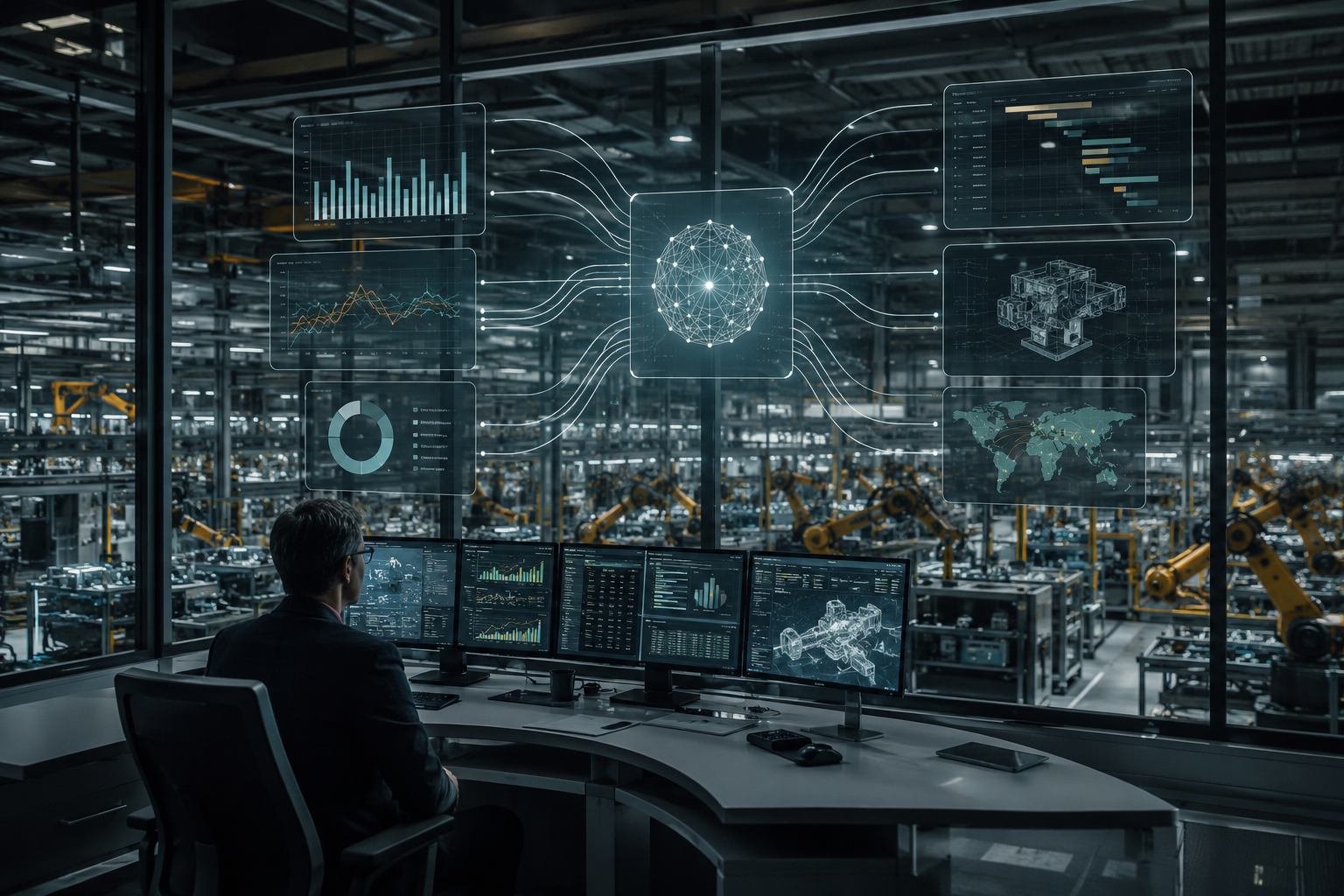
Connected machines are not the same as a learning manufacturing system. A factory can collect signals from equipment, stream data from sensors, display dashboards, and still repeat the same failures month after month. That is the practical gap many Industry 4.0 programs now face. The machines are connected, but the enterprise is not learning quickly enough from what they reveal.
A learning manufacturing system uses connected-machine data as the beginning of the loop, not the end. It connects signals to process context, turns context into evidence, routes decisions through accountable workflows, validates outcomes, and preserves lessons so the next similar decision is better.
That is the bridge from Industry 4.0 to Industrial Intelligence. Industry 4.0 vs Industrial Intelligence framed Industry 4.0 as the digital foundation and Industrial Intelligence as the governed ability to sense, contextualize, decide, act, and learn. This article explains what changes when the factory moves from connected machines to learning systems.
How Do Connected Machines Become Learning Manufacturing Systems?
Connected machines become learning manufacturing systems when machine signals are linked to product, process, quality, maintenance, planning, and supplier context; interpreted as evidence; routed into decisions and workflows; measured against outcomes; and reused as organizational knowledge. The shift is from collecting machine data to improving future manufacturing decisions.
Why Connected Machines Are Only the Starting Point
Connected machines create visibility. They can show status, cycle time, alarms, downtime, temperature, vibration, tool life, scrap signals, energy use, and process variation. Visibility is useful. It helps teams see problems sooner and with less manual effort. But visibility alone does not guarantee learning.
A connected machine can show that a process drifted. It cannot, by itself, explain whether the drift came from tooling, material, setup, programming, operator qualification, environmental conditions, or maintenance state. It cannot decide whether to stop production, add inspection, adjust the schedule, launch containment, or revise the control plan. It cannot know whether last month’s corrective action prevented recurrence unless the organization closes the loop.
That is why Industry 4.0 needs an AI Orchestration Layer. Connected systems need orchestration before they can support coordinated decisions.
The Difference Between Connection and Learning
| Connected machines | Learning manufacturing systems |
| Capture equipment signals | Connect signals to manufacturing context |
| Display status and trends | Interpret evidence and risk |
| Alert local teams | Route decisions to accountable owners |
| Store historical data | Preserve reusable lessons |
| Support reaction | Improve future prevention |
| Measure activity | Measure decision quality and recurrence reduction |
The real difference is memory. A connected machine can report what happened. A learning manufacturing system remembers what the enterprise learned and applies that lesson the next time a similar pattern appears. This is How Industrial Intelligence Creates Organizational Memory is a foundational article on this topic. Learning requires more than data storage. It requires evidence, context, decisions, actions, outcomes, and reuse.
 Swimlane flowchart for manufacturing improvement
The Six Layers of a Learning Manufacturing System
1. Machine Signals
The first layer is machine data: sensor readings, states, cycle times, alarms, process parameters, inspection results, tool life, and downtime events.
The leadership trap: assuming that more machine data automatically creates better performance.
It does not. More signals can create more noise unless the organization knows which decisions those signals should improve.
2. Manufacturing Context
The second layer connects signals to product, routing, operation, work center, material, supplier, operator qualification, control plan, maintenance status, and customer requirement. This is where connected-machine data begins to become usable evidence. The Difference Between Factory Data and Factory Knowledge explains this shift: data tells you what was recorded; knowledge explains what it means.
3. Evidence and Interpretation
The third layer separates signal from noise.
For example, vibration may be normal under one product mix and abnormal under another. A temperature shift may matter for a tight-tolerance product but not for a roughing operation. A cycle-time increase may reflect a process problem, a maintenance issue, a staffing constraint, material variation, or a scheduling decision. A learning system interprets signals in context.
4. Decision and Workflow
The fourth layer routes the right decision to the right owner. That may mean creating a maintenance work order, adding inspection, escalating supplier risk, revising a schedule, launching containment, updating standard work, or opening a CAPA. If the system only produces an alert, it is still shallow. If it produces an accountable decision path, it is becoming Industrial Intelligence.
5. Outcome Validation
The fifth layer checks whether the action worked. Did downtime decrease? Did the defect recur? Did the schedule stabilize? Did the scrap fall? Did the inspection catch the risk earlier? Did the corrective action actually change the process? Without outcome validation, the organization is not learning. It is only reacting.
6. Reusable Knowledge
The sixth layer preserves the lesson so that future decisions improve. This is where machine connectivity becomes organizational capability. The lesson should be searchable, reusable, governed, and connected to future decisions across plants, lines, products, suppliers, and programs.
Why Industrial Internet Thinking Still Matters
Manufacturers should not abandon connectivity. They should build on it. The Industry IoT Consortium remains a useful authority reference because industrial systems need secure, interoperable, connected foundations before advanced intelligence can operate at scale. But the next strategic question is not only whether industrial things are connected. It is whether connected systems improve the decisions that determine quality, delivery, cost, safety, resilience, and learning. Connectivity is the infrastructure. Learning is the capability.
Example: A Connected Machine That Does Not Learn
A CNC machine sends tool-life data to a dashboard. Operators see that tool life is declining faster on one product family. The team changes tools more often for a few weeks. The dashboard still records the data, but no one updates the control plan, supplier review, maintenance assumptions, or setup guidance. Three months later, the same pattern returns. The machine was connected. The system did not learn.
Example: A Learning Manufacturing System
The same tool-life signal appears, but this time it is connected to product family, material lot, machine history, fixture condition, inspection characteristic, operator notes, supplier history, and prior nonconformance records. The system identifies a recurring pattern. It routes an engineering review, updates inspection frequency for the affected condition, changes the tool-life rule, captures the outcome, and preserves the lesson for similar machines and materials. Now the enterprise has learned.
What Leaders Should Measure
Executives should measure whether connected machines are creating learning, not just data.
Useful measures include:
- Signal-to-decision time
- Decision-to-action closure time
- Recurrence rate for known issues
- Percentage of machine alerts linked to workflows
- Percentage of corrective actions tied back to machine evidence
- Number of lessons reused across lines or plants
- Override reasons for AI or analytics recommendations
- Outcome validation rate after machine-triggered actions
These measures align with the Industrial Intelligence Metrics for Executives, which emphasize measuring decision capability rather than digital activity.
How Quality Teams Benefit
Quality teams gain more than inspection visibility. A learning manufacturing system can connect machine conditions to defect patterns, process capability, control plans, CAPA history, and customer requirements. That means quality teams can move from detection to prevention. The lesson from Fail Fast Is Not a Quality Strategy applies directly: the goal is not to fail faster with better sensors. The goal is to prevent repeat failure through evidence and learning.
How Maintenance Teams Benefit
Maintenance teams gain more than predictive alerts. A learning manufacturing system can connect asset signals to production schedules, spare parts, labor availability, quality risk, and prior failure modes. That helps leaders decide when to inspect, repair, defer, reroute, or escalate. The value is not prediction alone. The value is better maintenance decision-making within the factory’s operating system.
How Planners Benefit
Planning teams gain more than machine status. If connected machines show constraint risk, the learning system can connect that risk to open orders, customer priorities, inventory, changeovers, supplier timing, and maintenance windows. The result is a planning system that learns from execution rather than repeating the same assumptions each cycle.
What To Build Next
Manufacturers moving from connected machines to learning manufacturing systems should build:
- A decision inventory for machine-driven decisions.
- A context model connecting machine signals to product, process, quality, maintenance, and planning context.
- Workflow triggers that turn signals into accountable action.
- Outcome validation that proves whether the action worked.
- Organizational memory that preserves reusable lessons.
- Governance rules define when AI recommends, when humans approve, and when automation is appropriate.
This is how connected machines become part of Industrial Intelligence instead of another isolated data source.
The Executive Test
Ask one question: When a connected machine reveals a problem, does the organization become smarter next time?
If the answer is no, the factory is connected but not learning. If the answer is yes, the manufacturer is moving toward Industrial Intelligence.
FAQ
What is a learning manufacturing system?
A learning manufacturing system is a manufacturing operating system that uses data, context, decisions, workflows, outcomes, and lessons learned to improve future decisions across production, quality, maintenance, planning, suppliers, and leadership.
How are connected machines different from learning systems?
Connected machines capture and transmit signals. Learning systems use those signals in context, route decisions, validate outcomes, and preserve lessons so the organization improves over time.
How do connected machines become learning manufacturing systems?
Connected machines become learning manufacturing systems when their signals are linked to manufacturing context, interpreted as evidence, used in accountable workflows, measured against outcomes, and converted into reusable organizational knowledge.
Why does this matter for Industry 4.0?
Industry 4.0 often creates connectivity and visibility. Industrial Intelligence requires learning. Without learning, manufacturers may have more data but still repeat the same operational problems.
What should executives measure?
Executives should measure signal-to-decision time, workflow closure, recurrence reduction, lesson reuse, outcome validation, and decision quality rather than only connected assets, dashboard usage, or sensor counts.