

For manufacturing leaders, uncovering hidden waste within production flow remains a persistent challenge. Traditional observations or manual audits often miss waste such as waiting, excess inventory, rework, unproductive motion, or inefficient handoffs. These inefficiencies not only erode lean manufacturing goals but complicate throughput consistency and cost control.
Advances in artificial intelligence (AI) offer a promising pathway to systematically surface candidate waste signals from governed production-event data, complementing but not replacing human expertise. The workflow from identifying anomalies in event timing or sequences to validating waste context at the gemba forms a crucial bridge between digital shop-floor visibility and actionable continuous improvement.
Understanding Hidden Waste in Manufacturing Flow
Production-Event Data: The Foundation for Waste Detection
AI-enabled waste detection depends critically on comprehensive production-event data, which logs discrete occurrences such as machine cycle completions, worker inputs, buffer entries and exits, or quality inspection results. Such event data streams encapsulate timestamps, process step identifiers, units processed, and may include metadata defining communication protocols or machine interfaces. This granular, structured record is essential for automatically detecting timing delays, sequence deviations, or missing signals that indicate non-value-adding activity.
A 2026 study on Value Stream Mapping (VSM) 4.0 highlights the necessity of coupling production data with contextual metadata to enable meaningful interpretation. Without standardized units, recording frequencies, and accurate interface descriptions, AI algorithms risk flagging false-positive anomalies or overlooking subtle process divergences. Consequently, AI’s waste identification function is bounded by the quality and coherence of the underlying event dataset.
How AI Flags Candidate Waste Signals
Within well-defined event boundaries, AI algorithms can organize and analyze sequences to detect anomalies that may indicate waste. Examples include:
- Timing anomalies: Unusual delays between related steps, machine idle periods, or unexpected process pauses.
- Sequence anomalies: Events occurring out of expected order, skipped steps, or duplicated operations.
- Pattern irregularities: Variations in event frequency or batch sizes inconsistent with normal operation.
A 2026 distributed manufacturing study warns against rigid timeout thresholds that treat delays or missing workpiece signals as failure indicators, since such static rules fail to adapt to process diversity and complex workflows. More sophisticated statistical or machine-learning models that incorporate production context and prior process knowledge yield narrower candidate waste queues with fewer false alarms.
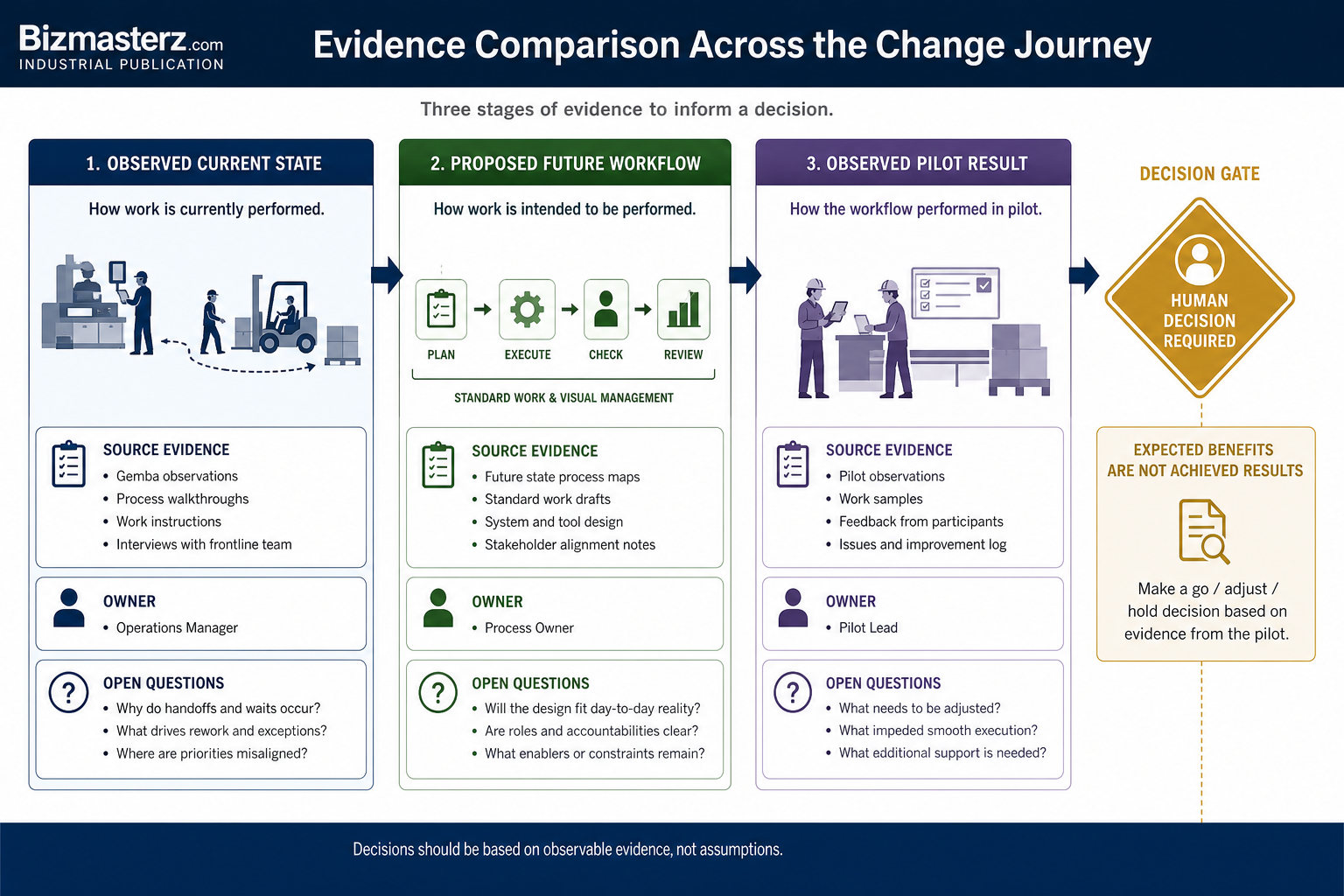
Example: Identifying Waiting Waste in an Automotive Assembly Line
Consider a Tier 1 automotive parts manufacturer aiming to reduce idle time between stamping and welding operations in a high-volume assembly line. AI ingests event logs capturing stamping cycle completions and welding start signals. By applying anomaly detection to inter-event timing, AI flags instances where stamping cycles consistently complete but welding stalls beyond expected buffer time, suggesting waiting waste.
Once candidate waiting occurrences are enumerated, plant Lean engineers verify at the gemba whether delays arise from buffer constraints, material staging issues, or workforce allocation. This human investigation confirms root cause and prioritizes corrective actions such as process rebalancing or takt time adjustments. AI’s role remains evidence presentation and candidate triage, delegating final interpretation and process decision authority to domain experts and frontline managers.
Human Verification and Investigation Workflow
AI-generated candidate waste signals require a rigorously governed workflow to convert anomalies into an actionable backlog for human investigation. Manufacturing leadership defines the:
- Event boundary: Which production steps or equipment data streams are included to contextualize anomalies.
- Anomaly evidence threshold: Statistical or rule-based criteria for when timing or sequence deviations qualify as candidates.
- Investigation ownership: Designated roles, such as Lean specialists, industrial engineers, or quality managers, responsible for gemba validation.
- Cause verification rule: Methods for determining whether an anomaly constitutes true waste or acceptable process variation.
- Escalation point: Criteria and avenues for raising unresolved or high-impact waste findings for senior management attention.
- Monitoring method: Continuous measurement strategies to verify remediation effectiveness after intervention.
This structured approach ensures AI-supported anomaly detection remains an augmentative tool rather than an autonomous decision-maker, preserving human accountability and operational transparency.
AI’s Scope and Role Limitations
Importantly, AI’s task in this waste-detection workflow is narrowly delineated. The system may:
- Organize production-event evidence into temporal and logical sequences.
- Flag bounded timing or sequence anomalies that meet configured criteria.
- Classify candidate waste signals by type (e.g., waiting, rework, inventory).
- Prepare prioritized investigation queues for human review.
Conversely, AI is explicitly not authorized to:
- Establish root causes or direct causal analyses.
- Prioritize consequential operational decisions based on candidate signals.
- Dispatch work orders or implement process changes.
- Close or mark investigations complete without human approval.
This separation ensures AI remains a decision support technology rather than an autonomous process management agent, respecting organizational governance models and frontline expertise.
Implementing AI-Driven Waste Detection
To successfully implement AI detection of hidden manufacturing waste, leaders should follow clear steps:
- Establish robust production-event data capture: Deploy or upgrade shop-floor data acquisition with defined communication protocols and metadata standards, as advised by VSM 4.0 methods and sensor strategy research (Bizmasterz sensor strategy).
- Define event boundaries and anomaly criteria: Map the end-to-end production process digitally to specify event scopes and configure AI to detect meaningful deviations while minimizing false positives.
- Create roles and assign investigation ownership: Clarify responsibilities for gemba waste verification among Lean, quality, maintenance, and industrial engineering teams to ensure prompt and accurate examination of flagged candidates.
- Integrate AI waste detection with continuous improvement cycles: Feed verified waste findings into existing Lean or Six Sigma workflows for corrective action and sustained process optimization.
- Monitor and refine anomaly detection: Continuously evaluate flagged signals, tuning thresholds and model parameters to evolve detection accuracy while maintaining human oversight.
Challenges and Limitations to Consider
Manufacturing leaders must recognize inherent limitations in AI-assisted waste detection:
- Data quality and completeness: AI effectiveness depends heavily on consistent, accurate event logging; missing or corrupted data risks blindspots or erroneous alerts.
- Context sensitivity: Anomalies don’t always indicate waste; some timing variations reflect legitimate process flexibility or takt time adjustments.
- Threshold configuration: Static thresholds can miss early indicators or generate excess false alerts, requiring ongoing tuning and contextual understanding.
- Human dependency: Verification, prioritization, and resolution remain fully in human hands, demanding sufficient expertise and cross-functional coordination.
Manufacturers should view AI-enabled waste detection as augmenting human insight rather than replacing it, preserving accountability and enhancing decision focus.
Ensuring Clear Human Accountability
Explicitly assign and document accountability for waste identification, cause verification, and corrective action. Typically, a cross-disciplinary team of production supervisors, Lean coordinators, industrial engineers, quality managers, maintenance leads, and workforce representatives conducts gemba investigations triggered by AI-candidate waste alerts.
The team validates AI-flagged anomalies through stepwise process observation, root-cause analysis, and confirmation of non-value-added activity. Designated leadership then prioritizes and authorizes process adjustments or corrective routines, supported by factual evidence from both digital logs and on-the-floor assessments.
Clear audit trails documenting anomaly-detection timestamps, AI classification rationale, human validation results, and outcome monitoring strengthen continuous-improvement governance and compliance.
Integrating AI Waste Detection into Lean Manufacturing Intelligence
AI-based detection of hidden waste aligns with modern methods advancing digital lean flow intelligence. The emerging practice of AI-enabled Lean Flow Intelligence incorporates AI evidence generation into lean production control systems to surface variation early and support rapid, informed decision-making (Bizmasterz AI-Enabled Lean Flow Intelligence).
By embedding AI tools within established VSM frameworks—augmented by sensor strategy and robust production-event metadata—manufacturers unlock real-time visibility into production anomalies. This synergy helps maintain production rhythm, reduce downtime, and target waste with precision beyond manual detection capacity.
AI Detects Hidden Waste in Manufacturing Flow
AI detection of hidden waste in manufacturing flow relies on governed production-event data, anomaly detection within defined event boundaries, and structured human investigation to confirm and prioritize candidate wastes. While AI organizes and flags potential inefficiencies such as waiting, excess inventory, or rework, accountable human leadership makes final decisions and drives process changes. Manufacturing leaders implementing AI-driven workflows should focus on data quality, clear role assignments, iterative threshold tuning, and integration into established Lean continuous improvement practices to harness AI’s potential effectively and responsibly.
Frequently Asked Questions
What types of waste can AI detect from production-event data?
AI can flag candidate signals corresponding to waiting times, excess inventory, rework loops, unnecessary motion, or inefficient handoffs based on timing or sequence anomalies in event logs. In this workflow, teams verify candidate signals against process evidence before classifying them as confirmed waste.
How do humans verify AI-flagged candidate waste?
Investigation teams conduct gemba observations at the production site to examine flagged anomalies within process context. They apply cause-verification rules to distinguish legitimate process variations from non-value-added activity before prioritizing corrective action using verified process evidence.
Why can’t AI autonomously assign causes or close investigations?
Root cause analysis and decision-making require domain expertise, situational awareness, and consideration of cross-functional impacts, which AI is not authorized or capable to replicate fully. Human accountability preserves process control and governance within defined operating limits.
How can manufacturers improve the accuracy of AI waste detection?
Ensuring complete, consistent production-event data enriched with metadata, using adaptable anomaly detection thresholds, and integrating continuous feedback from human investigations help refine detection precision over time through review by accountable process owners and validation against observed shop-floor conditions.
What role does AI-enabled Lean Flow Intelligence play?
AI-enabled Lean Flow Intelligence integrates AI detection capabilities with lean production methods to create real-time visibility into process deviations. This supports faster identification and resolution of waste, enhancing traditional value stream mapping with digital automation.


