
Manufacturing sales organizations face a critical challenge in harnessing generative AI’s potential to draft customer communications while rigorously preserving the accuracy of client-specific facts. As AI tools develop more human-like language capabilities, unchecked systems risk producing fabricated or misleading content—a phenomenon identified by NIST as generative-AI confabulation. To mitigate this risk, manufacturing sales teams can use a structured Customer Fact-to-Message Control Record that links each customer assertion to an approved data source and routes AI-generated drafts through accountable human review before external communication. This approach helps teams detect unsupported claims and data-use concerns before sending; it does not guarantee accuracy or regulatory compliance.
Balancing AI Assistance and Verified Customer Facts in Manufacturing Sales
Within manufacturing sales workflows, AI can significantly increase efficiency by sorting vast customer data, personalizing messages, and accelerating proposal drafts. However, the risk of generating inaccurate or fabricated customer assertions demands a balanced approach where AI augments but does not replace human accountability. Employing generative AI without constraints risks introducing errors such as misstated purchase histories or incorrect operational preferences, which can undermine sales relationships and contractual integrity.
As such, the key to leveraging AI lies in strict adherence to verified data, controlled source access, and layered human validation, ensuring every customer-specific statement in a message is linked directly to an authorized record.
The Risk of Invented Facts in AI-Generated Sales Content
The NIST Generative AI Profile identifies a specific risk known as “confabulation” — confidently presented but false or fabricated information that diverges from given inputs or contradicts previous context. In manufacturing sales, such confabulation may manifest as inaccurate claims about order volumes, pricing agreements, quality control statistics, or delivery terms, potentially leading to legal exposure, damaged customer trust, and operational inefficiencies.
For example, if AI generates a sales proposal that inaccurately asserts a customer’s historic purchase quantities or commitments without direct linkage to system-of-record data, the customer may question the manufacturer’s reliability, or worse, the company might unintentionally enter binding agreements not supported internally. Thus, recognizing confabulation risks demands that AI-generated content must never stand on inference alone but must be anchored to pre-validated customer facts.
A Controlled Customer Fact-to-Message Workflow
To address the critical need for accuracy and accountability, manufacturing companies can implement a Customer Fact-to-Message Control Record workflow that systematically ties every customer-specific assertion in AI drafts to a precisely identified and approved source. This enables traceability and effective human oversight. Key phases include:
- Source Definition: Sales operations and data owners specify which customer data sources—such as Customer Relationship Management (CRM) systems, Enterprise Resource Planning (ERP) modules, support logs, and verified third-party databases—are authorized for AI retrieval.
- Secure Data Ingestion: AI tools access these approved data stores using secure, policy-compliant methods that ensure compliance with privacy and confidentiality mandates established by security, legal, and compliance teams.
- Fact Retrieval and Drafting: AI systems extract and organize customer facts, explicitly linking each assertion in a draft message back to its source record and timestamp. Unsupported or conflicting information is flagged and labeled for review.
- Human Review and Validation: The responsible account owner or sales representative carefully verifies all assertions’ accuracy, checks tone appropriateness, confirms any commitments or proposals are in line with company policy, and approves the final message content and recipient before external sending.
- Correction and Audit Trail: All errors or unsupported claims identified are corrected with the involvement of sales operations, with revisions and decision rationales logged in an audit trail accessible for compliance and continuous process improvement.
This lifecycle creates a defensible process that captures the efficiency of AI while maintaining human accountability and preserves an up-to-date, accurate knowledge base of customer communications.
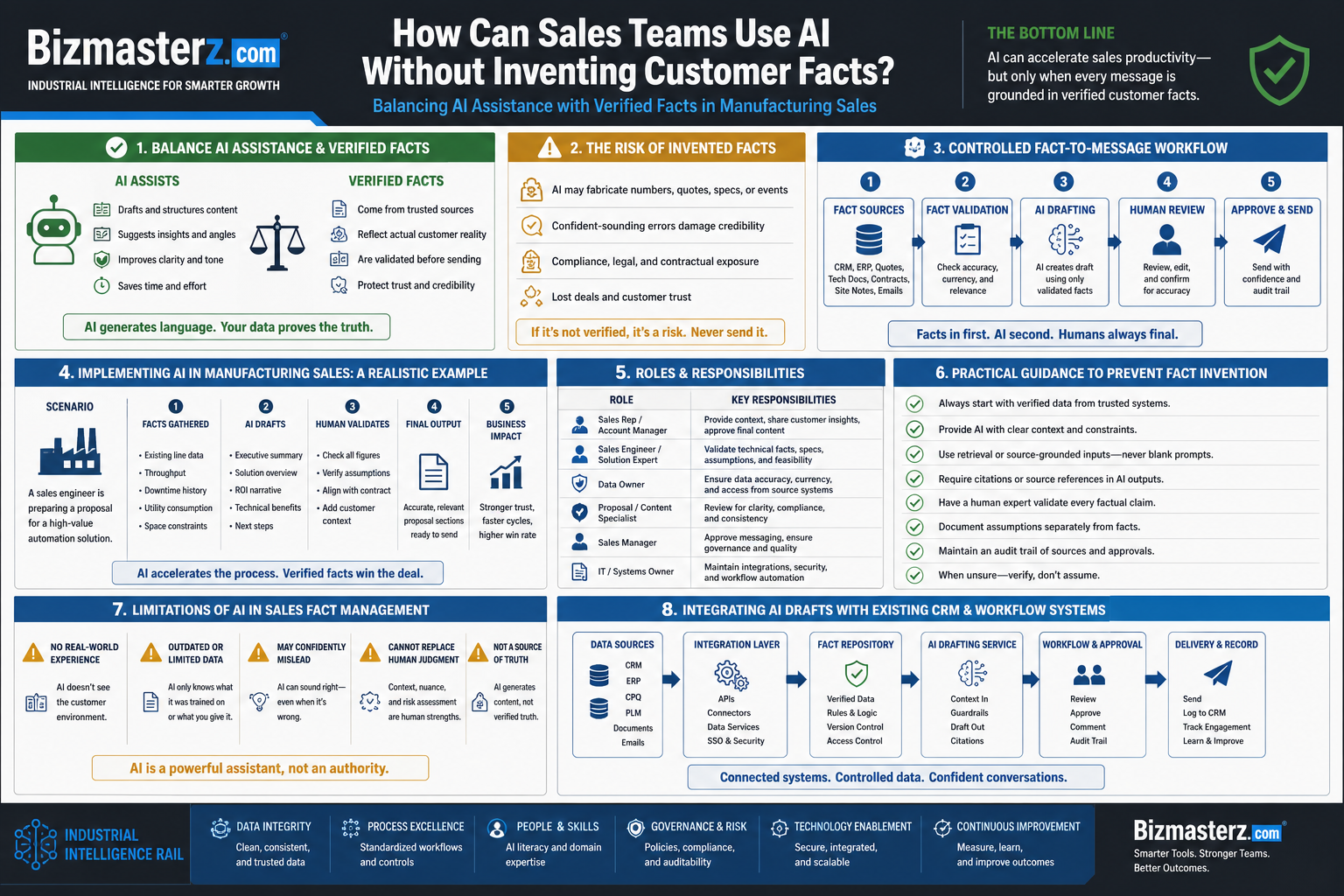
Implementing AI in Manufacturing Sales: A Realistic Example
Consider a Tier 1 automotive parts manufacturer that relies on dedicated sales teams managing relationships with large original equipment manufacturers (OEMs). The company employs AI to scan approved CRM entries, production forecasts, and quality assurance reports to draft customer communications such as order status updates, renewal proposals, or pricing announcements.
For instance, the AI system may retrieve verified past delivery volumes, contractual purchase orders, and quality metrics to produce a draft letter outlining upcoming price adjustments driven by material cost trends. Each factual statement—such as “Your Q1 order volume exceeded projections”—is linked to the exact CRM record with timestamps.
Before sending, the assigned sales engineer reviews the AI draft alongside real-time operational data and recent client interactions. They validate every fact, revise the tone to suit the client relationship, eliminate unsupported assumptions, and flag any discrepancies. The use of the Customer Fact-to-Message Control Record ensures all assertions are source-approved, helping avoid overselling or inaccurate promises, thereby protecting the manufacturer’s credibility.
Key Roles and Responsibilities in Managing AI-Assisted Sales Content
Successfully integrating AI-assisted messaging with customer fact governance requires a clear division of responsibilities:
- Sales Operations and Data Owners: Determine and authorize which customer data sources are accessible to AI tools. They configure AI integrations to prevent unauthorized or incomplete data exposure.
- Privacy, Security, and Legal Teams: Define data privacy, confidentiality, and compliance constraints on data usage within AI workflows. They assess risks around data leakage and regulatory adherence.
- Account Owners (Sales Representatives/Managers): Hold ultimate responsibility for final review, validation, and approval of AI-generated content prior to external communication. They confirm the message tone, factual accuracy, commitments, recipient list, and final sending authority.
- AI Systems: Operate as tools to retrieve only approved data, prepare customer fact-linked message drafts, flag unsupported assertions, and suggest corrections. These systems do not authorize sending, infer missing information, or override human decisions.
Practical Guidance to Prevent Fact Invention in AI-Assisted Messaging
- Restrict AI Inputs: Limit AI access to controlled, validated customer data repositories only. Avoid submitting sensitive or proprietary information to public or unvetted large language models, consistent with UK NCSC guidance on public large language models.
- Mandate Source Linking: Require AI drafts to trace every customer-specific assertion to the original data record with metadata such as timestamps and source identifiers to enable straightforward verification.
- Flag Unverified Content: Integrate mechanisms that explicitly label claims for which data is missing, ambiguous, or conflicting, triggering human review before any client exposure.
- Maintain Human Approval: No customer message—especially those including commitments or proposals—should proceed to external transmission without explicit signoff from the responsible account owner.
- Document Corrections and Escalations: Implement audit trails that log errors, corrections, and reviews, supporting compliance oversight and continuous improvement initiatives.
Limitations of AI in Sales Fact Management
Despite procedural advances, AI presents inherent limitations when managing customer facts in manufacturing sales:
- AI Cannot Reliably Infer Missing Facts: AI models lack the contextual business judgment to generate assumptions safely and should not be tasked with filling data gaps without source validation.
- No Autonomy in Authorization: AI cannot decide recipient eligibility or authorize sending messages externally, preserving human stewardship over customer communications.
- Potential for Data Leakage: Public or generalized AI models pose cybersecurity risks if sensitive customer details are included in queries—necessitating strict data-use governance.
- Enhanced Oversight Demanded: NIST guidelines recommend additional layers of human review, documentation, and organizational control proportionate to generative AI risks.
Integrating AI-Generated Drafts with Existing CRM and Workflow Systems
To maximize operational efficiency and maintain data integrity, manufacturing sales organizations should tightly integrate AI-assisted drafting tools with existing CRM and communication platforms. Teams using Microsoft Copilot to prepare customer meetings and emails still need to reconcile each customer-specific assertion with approved records before the account owner sends a message. Effective integration includes:
- Automatic synchronization of customer fact-to-source mappings within the CRM enabling real-time traceability.
- User-friendly interfaces that facilitate easy draft review, editing, and approval workflows for sales account owners.
- Automated alerts and process escalations triggered when data conflicts, missing facts, or flagged assertions arise during drafting.
Such integrated platforms ensure AI operates as a productivity multiplier — enhancing, not fragmenting, the sales communication process and maintaining a unified record of customer facts and interactions.
Summary: Human-Led AI Assistance for Trustworthy Manufacturing Sales
Generative AI may help manufacturing sales teams prepare messages, but each customer-specific assertion still needs an approved source. The tool-agnostic Customer Fact-to-Message Control Record documents that source and keeps final approval with the account owner. It cannot prevent a model from generating a false statement; it helps the reviewer catch unsupported statements before they reach a customer.
Sales teams should define approved data sources, link assertions to records, specify who reviews commitments and recipients, and retain corrections. They can then measure whether AI-assisted preparation saves time without weakening factual review or the applicable data-use controls.
Frequently Asked Questions
What is generative-AI confabulation and why is it a problem for sales teams?
Generative-AI confabulation refers to AI confidently producing false or fabricated content without supporting facts. For sales teams, this can result in inaccurate customer details or unauthorized commitments that undermine trust and lead to compliance risks.
How can sales operations ensure AI only uses verified customer facts?
Sales operations achieve this by restricting AI access to approved data sources like validated CRM and ERP systems, enforcing traceability of every assertion within drafts to source records, and implementing human verification before message approval.
Who should have final approval authority over AI-generated customer messages?
The human account owner, such as the sales representative or manager responsible for the customer relationship, retains exclusive authority to confirm factual accuracy, commitments, tone, and recipient approval before any external communication and any subsequent correction.
Can AI automatically send customer communications without human intervention?
No. AI tools are designed to assist in drafting and fact retrieval but are not authorized to send messages externally. All communications must pass through a human approval process to ensure accuracy, appropriateness, and compliance.
What security practices help protect sensitive manufacturing customer data in AI workflows?
Key practices include avoiding sensitive data input into public AI systems, restricting AI access to secure internal data sources, complying with data privacy regulations, and following cybersecurity guidance such as that from the UK National Cyber Security Center.