

Open-weight artificial intelligence models are changing the economics of AI. Instead of relying entirely on proprietary AI models accessed through an API, companies can download powerful pretrained models, run them on their own infrastructure, and adapt them for specialized applications.
But how do you actually train an open-weight AI model?
The answer is more nuanced than feeding company documents into an AI system. There are several ways to train or adapt an AI model, and each serves a different purpose. For most organizations, the practical approach is not to create a foundation model from scratch. It is to start with an existing open-weight model and adapt it to the organization’s domain, tasks, data, and operating environment.
A typical path looks like this:
Pretrained AI model → domain adaptation → supervised fine-tuning → preference training → RAG → tools and agents → deployment
Understanding what happens at each stage is essential for companies considering private, domain-specific, or industrial AI.
What Is an Open-Weight AI Model?
An open-weight AI model is a model whose trained numerical parameters, known as weights, are available for others to download and run.
Major open-weight model families include models from organizations such as:
- Meta
- Mistral AI
- Alibaba/Qwen
- DeepSeek
These models have already undergone extremely expensive foundation-model training. They have learned language patterns, mathematics, coding, reasoning skills, and a substantial amount of general knowledge. The organization adopting the model does not need to recreate that training. Instead, the pretrained model becomes the starting point for specialization.
This distinction is important because training a competitive large language model from scratch can require enormous datasets, large GPU clusters, distributed-computing infrastructure, specialized engineering teams, and millions of dollars in computing resources. Most manufacturers and other businesses do not need their own foundation model. They need a good foundation model that can be adapted to their specific problems.
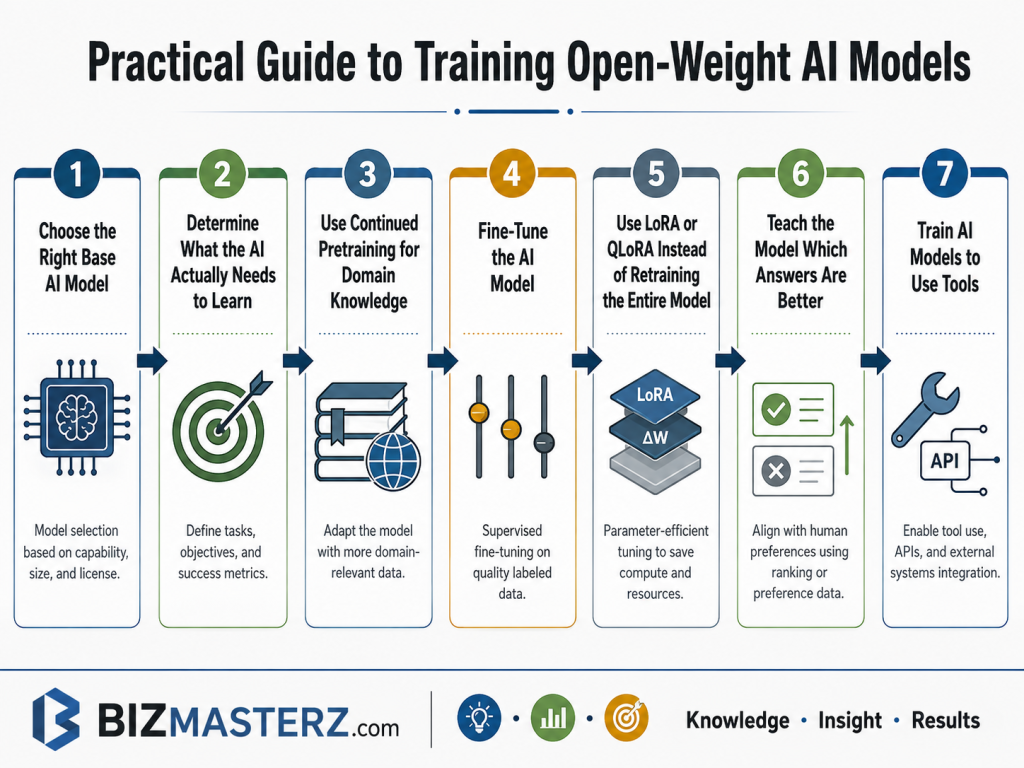 Practical Guide to Training AI Models
Step 1: Choose the Right Base AI Model
Training an open-weight model usually starts with selecting an existing pretrained model. Models vary considerably in size and capabilities. They may contain 7 billion, 14 billion, 32 billion, or many more parameters. Larger models can provide stronger reasoning and language capabilities, but they also require more memory and computational resources.
An organization should consider:
- Accuracy
- Reasoning capability
- Context-window length
- Commercial licensing
- GPU requirements
- Inference speed
- Quantization support
- Tool-calling capability
- Security requirements
- Performance on domain-specific tasks
For many specialized industrial applications, a model in the 7-billion-to-32-billion-parameter range may provide a useful balance between capability and infrastructure cost. The objective should not be to deploy the largest available AI model. The objective is to deploy the smallest model that reliably performs the required task.
Step 2: Determine What the AI Actually Needs to Learn
Before training anything, organizations need to distinguish among different types of knowledge. Consider an AI system supporting manufacturing quality.
It might need to understand:
- Manufacturing terminology
- Quality management
- Root cause analysis
- CAPA
- PFMEA
- Control plans
- Statistical process control
- How to analyze a manufacturing problem
- The company’s current quality procedures
- Today’s production results
- Current supplier quality performance
These things should not all be stored in the AI model. Some should be learned through model training. Others should be retrieved when needed. Others should come directly from operational databases. This distinction becomes one of the most important architectural decisions in enterprise AI.
Step 3: Use Continued Pretraining for Domain Knowledge
One way to specialize an open-weight AI model is through continued pretraining. Foundation models are initially trained on enormous amounts of text, learning to predict the next token. That training process can continue using domain-specific material.
For an industrial AI model, continued pretraining might use large collections of:
- Manufacturing literature
- Engineering documents
- Quality-management materials
- Maintenance documentation
- Supply-chain literature
- Technical reports
- Process documentation
- Corrective-action records
Over time, the model becomes more familiar with the terminology, concepts, and relationships found in the domain.
For example, it may strengthen its understanding of relationships among concepts such as:
PFMEA → failure mode → cause → process control → control plan → corrective action
Continued pretraining can therefore increase domain fluency. However, it can require substantial data and computing resources. For many organizations, supervised fine-tuning is a more practical place to begin.
Step 4: Fine-Tune the AI Model
One of the most common approaches is supervised fine-tuning, usually abbreviated as SFT. Instead of simply providing documents, the organization provides examples that show the model how it should respond.
Consider this training example:
User Question
A supplier delivered 2,000 components. The inspection found 87 components outside the dimensional specifications. What should the quality engineer do first?
Desired AI Response
- Contain the affected lot.
- Verify the inspection and measurement method.
- Determine whether other lots may be affected.
- Assess production and customer exposure.
- Initiate the appropriate supplier nonconformance process.
During fine-tuning, the model’s parameters are adjusted so that similar future questions are more likely to elicit responses that resemble the desired behavior.
A manufacturing organization could create training examples covering:
- Root cause analysis
- Corrective action
- CAPA investigations
- Supplier quality
- Internal auditing
- Statistical process control
- Process capability
- Production planning
- Inventory decisions
- Maintenance troubleshooting
- Lean problem solving
The important distinction is that fine-tuning does not merely provide the AI with more facts. Fine-tuning teaches the model how you want it to approach a class of problems. For example, a company could train an AI model to consistently investigate root causes rather than immediately suggesting corrective actions. That behavior can be particularly valuable in quality management, where jumping directly from a problem to a solution often results in ineffective corrective action.
Step 5: Use LoRA or QLoRA Instead of Retraining the Entire Model
Modern AI models can contain billions of parameters. Updating every parameter during training can require substantial computing resources. Fortunately, that is often unnecessary.
A technique called LoRA, or Low-Rank Adaptation, makes fine-tuning far more practical. Instead of modifying all of the original model’s parameters, LoRA introduces relatively small trainable components into selected portions of the neural network.
Conceptually:
Original model weights: frozen
LoRA adapters: trained
Only a small percentage of the overall system may therefore need to be trained. An even more resource-efficient technique is QLoRA. QLoRA combines LoRA with model quantization. The original model can be loaded using lower-precision numerical representations while the smaller adapter components are trained. This dramatically reduces memory requirements. For many companies interested in developing specialized AI, LoRA or QLoRA represents a much more realistic approach than fully retraining a large model.
Step 6: Teach the Model Which Answers Are Better
Supervised fine-tuning teaches the AI what an acceptable answer looks like. Preference training goes further by teaching it which answers experts consider better. Suppose an AI generates two responses to a quality problem.
Answer A
Replace the defective parts and close the issue.
Answer B
Contain the affected material, determine the scope of the problem, identify the root cause, implement appropriate corrective action, and verify effectiveness before closure.
An experienced quality engineer selects Answer B. That preference becomes training information. Repeat this process hundreds or thousands of times, and expert judgment begins shaping model behavior.
Preference-training approaches include techniques such as:
- Reinforcement Learning from Human Feedback
- Direct Preference Optimization
- Other reinforcement-learning and preference-learning approaches
This creates an important opportunity for industrial AI.
A company can potentially incorporate the judgment of experienced:
- Manufacturing engineers
- Quality engineers
- Supply-chain professionals
- Maintenance engineers
- Lean practitioners
- Auditors
- Operations managers
into the behavior of the AI system. This means the organization’s competitive advantage may eventually come not from owning a unique foundation model, but from owning a unique collection of expert-reviewed training examples and preference data.
Step 7: Train AI Models to Use Tools
An enterprise AI system should not try to memorize everything.
Consider this question:
What was yesterday’s scrap rate on Line 4?
That information changes continuously. It should not be embedded permanently in the model’s weights. Instead, the AI should recognize that current operational information is required and retrieve it.
A tool-enabled AI interaction might work like this:
User asks for Line 4 scrap rate
↓
AI determines that production data is required
↓
AI queries the MES
↓
Production and scrap quantities are retrieved
↓
AI calculates the scrap rate
↓
AI returns the answer with supporting evidence
The same approach can connect AI models to:
- ERP
- MES
- QMS
- CMMS
- PLM
- Warehouse-management systems
- Supply-chain systems
- Data warehouses
- Business-intelligence platforms
This capability begins to transform a language model into an agentic AI system. Instead of merely answering questions, the AI can determine what information it needs, retrieve that information, use specialized tools, perform calculations, and coordinate controlled workflows.
Fine-Tuning vs. RAG: What Is the Difference?
Fine-tuning and Retrieval-Augmented Generation, or RAG, are often confused. They solve different problems.
Fine-Tuning Changes How the Model Behaves
Fine-tuning changes model weights.
For example:
Teach the model how a quality engineer should conduct a corrective-action investigation.
That is an appropriate fine-tuning objective.
RAG Gives the Model Current Information
RAG retrieves relevant information when a question is asked.
For example:
Retrieve the company’s current corrective-action procedure and the nonconformance records associated with this problem.
That is a RAG task. A useful way to think about the difference is:
Fine-tuning teaches the AI how to think about the problem.
RAG tells the AI what is currently true.
What Should Be Trained, Retrieved, or Queried?
For an industrial AI system, different information belongs in different parts of the architecture.
| Requirement | Best Approach |
|---|---|
| General language and reasoning | Foundation model |
| Manufacturing terminology | Domain training |
| Quality-engineering behavior | Fine-tuning |
| Expert judgment and preferences | Preference training |
| Current company procedures | RAG |
| Current PFMEA | RAG |
| Current control plan | RAG |
| Today’s production information | MES/database tool |
| Current supplier performance | ERP/QMS tool |
| Workflow execution | AI agent |
| Approval of consequential actions | Human governance |
This separation becomes especially important in regulated or quality-controlled environments.
Why Not Train the Model on Every Company Document?
A common assumption is that companies should fine-tune AI models using all of their procedures, work instructions, drawings, specifications, and quality records.
There is a fundamental problem with that strategy:
Operational knowledge changes.
- Procedures are revised.
- Specifications change.
- PFMEAs are updated.
- Corrective actions are completed.
- Equipment conditions change.
- Supplier performance changes.
- Customer requirements change.
Training these facts directly into model weights can make updating the AI difficult and reduce the traceability of its answers. Suppose an AI gives an answer about a quality requirement.
A quality manager may need to know:
- Which procedure supports the answer?
- Which revision was used?
- Was the document approved?
- Is it still current?
- Which record contains the evidence?
RAG is much better suited to these questions because the AI can retrieve controlled evidence at the time of the inquiry.
A Better Architecture for Manufacturing AI
A more robust industrial AI architecture combines several technologies:
Open-weight foundation model
↓
Industrial domain adaptation
↓
Specialized fine-tuning
↓
RAG for company knowledge
↓
Tools connected to operational systems
↓
AI agents coordinating workflows
↓
Human oversight and governance
Consider an AI Quality Engineer.
The underlying model might be trained to understand:
- 5 Why analysis
- Fishbone diagrams
- PFMEA
- Control plans
- CAPA
- 8D
- Process capability
- Statistical process control
- Audit methodology
But when investigating an actual quality problem, the AI could retrieve:
- The current control plan
- The affected PFMEA
- Customer requirements
- Inspection records
- Previous corrective actions
- Supplier records
- Production history
The AI doesn’t need to memorize those records. It needs to know how to use them. That is a much more powerful distinction.
How Could This Work in an AI Quality Engineer?
Consider a manufacturing quality problem involving an out-of-specification dimension.
An industrial AI system might perform the following sequence:
- Identify the issue as a potential nonconformance.
- Retrieve the applicable inspection requirement.
- Verify the current control plan.
- Retrieve the relevant PFMEA.
- Search previous nonconformances for similar failures.
- Review previous corrective actions.
- Retrieve production and supplier data.
- Guide the quality engineer through root cause analysis.
- Recommend potential corrective actions based on evidence.
- Document the investigation.
- Require human approval before taking consequential actions.
This is considerably different from asking a general-purpose chatbot:
“What causes dimensional defects?”
The chatbot provides general knowledge. The industrial intelligence system combines general reasoning, specialized expertise, controlled evidence, operational data, and workflow logic. That is the direction enterprise AI is moving.
Do You Need to Train an AI Model From Scratch?
Usually, no.
Training a modern foundation model can involve:
- Trillions of training tokens
- Hundreds or thousands of GPUs
- Distributed-computing infrastructure
- Large engineering teams
- Long training cycles
- Millions of dollars in computing resources
For most manufacturers, this would make little economic sense. Adapting an existing open-weight model can be dramatically less expensive. Depending on the model, dataset, computing environment, and number of experiments, a specialized fine-tuning effort can potentially cost hundreds, thousands, or tens of thousands of dollars rather than millions.
The strategic question is therefore usually not:
Should we build our own foundation model?
It is:
What expertise should we add to an existing model, and what knowledge should remain outside the model?
The Training Data May Become More Valuable Than the Model
Open-weight AI creates an interesting competitive dynamic. Imagine two companies using exactly the same foundation model. Company A installs the model and begins using it.
Company B develops:
- 10,000 expert-reviewed training examples
- Domain-specific evaluation benchmarks
- Expert preference data
- Specialized RAG collections
- Connections to operational systems
- Proprietary workflows
- Specialized AI agents
They technically use the same foundation model. But they no longer have the same AI system. The second organization’s competitive advantage resides in the knowledge, workflows, and expert judgment surrounding the model.
This suggests that some of the most valuable AI intellectual property may eventually consist of:
Domain expertise is encoded as training data, evaluation data, retrieval systems, workflows, and agents.
Open-Weight AI and the Future of Industrial Intelligence
Open-weight AI gives manufacturers and other businesses much more control over their AI architecture. Organizations can potentially operate models locally, control their data, specialize model behavior, integrate proprietary knowledge, and connect AI directly to operational systems. But downloading an open-weight model is only the beginning.
A sophisticated industrial AI system may ultimately combine:
Foundation model + domain training + fine-tuning + expert preferences + RAG + operational tools + AI agents + governance
Each layer serves a different purpose.
- The foundation model provides general intelligence.
- Fine-tuning teaches specialized behavior.
- Preference training incorporates expert judgment.
- RAG provides current organizational knowledge.
- Tools provide real-time operational information.
- Agents coordinate tasks and workflows.
- Governance determines what the AI is permitted to do.
The objective is not simply to build an AI system capable of producing convincing answers. For industrial applications, the objective is to build AI that can reason appropriately, retrieve authoritative evidence, interact safely with operational systems, and support better decisions. That is when an open-weight model begins evolving from a chatbot into Industrial Intelligence.
Frequently Asked Questions About Training Open-Weight AI Models
Can I train an open-weight AI model on my own company data?
Yes, but company information should be organized by purpose. Stable examples that teach the model specialized behavior may be appropriate for fine-tuning. Frequently changing information, such as procedures, production records, specifications, and supplier performance, is generally better provided through RAG or operational system integrations.
What is the difference between training and fine-tuning an AI model?
Training from scratch creates the underlying foundation model using massive datasets. Fine-tuning starts with an already trained model and modifies its behavior using a much smaller specialized dataset.
What is LoRA fine-tuning?
Low-Rank Adaptation, or LoRA, is a technique that leaves most original model parameters unchanged while training smaller adapter components. This dramatically reduces the computational resources required to specialize a large AI model.
What is QLoRA?
QLoRA combines model quantization with LoRA fine-tuning. It further reduces memory requirements by representing the underlying model at lower numerical precision and training smaller adapter components.
Is RAG the same as fine-tuning?
No. Fine-tuning modifies a model’s behavior by adjusting its parameters. RAG retrieves external information and provides it to the model when a question is asked. Fine-tuning is generally better for teaching behavior; RAG is generally better for providing current facts and controlled evidence.
Can an open-weight AI model run locally?
Yes. Depending on model size and hardware requirements, many open-weight models can run on local workstations, servers, private data centers, or private cloud infrastructure. Quantization can substantially reduce the hardware needed for inference.
Should manufacturers train their own AI models?
Manufacturers usually do not need to create foundation models from scratch. A more practical strategy is to start with an existing open-weight model and combine fine-tuning, RAG, operational-system integrations, and domain-specific AI agents.
What is the best way to train an AI model for manufacturing?
There is no single training technique. A strong manufacturing AI architecture may combine an existing foundation model, domain-specific fine-tuning, expert preference data, RAG for company documentation, tools for operational information, and controlled agentic workflows.


