

Manufacturing leaders seeking competitive advantage understand that performance management in intelligent factories goes beyond traditional KPI tracking. It is an integrated technical discipline aimed at ensuring smart manufacturing systems operate reliably, efficiently, and resiliently amid complex cyber-physical environments. This article defines and distinguishes performance management in this context, explains underlying mechanisms, demonstrates implementation with a manufacturing example, clarifies the role of human authority, discusses limitations, and connects the topic to the broader field of Industrial Intelligence.
Direct Definition: What Is Performance Management in Intelligent Factories?
For related manufacturing context, see What Is Industrial Intelligence, Advanced Manufacturing, AI and the Future of Industrial Operations?.
Performance management in intelligent factories refers to a continuous, systematic process of monitoring, analyzing, and optimizing the operation of smart manufacturing systems. These systems integrate cyber-physical components such as IoT-enabled machines, robotics, adaptive control systems, and real-time analytics platforms. Unlike generic performance measurement, performance management here emphasizes ensuring system-level qualities such as responsiveness, fault tolerance, and energy efficiency through feedback-informed operational adjustments.
Essentially, it operates as a closed-loop supervisory function that goes beyond raw data collection—enabling factories to sustain optimal throughput, quality, and flexibility by leveraging both automated mechanisms and human oversight. It prioritizes not just measurement but proactive control to maintain alignment with strategic operational objectives.
Core Mechanisms: How Performance Management Functions in Smart Manufacturing
At its core, performance management in intelligent factories involves four primary mechanisms:
- Real-time Data Acquisition and Integration: IoT sensors and devices continuously collect diverse operational data—machine health metrics, process timings, energy consumption, environmental conditions, and workforce interaction metrics.
- Analytics and Anomaly Detection: Embedded analytics engines apply advanced algorithms—ranging from statistical process control to machine learning—to identify deviations, bottlenecks, or latent faults in manufacturing workflows before they escalate into failures.
- Adaptive Control and Feedback: Automated controllers or supervisory systems adjust production parameters, scheduling, or maintenance routines in response to conditions, maintaining key performance indicators (KPIs).
- Real-time monitoring and Human Decision Support: Interactive dashboards translate raw data into actionable insights for operators and managers, supporting timely, informed decision-making, especially in ambiguous or novel situations.
This tightly coupled loop of sensing, analyzing, acting, and reviewing continuously assures that production remains aligned with defined objectives. Performance management also incorporates predictive maintenance and process optimization as essential functions, enhancing operational resilience and minimizing downtime.
Distinguishing Performance Management from Adjacent Concepts
Understanding what performance management is requires clarifying what it is not. It is critical to differentiate performance management from related but distinct concepts such as:
- Key Performance Indicators (KPIs): KPIs are quantifiable metrics used to gauge performance levels; however, performance management actively leverages these KPIs to diagnose issues and implement corrective measures, rather than only passively tracking results.
- Quality Management: While quality management systems emphasize consistent product or process quality, performance management adopts a broader operational perspective that includes throughput, resource utilization, energy efficiency, and system responsiveness.
- Manufacturing Execution Systems (MES): MES coordinate production scheduling and workflow execution. Performance management builds on MES data but integrates predictive analytics, dynamic control, and continuous optimization layers, enabling more proactive interventions.
- Industrial Automation: Automation typically executes predefined tasks and routines. In contrast, performance management continuously monitors and dynamically tunes those automated processes based on real-time contextual insights and operational goals.
These distinctions highlight performance management as a higher-level supervisory and optimization function bridging multiple operational and technological domains.
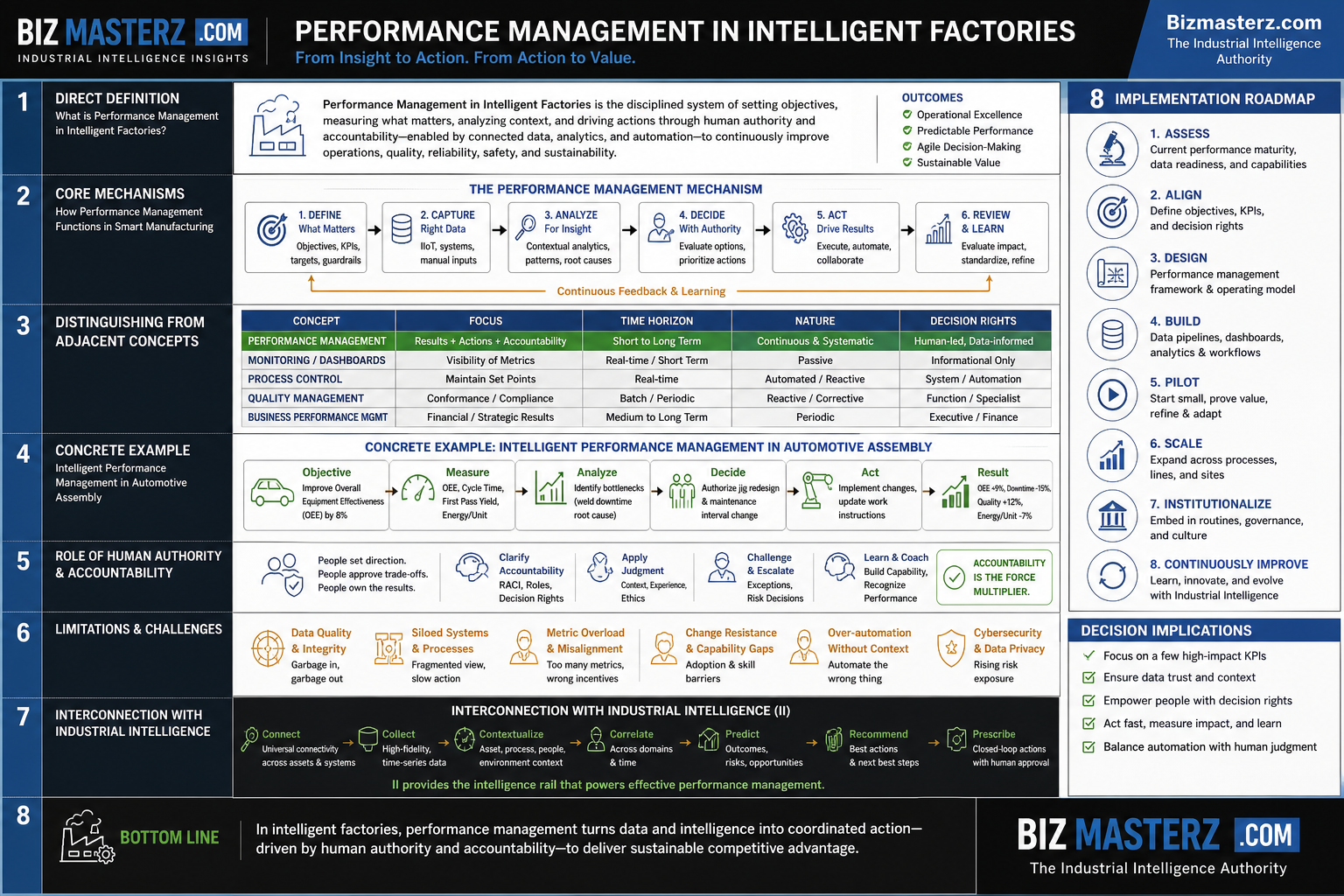 Explains Performance Management in Intelligent Factories.
Concrete Manufacturing Example: Intelligent Performance Management in Automotive Assembly
Consider a leading automotive assembly plant deploying a smart manufacturing system that integrates numerous robotic workstations, each equipped with sensors that monitor critical parameters—such as torque application, cycle time, and temperature. The factory’s performance management system continuously collects this data and applies machine learning models tailored to detect subtle deviations in robot behavior that often precede mechanical wear or alignment issues. For example, if the sensors detect a gradual decrease in torque consistency beyond normal variation, the analytics layer flags this as a potential precursor to joint defects.
Upon such detection, the system automatically adjusts robot speed parameters to reduce stress, schedules predictive maintenance during planned production breaks to avoid unplanned downtime, and sends alerts via an operator dashboard. Human supervisors, seeing prioritized alerts combined with contextual recommendations, review and validate corrective actions.
This closed-loop enables the plant to minimize unexpected outages, reduce defect rates, and maintain high assembly-line throughput—demonstrating the tangible benefits of assembly-line management through integrated sensing, analytics, adaptive control, and human collaboration.
Implementation Guidance: Integrating Performance Management in Your Intelligent Factory
Successful adoption of performance management in intelligent factories requires thoughtful coordination of technology, people, and processes. Key steps include:
- Define Objectives and Metrics: Collaboratively determine performance goals aligned with business strategy—for example, improving cycle time, reducing energy use per unit, or minimizing safety incidents.
- Deploy Comprehensive Sensing Networks: Implement and integrate IoT sensors across machines, conveyors, energy systems, and environmental monitoring devices to achieve end-to-end visibility.
- Establish Robust Data Infrastructure: Build scalable edge and cloud computing environments capable of ingesting, storing, and processing high-volume data streams with low latency.
- Develop or Acquire Specialized Analytics Models: Leverage advanced analytics, including machine learning, simulation, and statistical methods, tailored to detect anomalies, predict failures, and optimize workflows.
- Construct Feedback and Control Loops: Integrate adaptive control systems and supervisory software capable of automatically adjusting operational parameters within predefined safety and quality constraints.
- Design Human-Machine Interfaces: Deploy user-centric dashboards, alerting systems, and collaboration tools that translate complex analytics into actionable knowledge for operators and managers.
- Establish Governance and Training Programs: Define organizational roles for performance management, from data scientists to operators, and provide specialized training in interpreting analytics and exercising decision authority.
Such implementations require cross-disciplinary collaboration involving operations management, IT, industrial engineering, and corporate leadership to succeed.
Role of Human Authority and Accountability in Performance Management
For related manufacturing context, see Industrial Intelligence as a Management System, Not a Software Category.
Despite growing capabilities for automated oversight, human authority remains essential because:
- Complex Decision-Making: Humans interpret nuanced situational contexts, manage tradeoffs between conflicting objectives (such as speed versus quality), and respond flexibly to novel or ambiguous conditions that automated systems cannot fully anticipate.
- Exception and Crisis Handling: When unexpected events such as system failures, safety incidents, or cyber intrusions arise, human operators enact contingency plans and coordinate corrective responses beyond automation’s scope.
- Continuous Improvement: Experienced staff validate and refine analytical models, contributing domain expertise that helps adapt performance management systems to evolving manufacturing realities.
- Accountability and Compliance: Legal, safety, and ethical responsibilities rest with empowered personnel who make final decisions on production quality, environmental impacts, and regulatory compliance—areas where automation supports but does not replace judgment.
Performance management frameworks thus must explicitly design for algorithmic-human collaboration, transparency, and responsiveness to human input.
Limitations and Challenges in Performance Management of Intelligent Factories
While performance management offers substantial benefits, its deployment entails several challenges:
- Data Quality and Integration Issues: Sensor inaccuracies, communication failures, or incompatible data formats can degrade the reliability of analytics and operational decisions.
- Analytics Model Robustness: Machine learning models may perform poorly on unanticipated scenarios or require continual retraining as processes and environments evolve, imposing ongoing maintenance burdens.
- Cybersecurity Vulnerabilities: Increased connectivity exposes systems to threats such as ransomware, data tampering, or denial-of-service attacks that can disrupt critical control functions.
- Change Management and Workforce Adaptation: Shifts to data-driven, automated supervision may encounter resistance from staff accustomed to manual controls or hierarchical decision-making, necessitating focused training and organizational change efforts.
- Cost and Complexity Barriers: Initial capital expenditures, technical integration complexity, and skill requirements may inhibit adoption, especially for small and medium-sized enterprises.
Recognizing these limitations early and adopting mitigation strategies such as phased rollouts, robust cybersecurity frameworks, and continuous workforce engagement are essential for sustainable success.
Interconnection with Industrial Intelligence
Performance management in intelligent factories lies at the heart of Industrial Intelligence—a multidisciplinary field combining manufacturing processes with advanced digital technologies such as artificial intelligence, embedded analytics, and pervasive connectivity.
Organizations including the National Institute of Standards and Technology (NIST) highlight that methods and tools for performance assurance form foundational elements for Industrial Intelligence frameworks. These enable factories to evolve from reactive production environments into proactive, self-optimizing intelligent systems that continuously integrate real-world feedback.
Further ongoing international standardization efforts led by bodies like the International Telecommunication Union (ITU-T) contribute to harmonizing performance management practices, facilitating interoperability and scalability of Industrial Intelligence applications across global manufacturing operations.
Conclusion: Embracing Performance Management as a Strategic Enabler
For forward-looking manufacturing leaders, adopting performance management frameworks within intelligent factories is a strategic imperative to achieve operational excellence, cost efficiency, and sustainable competitiveness. By integrating real-time sensing, advanced analytics, adaptive control mechanisms, and empowered human oversight, such frameworks ensure continuous assurance of complex smart manufacturing systems’ performance amid dynamic conditions.
Success rests on thoroughly understanding performance management’s mechanisms, appreciating its distinctions from related concepts, managing implementation challenges effectively, and candidly embracing its limitations. Anchored firmly in the broader field of Industrial Intelligence, performance management transforms raw operational data into strategic assets that power next-generation intelligent manufacturing.
Frequently Asked Questions
For related manufacturing context, see Industry 4.0 vs Industrial Intelligence.
What differentiates performance management from simple performance measurement in intelligent factories?
Performance measurement involves collecting metrics like KPIs to assess system or process status. In contrast, people such as managers use these metrics to analyze, diagnose, and control manufacturing operations—enabling adaptive adjustments rather than passive observation. It emphasizes continuous closed-loop optimization and human-in-the-loop interventions.
How can smaller manufacturers implement performance management despite cost and complexity?
Smaller manufacturers can start with focused pilot projects targeting critical bottlenecks, use modular IoT devices with cloud-based analytics to reduce upfront infrastructure costs, and gradually build expertise through partnerships. Leveraging standardized tools and consulting resources helps mitigate complexity while demonstrating incremental value before scaling.
What is the role of predictive maintenance within performance management?
Predictive maintenance uses sensor data and analytics to forecast equipment failures before they occur, enabling proactive maintenance scheduling. Within performance management, it functions as a key feedback mechanism that reduces unplanned downtime, extends equipment life, and maintains production reliability as part of overall operational optimization.
How do performance management frameworks handle unexpected events or anomalies?
Automated systems detect anomalies through analytics and trigger alerts or corrective controls within predefined limits. For unexpected or complex events beyond automation capabilities, human operators intervene, guided by decision-support dashboards. This collaborative approach ensures robustness and flexibility in handling diverse scenarios.
How is human accountability maintained when automated control systems adjust manufacturing operations?
Human accountability is preserved by designing clear organizational roles and escalation paths. Operators and managers retain final authority over critical decisions, validate automated recommendations, and ensure compliance with safety and quality standards. Transparent logging and explainability features in performance management tools further support auditability and regulatory adherence.


