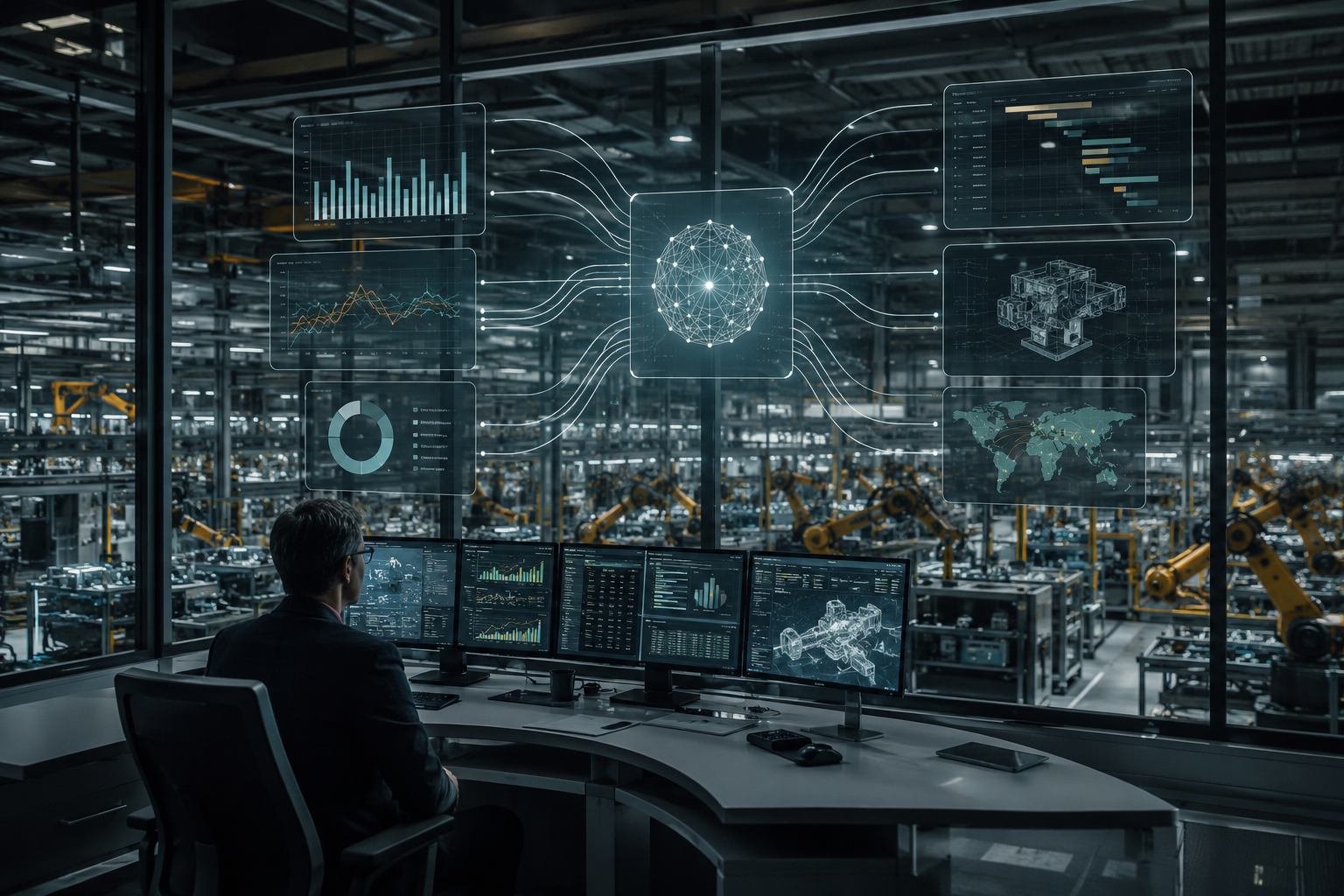
Intelligent Factories Are Defined by Capabilities, Not Gadgets
An intelligent factory is not a plant with more screens, more sensors, or more artificial intelligence pilots. Those tools may be necessary, but they are not sufficient. A factory becomes intelligent when it can sense what is happening, understand what the evidence means, reason across functions, make better decisions, act through governed workflows, and learn from outcomes.
That distinction matters because many manufacturers confuse digital activity with intelligence. A plant may have machine connectivity, dashboards, automated inspection, an MES, an ERP system, a QMS, a CMMS, and a few AI models. Yet leaders may still struggle to answer basic operational questions: why did scrap rise, which asset risk matters most, what schedule is realistic, which supplier issue is systemic, and which corrective action actually prevented recurrence?
The intelligent factory is not a technology checklist. It is a capability system.
The six capabilities are:
- Sense
- Contextualize
- Reason
- Decide
- Act
- Learn
These capabilities form the practical foundation of Industrial Intelligence. They also explain why the intelligent factory is broader than Industry 4.0. Industry 4.0 connected assets and data. Industrial Intelligence turns that connection into governed learning.
Capability 1: Sense
The first capability of an intelligent factory is sensing. Sensing means the factory can detect relevant signals from machines, materials, people, products, suppliers, processes, and customers.
Sensing includes obvious technical sources such as sensors, PLCs, SCADA systems, inspection equipment, machine vision, data historians, and industrial IoT platforms. It also includes less glamorous but equally important sources: operator notes, audit findings, nonconformance records, maintenance work orders, supplier deviations, customer complaints, calibration results, training records, and engineering change notices.
The point is not to sense everything. The point is to sense what matters to the decisions the factory must make.
For example, a production leader does not need every raw vibration reading if those readings are not connected to asset health, schedule risk, spare parts availability, or maintenance decisions. A quality engineer does not need an ocean of inspection data if it cannot be connected to product genealogy, process conditions, material lots, and control plans.
NIST’s smart manufacturing work emphasizes the importance of standards-based information flow across manufacturing systems (NISTIR 8107). That is the right starting point: an intelligent factory cannot act intelligently if evidence remains trapped in disconnected systems.
The sensing question for leaders is simple: what important operational changes do we currently notice too late?
Capability 2: Contextualize
Sensing creates signals. Context turns signals into evidence.
A temperature reading is not meaningful by itself. It becomes meaningful when connected to the product, process step, material lot, machine state, operator shift, ambient conditions, tolerance, specification, control plan, maintenance history, and known failure modes. A late order is not just a late order. It may be connected to supplier reliability, forecast error, quality holds, tooling constraints, labor availability, inspection capacity, or a planning parameter that no one has reviewed in years.
Contextualization is where many smart factory programs weaken. They collect data but do not create industrial meaning. An intelligent factory needs shared identifiers and relationships. Parts must connect to routings. Routings must connect to work centers. Work centers must connect to machines. Machines must connect to maintenance history. Defects must connect to process steps. CAPAs must connect to recurrence patterns. Suppliers must connect to incoming quality, delivery performance, and risk.
This is why the digital thread and industrial knowledge graph matter. They are not buzzwords when used properly. They are the structure that allows the factory to know what its evidence is about.
Context also protects teams from false confidence. If a defect appears to correlate with a machine but is actually driven by the material supplier and humidity, the wrong context leads to the wrong action. Intelligent factories do not simply collect more data. They connect data to the right operational reality. The contextualization question for leaders is: when a signal appears, can we rapidly understand what product, process, asset, supplier, and customer risk it touches?
Capability 3: Reason
Reasoning is the ability to interpret evidence and form useful hypotheses. It is where statistics, engineering judgment, process knowledge, simulation, optimization, machine learning, and human experience begin to work together. Reasoning does not mean asking AI for an answer and accepting it. Manufacturing is too physical and too consequential for that. Reasoning means comparing evidence, testing mechanisms, evaluating risk, and deciding which explanation is most plausible.
In quality, reasoning may involve distinguishing special-cause variation from common-cause variation, comparing similar nonconformances, checking measurement systems, reviewing process capability, and asking whether the control plan still matches process reality. Taguchi Method and the Cost of Quality is useful here because it reminds leaders that loss often grows before a part becomes formally nonconforming. An intelligent factory reasons about degradation, not just pass/fail status.
In maintenance, reasoning may involve combining sensor anomalies with duty cycles, age, prior work orders, production criticality, and spare-parts status. Planning may involve weighing capacity, changeovers, material availability, customer priority, and asset risk. In the supply chain, it may involve supplier history, geopolitical risk, logistics delay, quality escapes, and inventory policy.
AI can help with reasoning by finding patterns, retrieving similar cases, detecting anomalies, generating hypotheses, and simulating scenarios. But human experts still matter because they understand mechanisms, constraints, customer consequences, and risk tolerance. The question for leaders is: can our teams move from a signal to a plausible explanation without relying solely on memory, meetings, and spreadsheet archaeology?
Capability 4: Decide
The fourth capability is decision-making. This is the point at which many factories lose the benefits of digital transformation. They can see problems and analyze them, but the decision process remains unclear.
An intelligent factory defines decision rights. It knows who can release a lot, change a schedule, stop a line, override an AI recommendation, open CAPA, escalate a supplier, defer maintenance, or accept a temporary deviation. It also defines which decisions can be automated, which require human approval, and which must remain human-led.
Decision capability requires:
- Clear owners
- Risk thresholds
- Approval paths
- Escalation logic
- Evidence requirements
- Override rules
- Audit trails
This is where Industrial Intelligence, as a Management System rather than a Software Category, becomes practical. Intelligence is not achieved when the organization produces a recommendation. Intelligence is achieved when the recommendation enters a governed decision system.
Consider a predictive maintenance model that flags a high-risk asset. The decision is not merely whether the prediction is accurate. The decision is whether to stop production, inspect, repair, defer, change the schedule, expedite spares, or accept risk. That decision belongs to a management system. The decision question for leaders is: when evidence points to a problem, do we know who decides, by what criteria, and with what accountability?
Capability 5: Act
An intelligent factory must convert decisions into action. This seems obvious, but it is often where initiatives stall. A recommendation sitting in a dashboard is not action. A model output that never reaches the maintenance planner is not an action. A quality insight that does not update containment, CAPA, or control plans is not an action. A scheduling recommendation that cannot flow into execution systems is not an action.
Action requires workflow integration. The intelligent factory connects decisions to MES, QMS, CMMS, ERP, PLM, WMS, supplier systems, and management routines. It also recognizes that action can be physical, digital, or managerial.
Examples include:
- Quarantine a lot
- Adjust inspection frequency
- Trigger a maintenance work order
- Revise the production schedule
- Escalate to a supplier
- Update a work instruction
- Modify a control plan
- Change a reorder point
- Launch a CAPA
- Convene a cross-functional review
The article QRQC Explained: How Quick Response Quality Control Drives Operational Excellence shows why speed and structure matter together. Quick response without evidence becomes firefighting. Evidence without response becomes passive reporting. The intelligent factory needs both. The action question for leaders is: do our insights reliably change what happens on the shop floor, in planning, in maintenance, in quality, and in supplier management?
Capability 6: Learn
The final capability is learning. This is the capability that separates a truly intelligent factory from a merely automated one.
Learning means the factory captures whether its actions worked and uses that knowledge to improve future decisions. Did the CAPA prevent recurrence? Did the schedule change improve delivery without creating quality risk? Did the maintenance intervention prevent downtime? Did the supplier escalation improve incoming quality? Did the control plan update reduce variation? Did the inventory policy protect customers without hiding process instability?
Without learning, the factory repeats itself. Problems may be solved locally but reappear elsewhere. The same failure mode gets renamed. The same supplier issues returns. The same maintenance decision gets debated every month. The same schedule instability becomes normal.
Learning requires memory. That memory may live in QMS records, CAPA effectiveness checks, lessons learned, model monitoring, knowledge graphs, standard work updates, engineering changes, and management review. The key is that learning must become part of the operating system, not an optional reflection after the crisis is over.
Fail Fast Is Not a Quality Strategy makes the boundary clear. Intelligent factories should learn quickly, but not carelessly. Manufacturing learning must be bounded by safety, quality, customer requirements, regulatory obligations, and process discipline.
The learning question for leaders is: how do we know whether our decisions made the factory smarter?
 Intelligent factory loop operational integration
How the Six Capabilities Work Together
The six capabilities are not separate departments. They are a loop. The factory senses a signal. It contextualizes the signal. It reasons about causes, risks, and options. It makes a governed decision. It acts through operational workflows. It learns from the result. If any capability is weak, the loop breaks.
If sensing is weak, the factory discovers problems late. If context is weak, teams misinterpret evidence. If reasoning is weak, they chase symptoms. If decision rights are weak, recommendations stall. If action is weak, insight never changes reality. If learning is weak, the same problems return.
Why AI Is Becoming the Operating System of Manufacturing frames AI as an orchestration layer. AI becomes valuable when it strengthens the full loop, not when it produces isolated predictions.
A Readiness Checklist for Manufacturing Leaders
Manufacturing leaders can assess intelligent factory readiness by asking six questions:
- Sense: Which critical process, quality, maintenance, supply, or customer signals do we detect too late?
- Contextualize: Can we connect signals to products, processes, assets, suppliers, customers, and risks?
- Reason: Can teams form evidence-based hypotheses quickly and test them against industrial reality?
- Decide: Are decision rights, approval paths, and risk thresholds clear?
- Act: Do recommendations flow into operational workflows and management routines?
- Learn: Do we measure whether decisions worked, and do we update standards, models, and practices?
The answers will usually reveal that the bottleneck is not just technology. It may be master data, process ownership, unclear escalation, weak CAPA effectiveness, disconnected systems, or inconsistent management routines. That is good news. It means the path to Industrial Intelligence is manageable. Leaders can improve one capability and one decision loop at a time.
Intelligence Is a Factory Capability System
The intelligent factory is not defined by how much data it collects or how many AI pilots it runs. It is defined by whether it can sense, contextualize, reason, decide, act, and learn. Those six capabilities turn digital manufacturing infrastructure into Industrial Intelligence.
They connect technology to operational excellence, quality discipline, planning reliability, maintenance strategy, supplier performance, and executive decision-making. Manufacturers should stop asking whether they have enough smart factory technology and start asking whether their factory is becoming better at learning from reality. That is the practical test of an intelligent factory.
FAQ
What are the six capabilities of an intelligent factory?
The six capabilities are sensing, contextualizing, reasoning, deciding, acting, and learning. Together, they form the loop that allows a factory to convert operational evidence into governed improvement.
Is an intelligent factory the same as a smart factory?
Not exactly. A smart factory is typically characterized by connected assets, sensors, automation, and digital systems. An intelligent factory builds on that foundation and focuses on decision quality, governance, and learning.
Why is context so important in an intelligent factory?
Context turns data into evidence. A signal becomes useful when connected to a product, process, asset, supplier, customer, specification, risk, and historical outcome.
Can AI create an intelligent factory by itself?
No. AI can strengthen sensing, reasoning, decision support, and learning, but the factory also needs decision rights, workflows, governance, industrial context, and human accountability.
Where should a manufacturer start?
Start with one high-value decision loop, such as CAPA prioritization, quality hold/release, schedule exception management, predictive maintenance intervention, or supplier escalation. Then assess the six capabilities around that decision.