

An AI system can identify a high-risk production cycle in milliseconds and still leave a quality organization unprepared to act. The model may be technically sound. The warning may arrive before the defect escapes. Yet the plant can still lose the opportunity because no one has defined whether operators should adjust the process, increase inspection, contain the lot, stop production, or escalate to engineering.
This is where the AI quality engineer becomes important. The role is not an autonomous digital employee that replaces a quality professional. It is an operating model in which quality engineers use AI to retrieve evidence, detect risk, compare conditions, recommend responses, prepare controlled records, and monitor outcomes while retaining clear responsibility for quality decisions.
The practical question is not whether AI can perform a quality task. The question is whether the organization has connected that capability to accepted evidence, defined authority, a controlled workflow, and verified results.
What Is an AI Quality Engineer?
An AI quality engineer is a quality professional who designs and governs AI-assisted quality workflows. The engineer does not need to become a data scientist, but must understand enough about data, model behavior, uncertainty, context, and monitoring to decide when AI evidence is fit for a quality decision.
The role combines four bodies of work:
- Quality engineering: requirements, risk analysis, control plans, measurement, process capability, nonconformance, root cause, corrective action, and change control.
- Industrial evidence: product identity, material genealogy, process conditions, equipment state, inspection results, standards, deviations, and outcome history.
- AI assurance: intended use, representative data, challenge testing, error analysis, explainability for the user, drift monitoring, and incident response.
- Operating governance: decision ownership, approval limits, escalation, override, record retention, review cadence, and verification.
For a broader view of where these capabilities apply, Bizmasterz maps ten manufacturing applications of AI in quality engineering. The AI quality engineer turns those capabilities into controlled work.
What the AI Quality Engineer Actually Owns
The role should own six controls. Together they form the Six-Control AI Quality Engineer Charter.
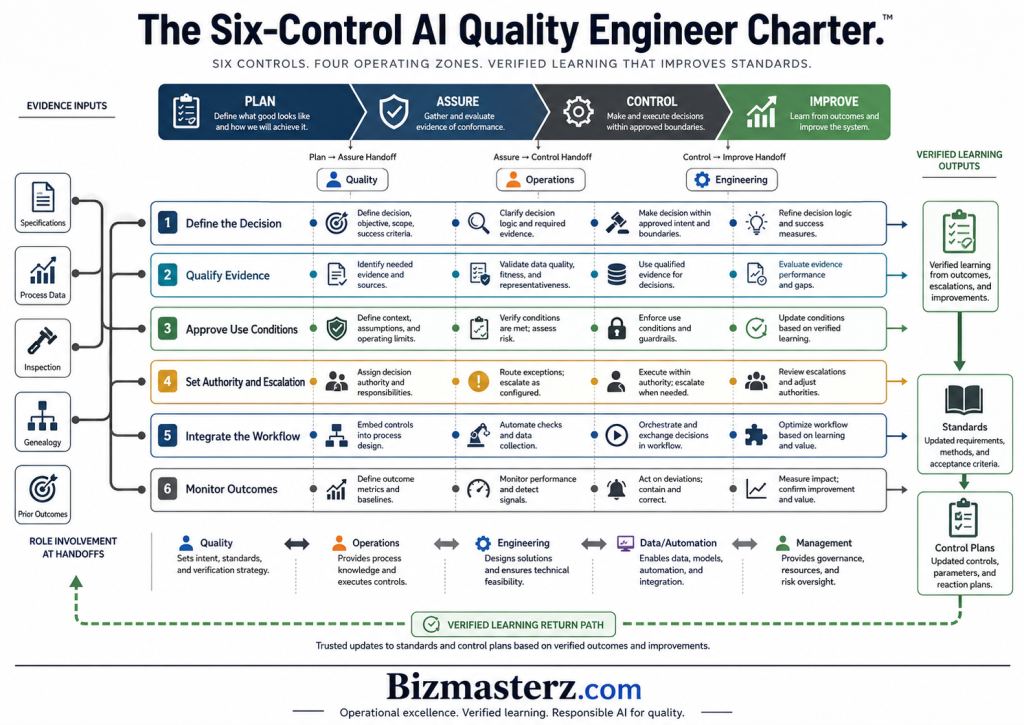 Use the Six Control AI Quality Engineer Charter to assess one active or proposed AI quality use case
1. Define the Quality Decision
AI projects often begin with a model idea: predict defects, classify images, summarize audits, recommend containment, or draft a control plan. The AI quality engineer starts one level earlier by defining the decision.
A useful decision statement identifies:
- The quality objective and failure risk
- The product, process, or operating scope
- The person who owns the decision
- The action that may follow
- The required response time
- The evidence needed to act
- The fallback when AI is unavailable or uncertain
“Predict fastener defects” is too broad. “Before final packaging, flag forming cycles with elevated crack risk so quality can route the affected production window to additional verification or containment” is specific enough to govern.
2. Qualify the Evidence
The AI quality engineer determines whether the data represents the physical and quality conditions behind the decision. That includes more than checking whether a database is complete.
For a cold-heading line producing safety-relevant steel fasteners, decision evidence might include material heat and coil identity, wire preparation, forming-force signature, die and punch identity, tool life, lubrication condition, dimensional results, eddy-current inspection, destructive test evidence, and prior nonconformance outcomes.
The quality engineer asks whether the evidence is traceable, representative, time-aligned, measured with sufficient confidence, and connected to the correct product and process state. This is the same discipline behind understanding quality loss beyond simple specification compliance: an accepted output can still carry increasing risk as the process moves away from its intended condition.
3. Approve Qualification and Use Conditions
A model should be evaluated against its intended quality use, not only an aggregate accuracy score. The AI quality engineer helps define representative conditions, rare but consequential cases, unacceptable errors, and conditions that force the system into fallback.
For visual or predictive quality systems, qualification should examine:
- False negatives and the consequence of missed defects
- False positives and the burden of unnecessary containment
- Performance by product family, material, tool, line, shift, and defect class
- Behavior at operating-range boundaries
- Missing, delayed, contradictory, or degraded evidence
- Changes in lighting, tooling, equipment, recipes, suppliers, and inspection methods
- User comprehension and the risk of automation bias
A 2025 study on safe human-in-the-loop machine learning for image recognition highlights the need to make inspection outputs understandable and controllable in safety-relevant settings. That principle applies beyond machine vision: a quality user must know what the system observed, what it did not observe, and what response remains authorized.
4. Set Authority and Escalation Boundaries
An AI quality system can have several authority modes:
| Authority mode | AI contribution | Quality control | ||
|---|---|---|---|---|
| Retrieve | Find specifications, similar events, inspection records, and prior actions | User verifies identity, revision, completeness, and applicability | ||
| Analyze | Detect patterns, classify evidence, estimate risk, and compare conditions | Engineer evaluates uncertainty, mechanism, and consequence | ||
| Recommend | Suggest additional checks, containment, escalation, or investigation paths | Authorized person approves or rejects the action | ||
| Execute within limits | Apply a preapproved response when defined conditions are met | Control plan specifies boundaries, logging, override, fallback, and review | ||
| Escalate | Route uncertain, novel, conflicting, or high-consequence cases | Named quality, engineering, or management role assumes authority |
AI may organize evidence and recommend a response. It should not independently invent acceptance criteria, release product, approve a deviation, close a corrective action, or revise a controlled standard unless that authority has been explicitly designed and qualified. This disciplined boundary is consistent with ISO guidance on AI management systems, which emphasizes defined responsibilities, risk treatment, oversight, performance evaluation, monitoring, and continual improvement.
5. Integrate AI into the Quality Workflow
A useful recommendation must enter an existing operating routine. The AI quality engineer connects the system to the control plan, reaction plan, nonconformance process, escalation route, engineering-change process, audit trail, and management review. Consider the fastener line. The model detects an unusual combination of forming force, tool age, and eddy-current response.
A governed workflow could:
- Identify the affected production window and preserve genealogy.
- Notify the line leader and quality technician with the evidence summary.
- Route the material to a specified additional verification method.
- Contain production automatically only when the approved risk threshold is met.
- Escalate conflicting or out-of-envelope cases to quality engineering.
- Record the disposition, actual defect evidence, and action outcome.
- Trigger formal investigation when recurrence or severity criteria are reached.
The speed of the signal matters, but the speed of the controlled response matters more. This extends the logic of Quick Response Quality Control: rapid response creates value when the right people see the right evidence, contain risk, and verify what happened.
6. Monitor Outcomes and Improve the System
The AI quality engineer does not finish when a model goes live. The role defines what must be monitored and what conditions force review, restriction, retraining, or withdrawal.
Monitoring should include model behavior, data and infrastructure health, user interaction, process outcomes, quality-system compliance, and broader operating impact. The 2026 NIST report on monitoring deployed AI systems separates functionality, operations, human factors, security, compliance, and large-scale impacts while noting continuing challenges around drift and human-AI feedback.
For manufacturing quality, the monitoring record should answer:
- Is the system still operating within its qualified use conditions?
- Are error rates changing by product, process, tool, material, or shift?
- Are users following, rejecting, or over-trusting recommendations?
- Do overrides reveal missing context or a weak response rule?
- Did the workflow reduce escapes, recurrence, containment time, or verification burden?
- Did any apparent gain create a new safety, delivery, cost, or compliance risk?
Without this outcome loop, AI becomes another inspection layer. With it, the quality system can convert operating evidence into controlled learning without adopting the reckless experimentation criticized in Fail Fast Is Not a Quality Strategy.
How the Role Changes Across the Quality Lifecycle
| Quality lifecycle stage | AI can support | AI quality engineer owns | ||
|---|---|---|---|---|
| Plan | Retrieve lessons, compare requirements, surface risk patterns, draft PFMEA or control-plan candidates | Applicability, risk logic, evidence requirements, approval, and controlled revision | ||
| Assure | Assemble audit evidence, check traceability, compare records, identify missing controls | Audit criteria, evidence acceptance, finding judgment, and escalation | ||
| Control | Detect anomalies, classify defects, estimate risk, recommend inspection or containment | Reaction plan, authority boundary, product disposition, and fallback | ||
| Improve | Retrieve similar events, rank hypotheses, draft analysis, monitor recurrence and effectiveness | Causal reasoning, action approval, standard change, and effectiveness decision | ||
Recent research on a generative-AI framework for proactive quality assurance and auditing demonstrates the potential to support PFMEA, control-plan, supplier, and audit-evidence work while retaining human approval, data governance, traceability, and provenance. The finding is promising, but the correct conclusion is not that AI can own quality. It is that quality professionals need a stronger operating design for using AI well.
Where Agentic AI Fits
Agentic AI can extend the role by coordinating multiple bounded tasks. An agent may retrieve the current specification, assemble process and inspection history, identify related nonconformances, draft a risk summary, route a review, and monitor whether required evidence arrives.
That coordination is valuable because quality work is often fragmented across QMS, MES, ERP, laboratory, maintenance, supplier, and document systems. It is also risky because an agent can propagate a wrong identity, obsolete revision, weak assumption, or unauthorized action across several steps faster than a person can notice.
The AI quality engineer should therefore require:
- Approved tools and data sources
- Verified product, process, asset, supplier, and revision identity
- Task-specific permissions and action limits
- Visible evidence and uncertainty
- Human approval at consequential gates
- Complete action and override records
- Stop conditions for missing, contradictory, or novel evidence
An agent may manage the workflow. It does not inherit quality authority merely because it can call more tools.
Skills the AI Quality Engineer Needs
The role requires a broader systems perspective, not abandonment of traditional quality discipline.
- Process and product knowledge to test whether a pattern has physical and engineering meaning
- Measurement and data literacy to evaluate evidence fitness, uncertainty, lineage, and representation
- Risk-based validation to define challenge cases and unacceptable errors
- Workflow design to connect signals to control plans, escalation, disposition, and change
- AI monitoring literacy to recognize drift, degraded inputs, automation bias, and use outside scope
- Cross-functional facilitation to align operations, engineering, automation, IT, data science, suppliers, and leadership
The quality engineer’s comparative advantage is not writing the most advanced algorithm. It is understanding what must be true before an industrial organization can trust and act on the result.
A 90-Day Implementation Plan
Days 1-30: Define One Decision
- Select one recurring quality decision with measurable cost, delay, risk, or learning value.
- Name the decision owner and the affected workflow.
- Document the current evidence, response time, escalation, and outcome.
- Define what AI will and will not do.
Days 31-60: Qualify Evidence and Response
- Map required product, process, equipment, inspection, and history evidence.
- Build representative and challenge cases.
- Set error tolerances and stop conditions.
- Test the control-plan response, human review, override, and fallback.
Days 61-90: Pilot and Verify
- Run in shadow or advisory mode before increasing authority.
- Measure recommendation quality and workflow adoption.
- Review missed defects, false alarms, overrides, and unresolved cases.
- Verify quality, delivery, cost, and workload outcomes.
- Approve, restrict, revise, or stop the use case based on evidence.
Metrics That Matter
Model accuracy alone cannot demonstrate quality-system value. A balanced scorecard should include:
- Defect escape and false-negative rate
- False-containment and false-positive burden
- Time from signal to authorized response
- Evidence completeness and traceability
- Human override rate and override quality
- Recurrence and corrective-action effectiveness
- Control-plan adherence and response execution
- Verified scrap, rework, warranty, and inspection-effort change
The objective is not maximum AI use. It is better quality decisions with a visible chain from evidence to action to outcome.
Frequently Asked Questions
Will AI replace quality engineers?
AI can automate evidence retrieval, classification, comparison, drafting, and monitoring, but manufacturing quality still requires accountable judgment about requirements, risk, causality, acceptance, disposition, change, and effectiveness. The role changes toward governing AI-assisted workflows rather than disappearing.
What tasks can an AI quality engineer automate?
Suitable tasks include retrieving controlled information, assembling evidence, detecting patterns, classifying defects, comparing similar events, drafting records, routing reviews, and monitoring defined conditions. The level of automation should match the consequence, evidence quality, qualification, and approved authority boundary.
Can AI approve product release or close CAPA?
Not by default. Product release, deviation approval, and CAPA closure are consequential quality decisions. AI may support them, but authority should remain with an authorized person unless the organization has explicitly designed, qualified, approved, monitored, and documented an automated decision process.
How should an AI quality system be validated?
Validation should be tied to intended use and include representative data, challenge cases, error consequences, operating boundaries, evidence lineage, human interaction, fallback behavior, workflow response, and sustained outcome monitoring. An aggregate model score is not sufficient.
What is the first AI quality engineering use case to implement?
Start with a recurring decision that has clear evidence, a named owner, measurable consequences, and a controlled response. Advisory triage, evidence retrieval, or additional-verification recommendations are often more manageable starting points than autonomous product disposition.
The AI Quality Engineer Is an Operating Role, Not a Software Feature
The AI quality engineer sits between quality discipline and industrial AI capability. The role defines the decision, qualifies the evidence, approves use conditions, sets authority, integrates the workflow, and verifies whether the result improved quality without creating a new operating risk. That is how AI becomes part of a governed Industrial Intelligence management system rather than another disconnected tool.


