

When the Defect Escapes Earth
In ordinary manufacturing, the cost of poor quality rises as a defect moves downstream. A design flaw caught during concept review is relatively cheap to correct. A defect caught during production is more expensive. A defect discovered by the customer is even more expensive. Quality professionals know this pattern well. Space changes the curve.
When a defect escapes into launch integration, orbit, or mission operations, correction may no longer be practical. The part may be inaccessible. The process may be remote. Inspection may be constrained. Rework may be impossible. A small defect that would be manageable on Earth can become mission-threatening in space. That is why the cost of poor quality in space is not merely higher. It is structurally different.
In space systems, prevention is not a philosophical preference or a quality slogan. It is an operating requirement. The farther a defect moves away from Earth, the more the quality system must rely on prevention, validation, monitoring, telemetry, configuration discipline, supplier control, and objective evidence.
This has important implications for quality engineers, aerospace auditors, Six Sigma practitioners, APQP professionals, reliability engineers, and standards leaders. As space shifts from exploration to industrial operations, quality must shift from event-based mission assurance to end-to-end industrial assurance. The future space economy will not scale on launch capability alone. It will scale when processes, products, evidence, and standards become trusted. The central thesis is simple: in space industrialization, prevention is the business model.
The Classic Cost-of-Poor-Quality Curve
Cost of poor quality, or COPQ, is a familiar quality concept. It includes the costs associated with defects, rework, scrap, warranty, returns, complaints, failures, delays, customer dissatisfaction, and lost opportunity. More broadly, it represents the economic damage caused when processes do not perform correctly the first time.
The classic quality cost model distinguishes between prevention, appraisal, internal failure, and external failure costs.
Prevention costs include planning, training, design reviews, FMEA, process validation, supplier qualification, mistake-proofing, and control planning. Appraisal costs include inspection, testing, audits, measurement, and verification. Internal failure costs include scrap, rework, retesting, downtime, and nonconformance handling before customer delivery. External failure costs include warranty, returns, recalls, liability, lost customers, regulatory action, and reputational damage after delivery.
The lesson from the quality lesson is that prevention is usually cheaper than correction. The earlier a defect is prevented or detected, the lower the total cost and risk. In space, this logic becomes extreme.
A design problem found in requirements review may be corrected through engineering analysis. A production issue found during inspection may be contained, reworked, or scrapped. A launch integration issue may require schedule delays, disassembly, retesting, and high cost. An orbital defect may be impossible to correct. A mission failure may destroy the asset, compromise safety, damage customer confidence, and undermine market trust. The curve is no longer just economic. It becomes operational, regulatory, reputational, and strategic.
The Aerospace Multiplier
Aerospace already has a strong prevention culture because the consequences of failure are high. AS9100, configuration management, first article inspection, supplier control, risk-based thinking, traceability, special processes, and design assurance all reflect this reality. Space adds another multiplier.
The operating environment is harsh and often inaccessible. Launch subjects hardware to vibration, acceleration, acoustic loads, and thermal conditions. Orbit exposes systems to vacuum, radiation, thermal cycling, micrometeoroid impacts, and limited access for repair. Communication delays or bandwidth constraints may limit response. If humans are involved, safety assurance becomes even more demanding.
In terrestrial manufacturing, a defect may be corrected by sending a technician, replacing a part, reworking a lot, or recalling the product. In space, the correction path may not exist. Even if recovery is possible, it may require extraordinary cost and planning. This makes the defect escape point critical.
A design escape is serious, but it can often be addressed before production. A production escape is expensive, but it may still be contained. A launch escape is more severe because the system has entered a high-cost, high-complexity interface. An orbit escape may be unrecoverable. A mission failure may erase years of development. The farther the defect travels, the fewer options the organization has. That is why prevention dominates.
Why “Inspect Later” Fails in Space
 Prevention Beats Inspection
Many organizations still rely too heavily on detection. They inspect, test, sort, review, and correct after the process has already created variation or defects. This approach is never ideal, but in some terrestrial environments it remains operationally possible. In space manufacturing, inspection may not be available later.
If the process occurs in orbit, physical access is limited. If the product is manufactured in microgravity, the relevant process behavior may not be easily replicated on Earth. If the product returns to Earth, the organization must still prove what happened during the orbital process. If the product is used in orbit rather than returned, release decisions may depend entirely on remote evidence. That changes the role of inspection.
Inspection becomes less about final physical review and more about evidence strategy. The quality system must define which data will demonstrate that the process remained under control. It must identify which process signatures correlate with product quality. It must validate sensors and telemetry. It must establish digital travelers, configuration records, environmental records, and acceptance criteria before production begins. Remote inspection is not the absence of inspection. It is an inspection redesigned around evidence.
That evidence must be trustworthy. The organization must know that sensors are calibrated or otherwise validated for their intended use. Data must be complete, time-aligned, protected, and traceable. Software versions must be controlled. Environmental conditions must be recorded. Process deviations must trigger defined reaction plans. The future quality engineer may need to validate the evidence system before the product exists.
APQP Logic for Space Systems
Advanced Product Quality Planning, or APQP, provides a useful language for this challenge. APQP is often associated with the automotive industry, but its logic applies wherever new industrial capability must become repeatable and trustworthy.
APQP forces the organization to move prevention upstream. It connects customer requirements, CTQs, design risk, process risk, validation planning, control plans, production readiness, and launch control. It asks whether the organization has translated intent into measurable characteristics, whether risks have been anticipated, whether processes can meet requirements, and whether evidence is sufficient for release.
Space systems add unique planning variables: radiation, thermal cycling, microgravity, vacuum, reentry, autonomy, limited access, launch vibration, and remote operations. These variables should not be treated as afterthoughts. They belong in requirements, DFMEA, PFMEA, control plans, verification strategy, and release criteria.
The APQP question for space industrialization is not simply, “Can the technology work?” The better question is, “What planning system proves that the technology can work repeatedly, at rate, with controlled risk?” That distinction separates demonstration from industrialization. A prototype can prove the possibility. APQP thinking helps prove capability.
FMEA in a Space COPQ Model
FMEA is central to prevention because it forces teams to anticipate how products and processes can fail. In space systems, FMEA must account for failure consequences that differ significantly from terrestrial production.
 Multi Dimensional FMEA
A design failure mode may not only affect performance. It may affect launch survivability, orbital deployment, thermal stability, communication, autonomy, maintainability, human safety, contamination control, or mission life. A process failure mode may not only create a nonconforming part. It may create a latent defect that cannot be detected until after launch. For in-space manufacturing, the environment itself becomes part of the process risk.
Microgravity can affect crystallization, fluid behavior, deposition, mixing, and material formation. Vacuum can affect heat transfer, outgassing, evaporation, and contamination. Radiation can affect electronics, polymers, sensors, and biological materials. Thermal cycling can affect dimensional stability, fatigue, adhesion, and seal integrity. Communication latency can affect intervention. Limited access can affect inspection, containment, and rework. A strong FMEA must therefore consider the interaction of product CTQs, process parameters, environmental conditions, and evidence systems.
For example, in pharmaceutical crystallization, a critical quality attribute may include crystal form, purity, size distribution, or stability. Process variables may include temperature profile, cooling rate, feedstock purity, mixing energy, and chamber conditions. Orbital conditions may alter crystallization behavior. Evidence may come from telemetry, imaging, and post-return inspection. A weak evidence model becomes a quality risk in itself. The FMEA must ask not only, “What could fail?” but also, “How would we know?”
Control Plans Beyond Earth
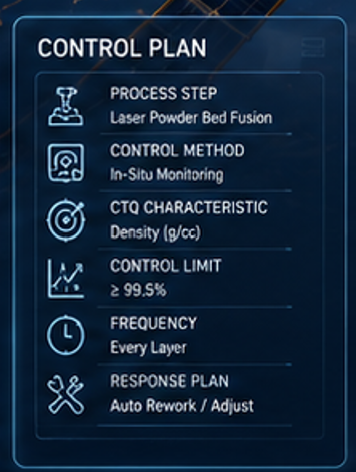 Multi Dimensional Control Plan
A control plan for a terrestrial process typically defines product and process characteristics, controls, methods, frequencies, sample sizes, responsibilities, and response plans. For space industrialization, the control plan must expand across environments.
The process does not begin in orbit. It begins on Earth with design, materials, supplier qualification, component manufacturing, assembly, test, and launch integration. It continues through launch loads, deployment, orbital setup, remote calibration, production run, inspection, release, and either return or orbital use. Each phase has distinct quality risks.
- Earth production may introduce material or component nonconformance. Prevention methods include supplier qualification, traceability, incoming inspection, process validation, and configuration control.
- Launch integration may introduce damage from vibration, load, packaging, handling, or environmental exposure. Controls include environmental testing, packaging validation, shock and vibration analysis, and acceptance testing.
- Orbital setup may fail due to incorrect deployment, calibration errors, software configuration issues, or sensor faults. Controls include remote verification, autonomous checks, telemetry review, and predefined go/no-go criteria.
- The production run may drift because of microgravity effects, thermal instability, fluid behavior, contamination, or equipment degradation. Controls include sensor fusion, process signatures, digital twins, and validated reaction plans.
- Inspection may be constrained by limited physical access. Controls include in-process monitoring, imaging, remote nondestructive evaluation, and post-process data review.
- The release may be challenged for insufficient objective evidence. Controls include digital travelers, telemetry records, acceptance criteria, configuration records, and authorized review.
- Return or orbital use may raise chain-of-custody concerns. Controls include tamper-resistant data, environmental history, configuration traceability, and documented custody transitions.
The control plan must span Earth, launch, orbit, and release. That is a very different model from inspecting a part at the end of a production line.
Supplier Quality and the Cost of Escape
Space industrialization will increase the importance of supplier quality. As launch systems, satellites, stations, habitats, payloads, robotics, in-space manufacturing platforms, and return vehicles become more commercial, supply chains will become broader and more complex. Every supplier interface creates risk. Material variation, special process defects, counterfeit parts, documentation gaps, configuration errors, software incompatibility, contamination, and incomplete traceability can all become expensive downstream problems.
In space systems, supplier defects may not be discovered until integration, launch, orbit, or operation. By then, the cost of correction may be enormous. Supplier development, therefore, becomes part of prevention economics. Qualification, audits, flow-down requirements, first article inspection, process validation, special process control, nonconformance management, and change notification are not paperwork burdens. They are mechanisms for preventing defects from escaping into environments where correction becomes impractical.
The more the space economy scales, the more supplier evidence will matter. Customers will need confidence not only in the prime contractor but also in the entire chain of materials, components, software, processes, and data.
CAPA and FRACAS in Space Systems
Corrective action does not disappear in space. It becomes more evidence-dependent. When failures occur in orbital systems, the organization may need to rely on telemetry, software logs, sensor readings, images, command histories, environmental records, and simulations to understand the event. Physical inspection may be delayed or impossible. Root cause analysis must therefore integrate digital evidence with engineering judgment.
FRACAS becomes essential because repeated anomalies, degradation trends, or operational failures must be addressed to drive reliability growth. CAPA becomes essential because failures must update the system, not merely resolve the incident.
For example, an orbital production anomaly might lead to a software update, sensor recalibration, revised process parameter limits, supplier material review, updated PFMEA, modified control plan, or new acceptance criteria. A weak corrective action would simply restart the process. A strong corrective action would improve the system’s ability to prevent, detect, or respond to the failure mode.
The CAPA question remains the same: what prevents recurrence? In space systems, that question is harder to answer and more important to prove.
Standards as Cost-of-Quality Infrastructure
Standards reduce cost by creating shared expectations. ISO 9001, AS9100, aerospace mission assurance practices, ECSS standards, ISO space systems standards, ASTM additive manufacturing standards, and customer-specific requirements all provide a common language for evidence, control, audit, and acceptance.
As space industrialization grows, standards will become even more important. They will help customers, regulators, suppliers, and operators agree on what must be proven. They will define expectations for traceability, configuration management, validation, risk management, release criteria, and corrective action.
Without standards, every customer may require a different evidence package. Every supplier may interpret requirements differently. Every audit may become a negotiation. Every release decision may be contested. That creates cost, delay, and uncertainty. Standards are therefore not merely compliance tools. They are market infrastructure. They reduce the cost of trust.
Economic Stakes: Space Does Not Scale on Hype
Space industrialization is often discussed in terms of launch costs, orbital infrastructure, lunar resources, asteroid mining, pharmaceutical processing, semiconductor materials, and commercial space stations. These topics attract excitement, and some of the long-term scenarios are genuinely significant. But quality professionals should frame these scenarios soberly.
A resource has no economic value until it can be characterized, extracted, processed, certified, transported, and trusted. A manufacturing process has no market value until it can produce repeatable outputs that meet customer requirements. A commercial station has no industrial value unless its operations, maintenance, safety, payload integration, and evidence systems are controlled. A reusable launch system has no economic value at scale unless repeated cycles demonstrate capability.
In other words, space industrialization is not only a technological problem. It is a quality, reliability, standards, and governance problem. The cost of poor quality will shape which business models are viable. If defects are too expensive, insurance is too high, evidence is too weak, or reliability is too uncertain, adoption will slow. If standards, controls, and prevention systems mature, markets can form. Quality creates trust. Trust creates adoption. Adoption creates volume. Volume creates learning. Learning lowers cost. That is the flywheel.
Practical Implications for Quality Professionals
The cost of poor quality in space offers several lessons for quality professionals working in any advanced manufacturing environment. First, prevention must move upstream. Quality should be involved in requirements, architecture, supplier strategy, design reviews, FMEA, validation planning, and evidence design before production begins.
Second, the inspection strategy must evolve. In remote, automated, or constrained environments, final inspection may not be enough. In-process monitoring, process signatures, telemetry, and digital evidence become critical. Third, measurement-system thinking must expand. Sensors, algorithms, cameras, data pipelines, telemetry, and digital records are part of the measurement system. They must be validated, controlled, and protected.
Fourth, FMEA must include environmental and access assumptions. Whether the environment is an orbit, a cleanroom, an automated cell, or a remote asset, the operating context affects risk. Fifth, standards should be treated as enablers of trust. Compliance is not the end goal. Market confidence is. Sixth, CAPA and FRACAS must establish a learning system. In high-consequence systems, repeated failure modes are unacceptable. The organization must prove that it learns.
Prevention Is the Business Model
The cost of poor quality in space forces quality professionals to confront a simple truth: the later a defect is found, the fewer options remain. On Earth, late detection is expensive. In space, late detection may be unrecoverable.
That reality changes the role of quality. Quality cannot be a downstream function. It cannot rely on inspection alone. It cannot wait for defects to escape before improving the process. It must shape requirements, design, supplier controls, process validation, evidence systems, release criteria, and governance from the beginning.
Space industrialization will require rockets, stations, robotics, AI, materials science, orbital logistics, and new business models. But none of those will create a durable industry without prevention, control, traceability, reliability, and trust.
The future of space manufacturing belongs to organizations that can prove their systems are capable, repeatable, auditable, and safe. In that future, prevention is not overhead. Prevention is the business model.
Frequently Asked Questions
What is the cost of poor quality in space?
It is the economic, operational, safety, regulatory, and reputational cost created when defects escape into launch, orbit, mission operations, or in-space production.
Why is COPQ higher in space?
Because correction is often difficult, delayed, or impossible. Once a defect reaches orbit, physical access, inspection, rework, containment, and recovery options may be severely limited.
How does APQP apply to space systems?
APQP provides a prevention-based planning logic: define requirements, identify CTQs, perform DFMEA and PFMEA, validate processes, create control plans, and prove readiness before launch or production.
Why is inspection less effective in space manufacturing?
Physical inspection may be constrained by remote operation, limited access, microgravity, or orbital use. Quality evidence must often come from telemetry, imaging, process signatures, and digital records.
What role do standards play?
Standards create a common basis for requirements, evidence, traceability, validation, audit, and release. They reduce uncertainty and help markets trust new space-manufactured products.
What should quality professionals focus on?
They should focus on prevention, evidence design, supplier control, FMEA, control plans, measurement-system integrity, CAPA, FRACAS, and standards development.


