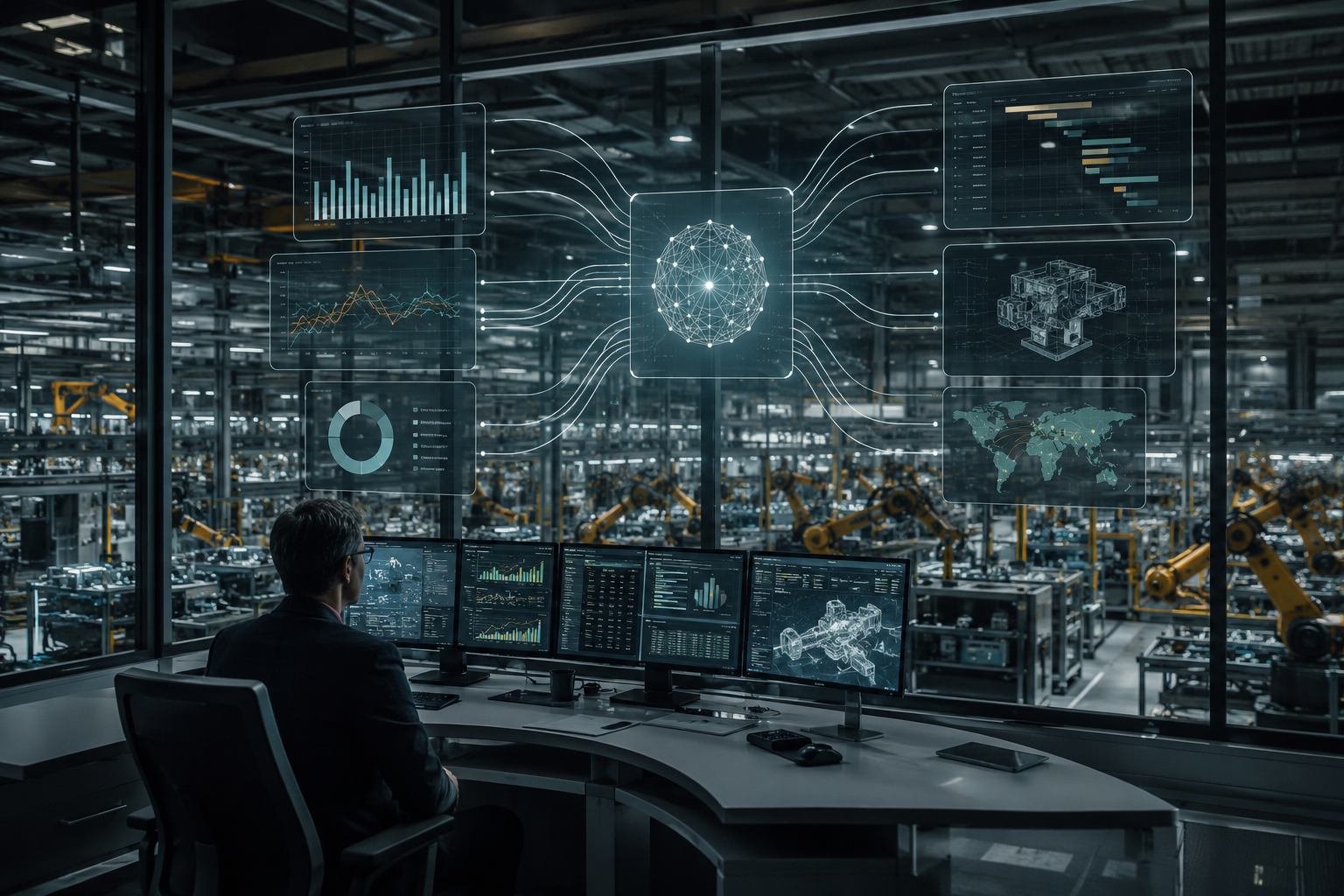
Dashboards are one of the most visible symbols of Industry 4.0, but they are also one of its most common traps. A manufacturer can build beautiful dashboards, connect them to live factory data, review them every morning, and still make slow, inconsistent, poorly governed decisions. The problem is not that dashboards are useless. The problem is that dashboards are often treated as the destination of digital transformation rather than as a component within a larger decision-making system.
Industry 4.0 gave manufacturers more data, greater visibility, and more ways to monitor their factories. But visibility is not the same as action. Awareness is not the same as accountability. A chart is not a decision. A metric is not a workflow. A red indicator is not a learning system. That distinction sits at the center of Industrial Intelligence. Industrial Intelligence is not merely the ability to see the factory more clearly. It is the governed ability to sense, contextualize, decide, act, and learn across physical, digital, human, and supply-chain systems.
Why Are Dashboards Not Enough in Industry 4.0 Programs?
Dashboards are not enough in Industry 4.0 programs because they create visibility but do not automatically create decisions, ownership, workflows, governance, action, or learning. Manufacturers need dashboards connected to decision architecture so that signals lead to accountable action, outcome validation, and reusable knowledge.
Dashboards Solve a Visibility Problem
Dashboards are useful because manufacturing leaders need visibility. They can show production status, OEE, downtime, scrap, backlog, schedule adherence, inventory, supplier performance, maintenance risk, energy use, and quality trends. They reduce manual reporting. They help teams see patterns faster. They create a shared operating picture.
That is real value.
But it is not the whole value chain. A dashboard answers the question “What is happening?” but it does not fully answer:
- “What does it mean?”
- “Who should act?”
- “Which decision rule applies?”
- “What tradeoff are we making?”
- “Did the action work?”, or
- “What should we learn?”
Those questions require decision architecture.
The Dashboard Trap
The dashboard trap occurs when leaders assume that better visualization will automatically lead to better performance.
It usually sounds reasonable at first:
- Give supervisors live production dashboards.
- Give quality teams defect trend dashboards.
- Give maintenance teams asset-health dashboards.
- Give executives performance dashboards.
- Give planners supply and demand dashboards.
Those tools may help. But if every dashboard attracts more attention without clear action, the organization faces a new problem: digital visibility without decision-making capacity. The factory sees more, but decides no better.
 Industrial intelligence decision tree infographic
Why Dashboard-First Programs Stall
1. Dashboards Do Not Define Ownership
A metric can be visible to everyone and owned by no one. If a delivery-risk dashboard turns red, who decides whether to expedite material, resequence production, notify the customer, use overtime, or protect margin? If the answer depends on a meeting, a message thread, or whoever notices first, the dashboard has not solved the decision problem. Visibility without ownership creates drift.
2. Dashboards Do Not Explain Context
A dashboard may show an increase in cycle time, but the chart may not explain whether the issue is material, tooling, programming, labor, maintenance, quality hold, engineering change, or schedule mix. The Difference Between Factory Data and Factory Knowledge explains this gap. Data records what happened. Knowledge explains what the evidence means in context. Manufacturers do not need more charts. They need contextualized evidence.
3. Dashboards Do Not Make Tradeoffs
Manufacturing decisions usually involve tradeoffs. A dashboard may show that one order is late, one machine is down, one customer is high priority, one supplier is risky, and one product has a quality concern. The organization still has to decide what to protect: throughput, customer promise, margin, inventory, quality, capacity, or cash. Dashboards present signals. They do not resolve tradeoffs.
4. Dashboards Do Not Close the Loop
A dashboard can show that a problem occurred. It may also show that a metric improved after action. But unless the system records what decision was made, why it was made, what evidence was used, who approved it, and whether the action prevented recurrence, the organization is not fully learning. How Industrial Intelligence Creates Organizational Memory is relevant here because dashboards often show the symptom, while memory preserves the lesson.
5. Dashboards Do Not Govern AI Recommendations
As AI and analytics enter manufacturing dashboards, the governance problem becomes sharper. If a model recommends a maintenance action, quality hold, schedule change, supplier escalation, or inventory adjustment, leaders need to know how to review the recommendation. They need decision rights, confidence thresholds, override reasons, audit trails, and outcome validation. Why Industry 4.0 Needs an AI Orchestration Layer explains why orchestration is the missing layer between connected systems and coordinated decisions.
Dashboard Visibility vs. Decision Architecture
| Dashboard visibility | Decision architecture |
|---|---|
| Shows status | Defines what decision is required |
| Displays metrics | Connects metrics to decision rules |
| Highlights exceptions | Routes exceptions to accountable owners |
| Supports review meetings | Launches governed workflows |
| Creates awareness | Creates action and follow-through |
| Tracks performance | Validates outcomes and captures learning |
A dashboard becomes valuable when it participates in decision architecture.
What Decision Architecture Adds
Decision architecture gives dashboards a job beyond display.
It defines:
- Decision triggers: What condition requires action?
- Decision owners: Who is accountable for the response?
- Context requirements: What evidence must be reviewed?
- Decision rules: What thresholds, policies, or tradeoffs apply?
- Workflow paths: What happens after the signal is recognized?
- Governance controls: What approvals, audit trails, or escalation rules are required?
- Outcome validation: How will the organization know whether the decision worked?
- Learning capture: How will the lesson improve the next decision?
This is where dashboards move from reporting tools to Industrial Intelligence assets.
Example: The Production Dashboard That Does Not Decide
Imagine a production dashboard showing that Line 4 is behind schedule. The dashboard is accurate. It updates every few minutes. The color is red. Everyone can see the issue.
But the team still has to ask:
- Is the delay caused by downtime, material shortage, labor gap, quality hold, or setup overrun?
- Which customer orders are affected?
- What inventory buffers exist?
- Can production be resequenced?
- Who has the authority to approve overtime?
- Should the customer be notified?
- What action prevents the same pattern tomorrow?
The dashboard reveals the gap. The decision architecture closes it.
Example: The Quality Dashboard That Still Allows Recurrence
A quality dashboard may show defect trends by part number, shift, work center, supplier, or defect code. That is useful. But if the same defects recur, the dashboard has not become a prevention system. Fail Fast Is Not a Quality Strategy makes the point plainly: speed is not enough if the organization keeps rediscovering the same failure. A quality dashboard becomes an Industrial Intelligence asset when it connects trends to containment, root-cause evidence, corrective action, control-plan updates, supplier feedback, and recurrence monitoring.
The Role of Standards and Integration
Dashboards depend on integration. Manufacturing data often crosses automation, MES, ERP, QMS, CMMS, PLM, warehouse, and supplier systems. Standards such as ISA-95 help define the relationship between enterprise and control systems, which matters when dashboard signals must connect to operational workflows. But integration alone is still not enough. Integration helps the dashboard see across systems. Decision architecture helps the enterprise act across systems.
What Executives Should Measure Instead
If leaders only measure dashboard adoption, they may reward digital activity rather than operational improvement. Industrial Intelligence Metrics for Executives recommends metrics that indicate whether the enterprise is improving in decision-making, learning, reliability, resilience, adoption, and trust.
For dashboard-heavy programs, executives should measure:
- Signal-to-decision time: How long does it take for a dashboard exception to become a decision?
- Decision-to-action time: How long does it take for the decision to become executed work?
- Closed-loop rate: What percentage of exceptions have recorded outcomes?
- Repeat-issue rate: Are the same alerts recurring after action?
- Owner clarity: Does every critical metric have a named decision owner?
- Workflow conversion: What percentage of dashboard signals launch governed workflows?
- Learning reuse: Are lessons from one line, shift, or plant reused elsewhere?
Those measures reveal whether dashboards are becoming intelligence assets or staying at the level of visualization.
How To Upgrade an Industry 4.0 Dashboard Program
Step 1: Inventory Critical Dashboards
List the dashboards that leaders rely on for production, quality, maintenance, planning, suppliers, logistics, finance, and customer performance.
Step 2: Identify the Decision Behind Each Metric
For every critical metric, ask what decision it is supposed to improve. If the answer is unclear, the dashboard is probably reporting activity rather than enabling action.
Step 3: Assign Decision Owners
Every critical exception should have a clear owner, escalation path, and response expectation.
Step 4: Connect Context
Link dashboard signals to the context needed for decisions: product, process, customer, supplier, material, maintenance, quality, schedule, and financial impact.
Step 5: Embed Workflow
Turn recurring exceptions into defined workflows. The dashboard should not simply display problems; it should help launch an accountable response.
Step 6: Validate Outcomes
Measure whether the action solved the problem, reduced recurrence, improved delivery, lowered scrap, stabilized schedules, or improved decision speed.
Step 7: Capture Learning
Preserve lessons so that future teams do not repeat the same investigation from scratch.
Where This Fits in the Industry 4.0 Transition
Industry 4.0 vs Industrial Intelligence framed Industry 4.0 as the connected digital foundation. From Connected Machines to Learning Manufacturing Systems shows that connected machines become valuable when the enterprise learns from them. How Industry 4.0 Investments Become Industrial Intelligence Assets explains how digital investments become reusable capabilities. This article adds the dashboard lesson: visibility must be converted into decision architecture. That conversion is one of the practical bridges from smart manufacturing to Industrial Intelligence.
The Executive Test
The test for any dashboard is simple: When this dashboard changes, does the organization know what decision to make, who owns it, what workflow starts, how success is measured, and what learning is captured?
If the answer is no, the dashboard may still be useful, but it is not yet enough. Industry 4.0 made manufacturing more visible. Industrial Intelligence makes manufacturing more capable.
FAQ
Why are dashboards not enough in Industry 4.0 programs?
Dashboards are not enough because they create visibility but do not automatically define ownership, decision rules, workflows, governance, action, outcome validation, or organizational learning.
Are dashboards still useful in smart manufacturing?
Yes. Dashboards are useful when they provide trusted visibility and support decision-making. The limitation appears when dashboards are treated as the final goal instead of as one component in a decision system.
What is decision architecture in manufacturing?
Decision architecture defines how manufacturing signals become decisions. It includes decision triggers, owners, context, rules, workflows, governance controls, outcome validation, and learning capture.
How can manufacturers improve dashboard ROI?
Manufacturers can improve dashboard ROI by linking metrics to accountable decisions, embedding workflows, validating outcomes, reducing repeat issues, and capturing lessons for reuse.
What should executives measure beyond dashboard adoption?
Executives should measure signal-to-decision time, decision-to-action time, closed-loop rate, repeat-issue rate, owner clarity, workflow conversion, and learning reuse.