

Why ISO 9001 and APQP Are No Longer Enough
Space industrialization will require a new generation of quality engineering. Learn why in-space manufacturing changes FMEA, control plans, SPC, CAPA, auditing, and root cause analysis.
The next quality frontier is not on the factory floor
Quality engineering has always evolved as manufacturing has crossed new thresholds. In the first era, quality management was about building disciplined systems: document control, corrective action, customer focus, internal audits, management review, process control, and continual improvement. ISO 9001 captured this mindset well. The organization needed a quality management system, a process approach, PDCA thinking, and evidence that it could consistently meet customer and regulatory requirements.
Then came the advanced quality era. Automotive and aerospace supply chains pushed quality engineering beyond general system discipline into prevention-based planning. IATF 16949, APQP, PPAP, FMEA, SPC, MSA, control plans, special characteristics, and supplier development created a more rigorous model. Quality was no longer simply “have a system and improve it.” Quality became “plan the product and process so defects are prevented before launch.”
Now, space industrialization is forcing another shift. The manufacturing environment itself is changing. We are no longer talking only about factories on Earth. We are talking about production in microgravity, orbital laboratories, autonomous platforms, commercial space stations, satellite factories, in-space materials processing, pharmaceutical crystallization, optical fiber production, semiconductors, additive manufacturing, and eventually lunar and deep-space infrastructure.
That changes the quality question.
The old question was:
Can the process meet requirements?
The advanced quality question was:
Can the product and process be planned, validated, controlled, and launched at rate?
The space industrialization question is:
Can the product, process, environment, autonomy system, digital evidence stream, and orbital operating conditions remain controlled together?
That is a different level of quality thinking.
From basic quality to advanced quality to space quality
The evolution of quality engineering can be viewed in three broad stages.
Stage 1: Basic quality management
The ISO 9001 model gave organizations a disciplined management system. Its logic is still powerful:
- define processes
- document responsibilities
- control information
- manage risks and opportunities
- audit performance
- correct nonconformities
- review system effectiveness
- improve continually
This was a major step forward because it moved organizations away from informal practices and toward repeatable management systems.
But ISO 9001 is intentionally generic. It tells an organization what must be controlled, but not always how deeply the product and process risks must be engineered before launch.
Stage 2: Advanced quality planning
Automotive and aerospace quality pushed the next level of maturity. The advanced quality era added prevention tools:
- APQP
- FMEA
- control plans
- SPC
- MSA
- PPAP
- special characteristics
- supplier development
- mistake-proofing
- layered process audits
- launch readiness reviews
- structured corrective action
This era taught quality professionals that prevention is more powerful than inspection. It also taught us that process capability must be proven before rate production begins.
The core APQP question is:
Can we design and launch a product and process that consistently meet customer requirements?
That question still matters. But space adds a new dimension.
Stage 3: Space industrialization quality
Space quality must control not only the product and process, but also the operating environment.
On Earth, the environment is often treated as a branch on a fishbone diagram: temperature, humidity, vibration, cleanliness, lighting, contamination, and operator conditions. In space, the environment is not merely a background condition. It is part of the process of physics.
Microgravity changes fluid behavior. Vacuum affects heat transfer and outgassing. Radiation can degrade electronics, polymers, biological materials, and sensors. Thermal cycling creates expansion and contraction stresses. Launch vibration may damage hardware before production even begins. Limited physical access changes inspection, containment, rework, and auditability.
For in-space manufacturing, the environment must be incorporated into the control plan. That is the core shift.
The new quality model: Product × Process × Environment × Evidence
Traditional quality planning often links the product and process:
Customer requirement → CTQ → design characteristic → process characteristic → control method → inspection evidence
Space industrialization requires a broader model:
Customer requirement → CTQ → design characteristic → process parameter → orbital environmental variable → measurement evidence → autonomous reaction plan → release decision
That means quality planning must become multi-dimensional.
A space manufacturing quality system must ask:
- What product characteristic is critical?
- What process variable controls it?
- What environmental condition changes the process?
- What sensor or evidence stream proves control?
- What happens if the process drifts?
- Can the system react autonomously?
- Is the evidence sufficient for release?
- Can the record be audited remotely?
- Can the root cause be reconstructed after the fact?
This is beyond traditional APQP. It is APQP extended into an environment where the factory may be remote, autonomous, inaccessible, and physically different from Earth.
Multi-dimensional FMEA: beyond the flat risk table
Traditional FMEA is usually organized around functions, failure modes, effects, causes, current controls, severity, occurrence, detection, and recommended actions. That structure still matters. But for in-space manufacturing, a standard FMEA may be too flat.
 Multi Dimensional FMEA
Space manufacturing failures are often not caused by one process input. It may be caused by an interaction among:
- product design
- process parameter
- orbital environment
- software logic
- sensor performance
- autonomy rules
- communication latency
- inspection limitation
- material behavior in microgravity
For example, a pharmaceutical crystallization process may produce a different crystal form because microgravity alters fluid behavior, thereby changing mixing, temperature gradients, nucleation, and growth. The root cause is not simply “operator error” or “temperature out of range.” The root cause may be an interaction among physics, process control, material behavior, and measurement assumptions.
That suggests a new form of FMEA:
Multi-dimensional FMEA
A multi-dimensional FMEA does not ask only:
What can go wrong?
It asks:
What interaction among product, process, environment, software, measurement, and autonomy can create a failure mode?
A simplified structure might look like this:
| FMEA dimension | Space quality question |
|---|---|
| Product CTQ | What characteristic must be achieved? |
| Process parameter | What process input controls the CTQ? |
| Environmental variable | What orbital condition changes the process? |
| Measurement system | How do we know the condition stayed controlled? |
| Autonomy logic | What decision will the system make without human intervention? |
| Failure mode | What defect or mission risk could result? |
| Evidence gap | What would prevent us from proving control? |
| Reaction plan | What happens when drift is detected? |
This is not a replacement for FMEA. It is an expansion of FMEA for a manufacturing environment where the environment itself is a process variable.
Control plans must become environmental control plans
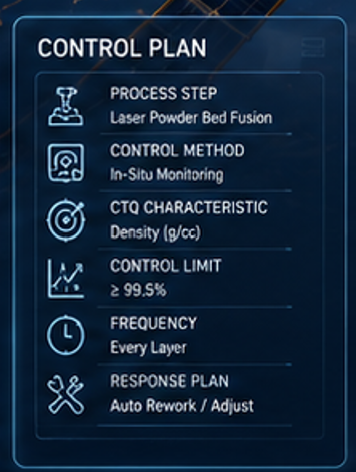 Multi Dimensional Control Plan
In traditional APQP, the control plan defines how product and process characteristics will be controlled during production. It includes process steps, characteristics, specifications, measurement methods, sample sizes, frequencies, reaction plans, and responsible parties. In space, that is not enough.
An orbital control plan must include:
- Earth-based material control
- supplier traceability
- launch packaging and vibration protection
- pre-launch configuration verification
- orbital deployment checks
- environmental monitoring
- autonomous process monitoring
- telemetry thresholds
- sensor calibration status
- remote inspection evidence
- anomaly response
- quarantine logic
- return-to-Earth validation if applicable
- customer release criteria
The control plan must span the full lifecycle:
Earth production → launch integration → launch environment → orbital setup → production run → inspection → release → use or return
This is a major change in quality thinking. The manufacturing process no longer begins when the machine starts running. It begins when the material, equipment, software, and configuration are prepared for launch. The launch itself becomes part of the process history. The orbital environment becomes part of the process condition. The digital record becomes part of the release evidence.
A practical in-space control plan would include columns such as:
| Phase | Quality risk | Control method | Evidence |
|---|---|---|---|
| Earth preparation | wrong material or configuration | supplier qualification, lot traceability | certificate, traveler, configuration record |
| Launch | vibration or load damage | environmental testing, packaging validation | launch load history, inspection record |
| Orbital setup | Incorrect deployment or calibration | remote verification, autonomous checks | telemetry, image confirmation |
| Production | process drift | sensor fusion, process signature monitoring | data stream, alarm log |
| Inspection | limited physical access | imaging, spectroscopy, remote NDT | inspection file, digital evidence |
| Release | insufficient proof of conformity | digital traveler, acceptance criteria | signed release decision |
This is where the old control plan becomes a space control architecture.
SPC and variation: from process variation to environmental interaction
SPC was developed to distinguish common-cause variation from special-cause variation. That remains essential. But space industrialization complicates the meaning of variation. On Earth, a control chart might track temperature, pressure, dimension, weight, surface finish, or defect count.
In orbit, variation may come from sources that are not present or not dominant on Earth:
- microgravity effects
- radiation exposure
- thermal cycling
- orbital day/night transitions
- vacuum-related heat transfer
- launch-induced damage
- communication latency
- autonomous decision timing
- sensor drift
- limited maintenance access
That means the SPC model must expand from monitoring process output to monitoring process-environment interaction.
The question is no longer only:
Is the process stable?
The question becomes:
Is the process stable under the current environmental state?
A future space SPC system may need to combine:
- traditional control charts
- environmental state monitoring
- multivariate SPC
- digital twins
- anomaly detection
- sensor fusion
- model-based process control
- autonomous reaction rules
For space manufacturing, SPC may become less about a single chart for a single characteristic and more about a live process signature.
A process signature might include:
- temperature profile
- radiation exposure
- vibration history
- microgravity condition
- pressure condition
- sensor confidence
- material response
- software state
- product measurement
- anomaly flags
The new quality question is:
Does the full process signature match the validated window?
That is a more advanced form of process capability.
CAPA in space: corrective action when containment is constrained
CAPA is already one of the most important parts of any QMS. But in space manufacturing, CAPA becomes more difficult because containment, investigation, correction, and verification may all be constrained.
On Earth, a nonconforming product can often be tagged, segregated, reworked, scrapped, or inspected by a quality engineer. In orbit, the nonconformance may occur inside a sealed process chamber, on a satellite, inside an autonomous production capsule, or on a platform that cannot be physically accessed. That changes CAPA.
Space CAPA must address:
- remote containment
- autonomous shutdown rules
- digital quarantine
- delayed inspection
- limited rework
- software rollback
- configuration reconstruction
- telemetry review
- evidence preservation
- recurrence prevention across future missions
The CAPA system must become more forensic. It must preserve the data needed to reconstruct what happened. That means the CAPA record must include not only the product nonconformance, but also the process state, environmental state, software state, sensor state, and decision history.
A space CAPA cannot rely on “go look at the part” as the first investigative step. The first step may be:
Reconstruct the event from the digital thread.
That is a different mindset.
Auditing in space: objective evidence without physical presence
Auditing is also transformed. Traditional audits rely heavily on physical presence: observing the process, interviewing personnel, reviewing records, sampling outputs, following audit trails, and verifying evidence.
In space manufacturing, the auditor may never physically see the process. The “shop floor” may be an orbital module, an autonomous capsule, a robotic platform, a commercial space station, or a lunar facility. The operator may be software. The record may be telemetry. The inspection evidence may be imaging, spectroscopy, sensor data, or automated decision logs.
So the audit question changes from:
Can I observe the process?
to:
Can I trust the evidence architecture?
Future space audits may focus on:
- digital thread integrity
- telemetry completeness
- sensor calibration
- software validation
- autonomy decision logs
- remote inspection methods
- cybersecurity controls
- configuration management
- data retention
- tamper resistance
- release authority
- anomaly escalation
- supplier traceability across Earth and orbit
The auditor’s role expands from compliance verification to assurance of the evidence system itself. A space auditor may need to audit the data pipeline before auditing the product.
Root cause analysis: from five why to multi-dimensional five why
Quality professionals know the standard five-why method. It is useful because it pushes teams beyond the immediate symptom. But many organizations have learned that a single chain of five whys can be too simplistic. Complex failures usually involve more than one causal path. That led to stronger versions, including three-legged five-why, where teams examine:
- Why does the specific problem occur
- Why was it not detected
- Why did the system allow it to happen
Space industrialization requires another step.
Call it:
Multi-dimensional Five Why
The multi-dimensional five-why does not follow one linear chain. It investigates several causal dimensions at once:
- Product why
Why did the product characteristic fail? - Process why
Why did the process create or fail to prevent the condition? - Environment why
Why did the orbital environment influence the result? - Measurement why
Why did the measurement system detect, miss, delay, or misinterpret the condition? - Autonomy/software why
Why did the control logic respond as it did? - System why
Why did the quality system allow the risk to remain uncontrolled?
This is not abandoning root cause analysis. It is making root cause analysis fit the complexity of the operating environment.
A traditional five-why might ask:
Why did the product fail?
A multi-dimensional five-why asks:
Which interaction among design, process, environment, software, measurement, and governance created the failure path?
That is the root cause question for space industrialization.
Example: microgravity crystallization failure
Imagine a company manufacturing pharmaceutical crystals in orbit. The CTQ is a crystal form. The process appears stable, but the returned sample shows an undesired polymorph.
A traditional investigation might ask:
- Why was the wrong crystal form produced?
- Because the crystallization conditions were not correct.
- Why were they not correct?
- Because the cooling profile was not maintained.
- Why was the cooling profile not maintained?
- Because the temperature control system drifted.
That is useful, but incomplete.
A multi-dimensional five-why would expand:
| Dimension | Root cause question |
|---|---|
| Product | Why was the desired polymorph not achieved? |
| Process | Why did the crystallization pathway shift? |
| Environment | How did microgravity change nucleation, mixing, or sedimentation? |
| Measurement | Did the sensors capture the actual product condition, or only the chamber conditions? |
| Software/autonomy | Did control logic respond correctly to drift? |
| Evidence | Was the digital record sufficient to prove that the process remained within the validated window? |
| System | Did the APQP process identify microgravity as a special process variable? |
The corrective action may not be “fix the temperature controller.” It may require revising the process model, updating the PFMEA, changing the validated process window, adding sensor inputs, revising the control plan, and modifying the release evidence requirement. That is the new quality engineering mindset.
Design-in quality becomes mission-critical
Space industrialization will push the quality profession even further away from inspection-based thinking. In orbit, inspection is constrained. Rework is constrained. Containment is constrained. Human intervention is constrained. Supply-chain recovery is constrained. Audit access is constrained. That means quality must be designed in before launch.
Design-in quality for space industrialization includes:
- design for manufacturability
- design for autonomy
- design for remote inspection
- design for sensor verification
- design for maintainability
- design for digital evidence
- design for containment
- design for radiation tolerance
- design for thermal cycling
- design for launch survival
- design for microgravity process behavior
- design for end-of-life or return
This is APQP thinking, but extended into a domain where every missed assumption can become a mission-level failure.
Standards will become market infrastructure
Space industrialization will not scale on technical capability alone. It will scale when customers trust the output. A pharmaceutical company will need confidence that a space-produced material meets identity, purity, potency, and stability requirements. A semiconductor customer will need confidence in material properties, traceability, and process repeatability. An aerospace customer will need assurance of configuration, reliability, and mission risk. A regulator will need objective evidence. An insurer will need risk data. A supplier will need common requirements.
That means quality standards are not bureaucracy. They are market infrastructure. ISO 9001 and AS9100 provide a foundation. IATF 16949 and APQP provide a prevention model. Aerospace mission assurance provides rigor. Medical device and pharmaceutical quality systems provide a discipline for validation. But in-space manufacturing will require new extensions:
- orbital process validation
- microgravity PFMEA
- autonomous release rules
- digital evidence requirements
- remote audit protocols
- space-based metrology
- orbital contamination control
- telemetry-based SPC
- launch-to-orbit traceability
- orbital CAPA requirements
- cybersecurity for quality evidence
- standards for returned and non-returned products
The industry will need a new quality engineering vocabulary.
The next quality profession
The future space quality engineer will need to understand more than inspection, audits, and corrective action.
They will need to understand:
- systems engineering
- reliability engineering
- software quality
- AI and autonomy assurance
- digital twins
- sensor fusion
- data integrity
- environmental effects
- supplier risk
- orbital operations
- advanced manufacturing
- regulatory strategy
- standards development
- evidence-based release
This is not science fiction. NASA and the ISS National Laboratory already support in-space production demonstrations. Companies are already exploring space-based manufacturing of pharmaceuticals, materials, optics, and semiconductors. Commercial stations, reusable launch systems, autonomous spacecraft, and return capsules are pushing the industry toward an industrial model.
The quality profession has a choice. It can wait until others have written the standards. Or it can help write the rulebook.
The environment is now part of the process
The history of quality engineering has been a history of expanding the boundary of control. ISO 9001 taught us to control the management system. Advanced quality taught us to control product and process risks before launch. Space industrialization will require us to control the product, process, environment, autonomy, evidence, and mission context as a single integrated system.
- That means the fishbone becomes multi-dimensional.
- The FMEA becomes interaction-based.
- The control plan becomes environmental and digital.
- SPC becomes process-signature monitoring.
- CAPA becomes forensic and remote.
- Auditing becomes evidence-system assurance.
- Root cause analysis becomes multi-dimensional.
- And quality engineering becomes one of the enabling disciplines of space industrialization.
The next industrial era will not be created simply because rockets fly more often. It will emerge when space-based work becomes capable, repeatable, auditable, and trusted. That is a quality problem. And quality professionals should be at the table before the rulebook is written.
FAQ
What is multi-dimensional FMEA?
Multi-dimensional FMEA is an expanded approach to failure mode and effects analysis that evaluates risk across design, process, environment, autonomy, supply chain, verification, human authority, and lifecycle learning. It is especially useful for space manufacturing and autonomous production because failures can emerge from interactions across these dimensions.
Why does space manufacturing need a different approach to FMEA?
Space manufacturing introduces constraints such as microgravity, vacuum, radiation, thermal cycling, remote operation, limited maintenance access, and autonomous production. These conditions can change how products fail, how processes behave, how evidence is collected, and how corrective actions are approved.
How does AI support quality engineering in space manufacturing?
AI can support quality engineering by detecting anomalies, retrieving similar failures, comparing telemetry to expected process behavior, classifying risk, supporting remote inspection, and recommending bounded response options. Human or mission-authorized decision owners should still validate and approve high-risk actions.
Related Quality, Space Manufacturing, and Industrial Intelligence Resources


