
For manufacturing leaders navigating the evolving landscape of production, the integration of additive manufacturing (AM) within human-out production systems is rapidly emerging as a seismic shift in operational design and capability. This article delivers a focused technical and operational exploration of this integration—defining the core concepts, explaining underlying mechanisms, examining real-world applications, and clarifying human roles, limitations, and future trajectories underpinned by Industrial Intelligence.
Direct Definition: What is Human-Out Production in the Context of Additive Manufacturing?
What Is Industrial Intelligence, Advanced Manufacturing, AI, and the Future of Industrial Operations? Human-out production refers to manufacturing systems designed to operate with minimal or no direct human intervention during production. These systems rely heavily on automation, advanced monitoring, and intelligent control to produce parts or products autonomously. Within this paradigm, additive manufacturing—a layer-by-layer material deposition process often driven by digital models—functions as both a production technology and a platform for enabling new degrees of automation, quality control, and responsiveness.
Unlike conventional automated manufacturing setups that typically require periodic human oversight for tool changes, calibration, or quality audits, the ambition of human-out production in AM is to close loops digitally and operationally, reducing human presence to supervisory roles, decision-making, and exception handling.
Fundamental Mechanism of Additive Manufacturing in Human-Out Systems
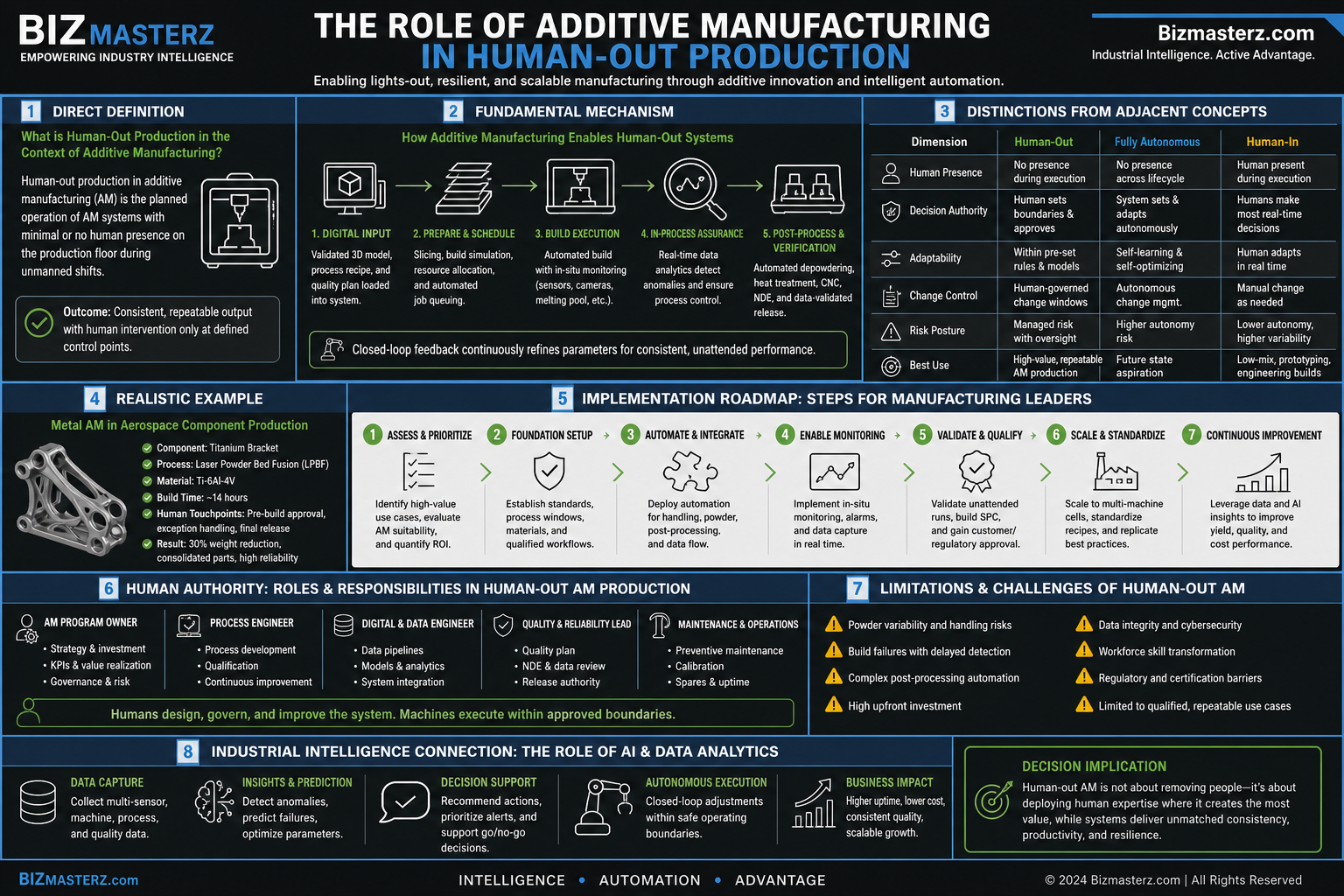
Additive manufacturing builds parts directly from digital 3D models, usually operating in a closed-loop system that involves several digitally orchestrated stages:
- Digital Model Creation: Using CAD and simulation, a precise geometric and material specification is prepared.
- Machine Setup and Process Planning: Software generates machine instructions and process parameters tailored to the part’s complexity.
- Layer-by-Layer Fabrication: The AM machine deposits or fuses material in successive thin layers until the final geometry emerges.
- In-Process Monitoring: Sensors and imaging technologies continuously gather data (thermal, optical, acoustic, etc.) to detect anomalies.
- Non-Destructive Evaluation (NDE) & Feedback: Immediate evaluations determine part quality and feed this information back to the control system to autonomously adapt process parameters.
- Post-Process Handling: Automated removal, cleaning, or secondary operations are executed as programmed.
This entire pipeline is made possible through advanced software orchestration and connectivity, enabling minimal human steps between digital command and physical outcome. NIST research highlights the critical role of model-based operational control in achieving this integration.
 Explains The Role of Additive Manufacturing in Human-Out Production.
Distinctions from Adjacent Concepts: Human-Out vs. Fully Autonomous and Human-In Systems
It is essential to distinguish human-out production from fully autonomous manufacturing or traditional human-involved processes:
- Human-Out vs. Fully Autonomous: Full autonomy would require no human roles whatsoever, including supervisory or strategic intervention. Human-out systems still depend on human authority for exception management, strategic planning, and high-level decision-making.
- Human-Out vs. Human-In Production: Human-in systems rely heavily on manual operations, direct intervention, and complex human-machine interaction. Human-out targets minimize these interventions, thus increasing repeatability, reducing error, and boosting speed.
AM’s digital-native process and continuous monitoring capabilities make it uniquely suited to human-out evolution compared to subtractive or forming technologies, which often require manual tooling or inspection steps.
Realistic Example: Metal AM in Aerospace Component Production
Consider a leading aerospace manufacturer employing laser powder bed fusion (LPBF) metal additive manufacturing to produce complex turbine blades. These components require dimensional precision and customized internal cooling structures achievable only by AM. Implementing human-out production involves the following:
- 3D CAD designs are developed with embedded process data using model-based systems.
- Automated powder spreading and inert-gas-atmosphere controls manage the build chamber environment.
- In-process monitoring systems, as documented in NIST’s research, track melt pool dynamics and layer consistency.
- Real-time defect detection algorithms alert operators only if anomalies exceed established thresholds.
- The post-build heat treatment and surface finishing are automated via robotic stations with little human intervention.
This process reduces cycle times, improves yield, and shifts human roles toward process engineers and data analysts monitoring the production dashboard remotely.
Implementation Guidance: Steps for Manufacturing Leaders
For related manufacturing context, see Industrial Intelligence as a Management System, Not a Software Category.
To realize human-out production with additive manufacturing, manufacturing leaders should consider the following roadmap:
- Assessment of Current Capabilities: Evaluate existing AM infrastructure, including machines, software, and in-process monitoring capabilities.
- Adoption of Model-Based Control: Move from manual process adjustments to model-driven controls as recommended by NIST frameworks.
- Integration of In-Process Sensing and Automated Feedback: Deploy high-resolution sensors and develop algorithms for real-time quality control.
- Automation of Material Handling and Secondary Processes: Use robotics for powder management, cleaning, and post-processing steps.
- Human-Authority Protocols: Define clear boundaries of automation and human intervention, emphasizing human oversight for strategic decisions and anomalies.
- Training and Change Management: Equip staff with the skill sets to analyze process data rather than handle manual production tasks.
Manufacturers can gain insights from industry case studies, such as those assessed in research on the Brazilian industrial AM performance system, noting how structured measurement supports operational transitions.
Human Authority: Roles and Responsibilities in Human-Out AM Production
Even with extensive automation, human expertise remains indispensable. Key areas of human authority should include:
- Process Oversight: Reviewing data outputs, managing exceptions, and verifying system integrity.
- Strategic Decision-Making: Determining production priorities, maintenance schedules, and continuous improvement opportunities.
- Design and Process Development: Creating digital twins and updating production models based on evolving product requirements.
- Ethical and Compliance Governance: Ensuring safety, regulatory adherence, and responsible use of production data.
By redefining human roles from hands-on operators to supervisors and analysts, organizations can fully leverage human intelligence where it is most impactful.
Limitations and Challenges of Human-Out Additive Manufacturing
Despite its promise, human-out production in AM faces several barriers:
- Complexity of Defect Detection: Ensuring accurate non-destructive evaluation without human touchpoints remains technically challenging.
- Machine Variability: Process parameters may vary due to material batch differences or environmental factors, requiring adaptive control systems.
- System Integration: Achieving seamless communication between AM machines, sensors, feedback controls, and factory automation infrastructure requires substantial investment.
- Workforce Transition: Shifting roles toward analytical and supervisory functions necessitates significant upskilling and cultural change.
Manufacturing leaders must strategically address these challenges through continuous R&D collaboration and staged implementation.
Industrial Intelligence Connection: The Role of AI and Data Analytics
Industrial Intelligence—comprising AI, machine learning, and advanced data analytics—enables human-out additive manufacturing. For example, Samsung’s collaboration with NVIDIA to create AI-enabled intelligent factories exemplifies the future trajectory of such integration in global manufacturing ecosystems (Samsung NVIDIA AI Megafactory).
Intelligent algorithms analyze in-situ sensor data to predict failures, dynamically optimize process parameters, and automate quality assurance. These capabilities close operational loops and reduce dependency on manual interventions. Consequently, human-out production is not purely about robotics but about embedding intelligence to complement physical automation with decision-making and process evolution.
Strategic Implications for Manufacturing Leaders
For related manufacturing context, see Industry 4.0 vs Industrial Intelligence.
Human-out production realized through additive manufacturing represents a pivotal transformation opportunity. By leveraging AM’s model-driven process control, sophisticated in-process monitoring, and Industrial Intelligence, manufacturers reduce reaction times, improve product quality, and enable scalable customization at reduced costs.
However, implementation requires deliberate planning, significant technology investment, and a workforce evolution strategy emphasizing human oversight over manual execution. Manufacturing leaders prepared to embrace these changes will lead the next wave of industrial innovation, driving competitive advantage in complex, high-precision manufacturing sectors.


