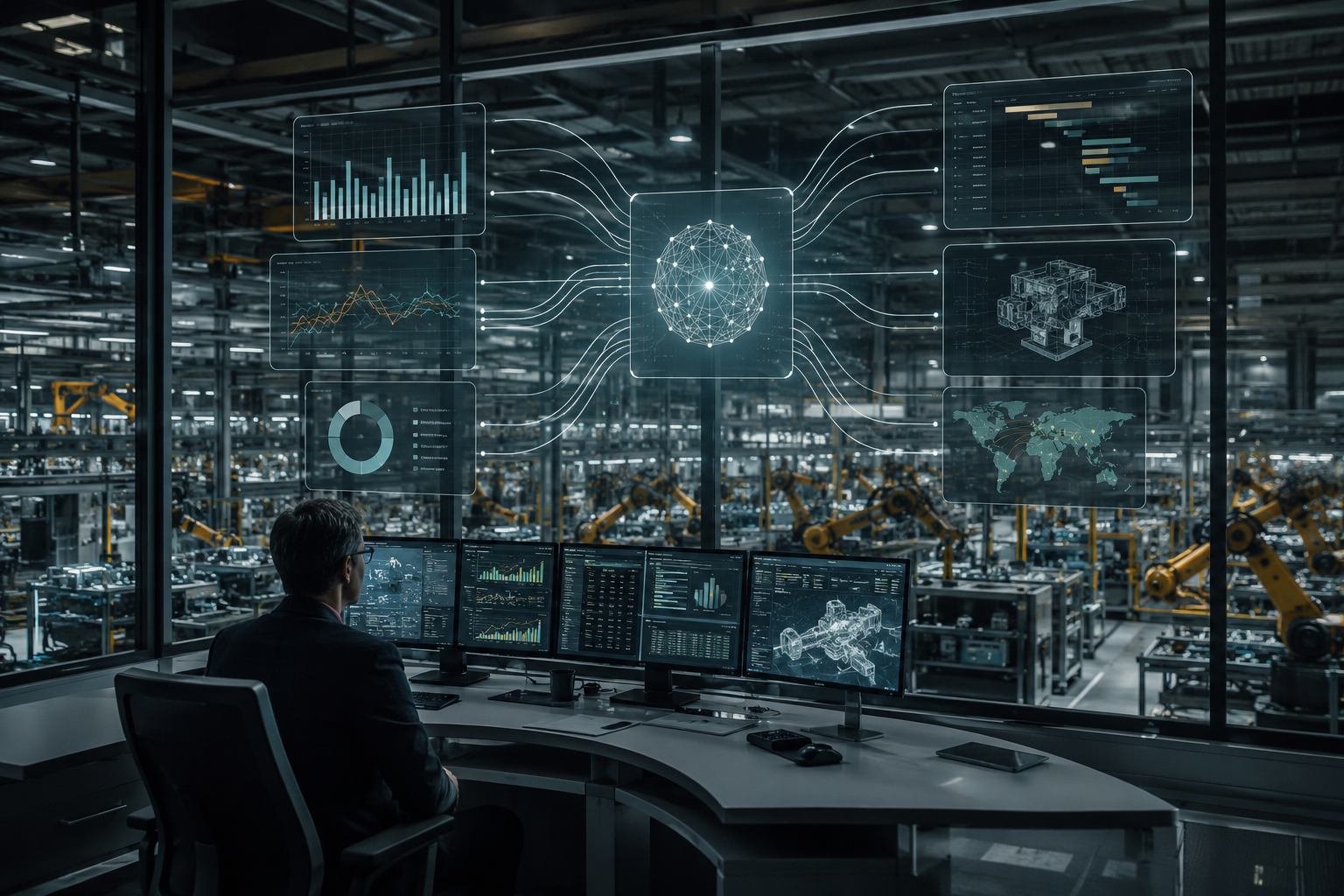
Smart manufacturing gave industrial leaders a powerful idea: the factory should be connected, visible, data-rich, and responsive. Machines should communicate. Systems should integrate. Quality, production, maintenance, planning, and supply chain teams should have better information than they had in the era of isolated equipment and paper-based control.
That idea still matters. But the next stage is not simply more smart manufacturing. It is Industrial Intelligence.
Smart manufacturing connects the factory. Industrial Intelligence helps the manufacturing enterprise decide, act, learn, and adapt. The distinction matters because many organizations have spent years building digital infrastructure without creating a management system that turns signals into better decisions.
Industry 4.0 vs Industrial Intelligence explains the difference between connected digital infrastructure and governed decision capability. This article answers the next executive question: if smart manufacturing is the foundation, what comes after it?
What Comes After Smart Manufacturing?
Industrial Intelligence comes after smart manufacturing. Smart manufacturing connects assets, data, automation, and digital systems. Industrial Intelligence builds on that foundation by adding contextual factory knowledge, AI orchestration, governed decision loops, organizational memory, and adaptive operating systems that improve manufacturing decisions over time.
Smart Manufacturing Was the Necessary Foundation
Smart manufacturing changed the conversation in useful ways.
It pushed manufacturers toward:
- Connected machines and industrial IoT
- Real-time production visibility
- Digital work instructions and traceability
- MES, ERP, QMS, CMMS, and PLM integration
- Robotics and automation
- Digital twins and simulation
- Data platforms and analytics
- Predictive maintenance
- Quality monitoring
- Connected supply chain signals
These capabilities are not obsolete. They are the infrastructure for what comes next. The WEF Global Lighthouse Network is a useful authority reference because it highlights manufacturers using advanced technologies to improve performance at scale. The lesson is not that every manufacturer should copy a lighthouse factory. The lesson is that technology matters most when it changes operating outcomes, management routines, and organizational capability.
The Limit of Smart Manufacturing
Smart manufacturing often reaches a ceiling when the enterprise confuses visibility with intelligence. A plant can have connected assets and still struggle with late decisions. It can have dashboards and still debate which number is true. It can have predictive models and still lack accountable workflows. It can have traceability and still fail to reuse lessons across programs. It can have automation and still treat recurring issues as new surprises. The limitation is not the technology. The limitation is the operating model around the technology.
Smart manufacturing answers:
- Can we connect the factory?
- Can we see what is happening?
- Can we automate parts of the process?
- Can we collect and analyze more data?
Industrial Intelligence asks:
- Which decisions should be improved?
- What context is needed?
- Who owns the action?
- What evidence supports the recommendation?
- How will outcomes be measured?
- How will the organization learn?
The Next Stage Is Decision-Centered
The next stage after smart manufacturing is decision-centered manufacturing.
That means digital investments are organized around the decisions they improve:
- Quality containment and recurrence prevention
- Production schedule recovery
- Maintenance timing and asset risk
- Supplier disruption response
- Inventory and service tradeoffs
- Engineering change readiness
- Control plan updates
- Management review priorities
This is where Why Industry 4.0 Needs an AI Orchestration Layer becomes important. Connected systems need orchestration so signals, context, models, rules, workflows, and decision owners can work together.
 Roadmap to industrial intelligence
The Roadmap From Smart Manufacturing to Industrial Intelligence
Manufacturers can think of the transition as a seven-stage roadmap.
Stage 1: Smart Manufacturing Foundation
The organization connects machines, systems, sensors, transactions, and work processes. This creates visibility and traceability. The risk is stopping here and treating connectivity as the final goal.
Stage 2: Integrated Systems
ERP, MES, QMS, CMMS, PLM, supplier systems, historians, and analytics environments begin to exchange data. The risk is building integration without shared decision logic.
Stage 3: Contextualized Factory Knowledge
Data becomes useful when it is connected to products, processes, assets, materials, suppliers, customers, requirements, and operating contexts. The Difference Between Factory Data and Factory Knowledge is the key bridge here. Data tells the organization what was recorded. Knowledge explains what it means.
Stage 4: AI Orchestration
AI, analytics, rules, optimization, and workflows begin to coordinate decisions across functions. The goal is not to be autonomous in everything. The goal is coordinated decision support with clear accountability.
Stage 5: Governed Decision Loops
The enterprise defines decision owners, approval rules, evidence requirements, override logic, escalation paths, and outcome measures. This is where Industrial Intelligence becomes a management system rather than a software layer.
Stage 6: Organizational Memory
Lessons from CAPA, maintenance, supplier issues, schedule disruptions, audits, and engineering changes become reusable knowledge. How Industrial Intelligence Creates Organizational Memory explains this step in detail. The intelligent factory should remember what it learned.
Stage 7: Adaptive Industrial System
The final stage is an operating system that improves through use. The factory senses change, contextualizes signals, recommends action, supports accountable decisions, validates outcomes, and updates its knowledge base.
That is Industrial Intelligence.
What Changes for Executives
After smart manufacturing, executives should stop asking only whether the factory is more connected.
They should ask:
- Which decisions are improving?
- Which problems recur less often?
- Which lessons transfer across plants?
- Which recommendations are trusted and why?
- Which workflows close faster?
- Which data gaps block decisions?
- Which governance risks remain?
- Which digital investments have become reusable Industrial Intelligence assets?
That last question foreshadows a later article in this cluster: How Industry 4.0 Investments Become Industrial Intelligence Assets.
What Changes for Quality
Smart manufacturing can detect defects faster and improve traceability. Industrial Intelligence should prevent more defects from recurring. It connects inspection results, process parameters, material lots, operator qualification, machine state, control plans, customer requirements, CAPA history, and corrective action effectiveness.
The result should be better containment, stronger root cause analysis, faster recurrence prevention, and more reusable quality knowledge. This is why Fail Fast Is Not a Quality Strategy belongs in the conversation. The goal is not a faster reaction. The goal is better prevention and learning.
What Changes for Operations
Smart manufacturing can show operations leaders what is happening. Industrial Intelligence should help them decide what to do next.
For example, an intelligent operating system can connect asset risk, schedule priority, quality risk, labor availability, spare parts, supplier status, and customer impact. It can help teams evaluate alternatives rather than respond to each signal in isolation. The value is not the dashboard. The value is coordinated action.
What Changes for Data Teams
After smart manufacturing, data teams should not be measured only by pipelines, platforms, and models. They should be measured by whether data products improve industrial decisions.
Useful questions include:
- What decision does this data product support?
- What context is required for that decision?
- Who owns the workflow?
- How will the recommendation be validated?
- How will the outcome improve the next decision?
This is the shift from data engineering to Industrial Intelligence engineering.
What Changes for Continuous Improvement
Smart manufacturing gives continuous improvement teams better evidence. Industrial Intelligence gives them a more adaptive operating system. Lean, Six Sigma, CAPA, RCA, SPC, auditing, and daily management do not disappear. They become more connected to real-time evidence, predictive signals, and organizational learning. How Industrial Intelligence Extends Operational Excellence describes this shift: improvement becomes less episodic and more adaptive.
What Leaders Should Build Next
Manufacturing leaders should build five capabilities after smart manufacturing:
- A decision inventory that defines the operational decisions that digital systems must improve.
- A context model that connects data to products, processes, assets, materials, suppliers, requirements, and customers.
- AI orchestration that coordinates signals, models, rules, workflows, and owners.
- Governance that defines decision rights, evidence, escalation, overrides, and accountability.
- Organizational memory that preserves outcomes and reuses lessons.
These five capabilities are the bridge from smart manufacturing to Industrial Intelligence.
The Executive Test
The executive test is simple:
If your smart manufacturing program disappeared tomorrow, which decisions would become worse? If the answer is unclear, the program may still be a visibility initiative. If the answer names specific quality, maintenance, scheduling, supplier, engineering, and management decisions, the program is becoming Industrial Intelligence.
FAQ
What comes after smart manufacturing?
Industrial Intelligence comes after smart manufacturing. It builds on connected assets and smart factory data by adding decision architecture, AI orchestration, factory knowledge, governance, organizational memory, and adaptive operations.
Is smart manufacturing the same as Industrial Intelligence?
No. Smart manufacturing focuses on connected, data-enabled production systems. Industrial Intelligence focuses on using those systems to improve decisions, workflows, learning, and enterprise performance.
Why is smart manufacturing not enough?
Smart manufacturing is not enough when it creates visibility without coordinated decisions. Manufacturers need context, owners, workflows, governance, outcome measurement, and learning loops.
What is the next stage after Industry 4.0?
The next stage after Industry 4.0 is a shift from connected digital infrastructure to Industrial Intelligence: governed decision systems that can sense, contextualize, decide, act, and learn.
How should manufacturers begin the transition?
Manufacturers should begin by identifying the decisions that matter most, mapping the context those decisions require, assigning owners, defining workflows, measuring outcomes, and preserving lessons for reuse.