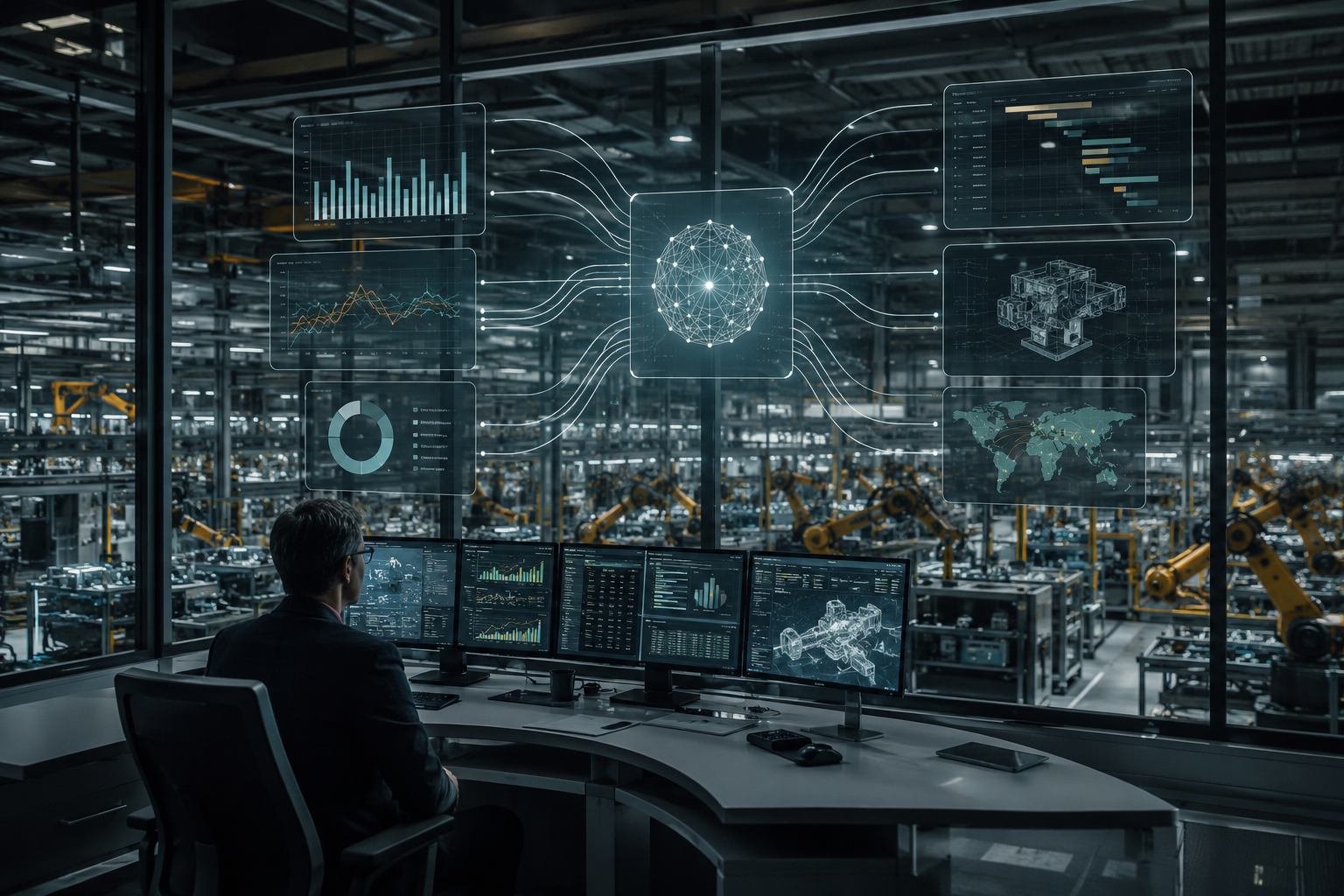
Industry 4.0 connected the factory. It gave manufacturers sensors, industrial IoT, smart machines, digital threads, digital twins, MES integrations, cloud platforms, edge analytics, and more visible operations. But connection is not coordination.
A connected factory can still have disconnected decisions. Quality may see one signal. Maintenance may see another. Planning may work from a different version of reality. Finance may review lagging results. Supervisors may still resolve exceptions through meetings, messages, and spreadsheets. The systems are connected, but the decisions are not orchestrated.
That is why Industry 4.0 needs an AI orchestration layer. An AI orchestration layer does not replace MES, ERP, QMS, CMMS, PLM, automation, or human judgment. It coordinates signals, context, models, decision rules, workflows, owners, governance, and learning across the manufacturing enterprise. It turns connected systems into an intelligent operating capability.
Industry 4.0 vs Industrial Intelligence explains that Industry 4.0 is the digital foundation, while Industrial Intelligence is the governed ability to sense, contextualize, decide, act, and learn. This article explains the missing layer between those two states.
Why Does Industry 4.0 Need an AI Orchestration Layer?
Industry 4.0 needs an AI orchestration layer because connected assets and smart factory data do not automatically create coordinated decisions. An AI orchestration layer connects industrial data, context, models, workflows, decision owners, governance rules, and learning loops, enabling manufacturers to act across quality, production, maintenance, planning, supplier, and management systems.
The Industry 4.0 Integration Problem
Many manufacturers have built a powerful yet fragmented digital landscape.
They may have:
- Machine data in historians
- Production transactions in MES
- Orders and inventory in ERP
- Nonconformances and CAPAs in QMS
- Asset records in CMMS
- Requirements and designs in PLM
- Supplier records in procurement systems
- Dashboards in business intelligence tools
- Models in data science environments
- Workarounds in spreadsheets
Each system has value. But the manufacturing problem rarely stays within a single system. A late shipment may involve supplier risk, inventory policy, production schedule, quality hold, maintenance downtime, labor availability, customer priority, and cash impact. A quality issue may involve process drift, material lot, tooling condition, inspection method, operator training, control plan, and prior CAPA history. Industry 4.0 connects more signals. AI orchestration connects the decisions that those signals should inform.
Interoperability Is Necessary, But Not Sufficient
Industrial interoperability matters. Standards and technologies such as OPC UA help smart manufacturing systems exchange information across machines, devices, and software layers. Without interoperability, orchestration cannot scale. But interoperability is not the same as decision intelligence.
Interoperability helps systems communicate. AI orchestration helps the enterprise decide what the communication means, who should act, which workflow should launch, what evidence is required, and how the outcome should be learned from. Manufacturers need both. The first enables connected Industry 4.0. The second makes Industrial Intelligence possible.
 AI orchestration for industrial systems
What an AI Orchestration Layer Does
An AI orchestration layer coordinates five things.
1. Signals
It listens across production, quality, maintenance, planning, supplier, and engineering systems.
This does not mean dumping every signal into one lake. It means identifying the signals that matter for priority decisions.
2. Context
It connects signals to products, processes, assets, materials, suppliers, orders, customers, requirements, control plans, and operating states.
This is the difference between factory data and factory knowledge, the theme of The Difference Between Factory Data and Factory Knowledge.
3. Models and Rules
It coordinates predictive models, optimization models, business rules, quality rules, maintenance thresholds, planning constraints, and governance requirements.
AI alone is not enough. Industrial decisions often require rules, constraints, judgment, and evidence.
4. Workflows and Owners
It routes decisions to the people or systems responsible for action.
If a model predicts downtime but no work order, schedule adjustment, spare parts check, or owner assignment follows, then the prediction is not operational intelligence. It is an observation.
5. Learning
It captures outcomes and improves future recommendations.
Did the action work? Was the recommendation accepted? Why was it overridden? Did the issue recur? Should the decision rule change? This is how AI orchestration contributes to organizational memory.
AI Orchestration Is Not a Bigger Dashboard
A common mistake is to imagine AI orchestration as a grand dashboard above all other dashboards. That is not enough. A dashboard presents information. Orchestration coordinates action.
A dashboard may show that a machine is trending toward failure. Orchestration asks:
- Is this asset on a critical path?
- What orders are at risk?
- Are spare parts available?
- Can maintenance act during a planned changeover?
- Does the schedule need to change?
- Who approves the tradeoff?
- What evidence should be kept?
- What outcome should be measured?
That is manufacturing decision orchestration.
Use Case: Quality Orchestration
In a connected Industry 4.0 environment, inspection data, process parameters, machine data, and nonconformance records may all be visible.
In an AI-orchestrated environment, those signals are connected to a decision loop:
- Detect abnormal variation.
- Connect it to product, operation, machine, material, tool, and control plan.
- Compare the pattern to prior defects and CAPAs.
- Estimate escape risk and production impact.
- Recommend containment, inspection, adjustment, or process correction.
- Route the action to the accountable owner.
- Track outcome and recurrence.
The value is not just better detection. It is a better coordinated response.
Use Case: Maintenance and Schedule Orchestration
Predictive maintenance is often treated as an isolated AI use case. But maintenance risk is also a scheduling problem, an inventory problem, a labor problem, a customer delivery problem, and sometimes a quality problem.
An orchestration layer connects asset risk to:
- Production schedule
- Customer priority
- Spare-parts availability
- Maintenance labor capacity
- Changeover windows
- Safety and compliance constraints
- Historical failure modes
- Financial impact
This lets the enterprise decide whether to run, inspect, repair, reschedule, reroute, or escalate.
Use Case: Supplier and Production Orchestration
Supplier disruption rarely belongs only to procurement. It affects production planning, inventory, quality, logistics, customer commitments, cash, and sometimes engineering. An AI orchestration layer can connect supplier risk signals to inventory position, open orders, alternate suppliers, receiving inspection history, production constraints, and customer priority. The point is not to automate every decision. The point is to give decision owners a coherent picture and an accountable workflow.
The Governance Layer
Industry 4.0 programs often underestimate governance because their early work is focused on connectivity and visibility. AI orchestration cannot do that.
It needs governance for:
- Decision rights
- Recommendation approval
- Override reasons
- Model monitoring
- Evidence traceability
- Data ownership
- Safety and quality boundaries
- Auditability
- Human accountability
This is why Industrial Intelligence is a management system, not a software category. The technology layer can suggest, prioritize, and route. The management system decides how authority, evidence, and accountability work.
A Practical Architecture for Manufacturers
Manufacturers can think of the AI orchestration layer as a middle layer between digital infrastructure and operating routines. At the bottom are Industry 4.0 assets: sensors, automation, MES, ERP, QMS, CMMS, PLM, supplier systems, historians, and data platforms. In the middle is the orchestration layer: context model, AI models, optimization logic, decision rules, workflow routing, governance, and learning memory.
At the top are industrial decisions: quality, scheduling, maintenance, supplier, engineering, operational excellence, and management review. The architecture is useful only if it changes decisions. That is the executive test: can the orchestration layer help the organization make better decisions faster, with clearer accountability and stronger learning?
What Leaders Should Do First
Leaders should not start by buying an “orchestration platform.”
They should start with five questions:
- Which decisions are most fragmented today?
- Which systems hold the signals and context for those decisions?
- Which owners need to act when those signals appear?
- Which rules, constraints, and governance requirements must shape the action?
- How will outcomes be captured so the next decision improves?
This keeps the work grounded in operations rather than architecture theater. The prior article Industrial Intelligence Metrics for Executives is useful here because orchestration should be measured by value realization, decision quality, adoption, learning velocity, and governance, not by the number of connected systems.
FAQ
What is an AI orchestration layer in Industry 4.0?
An AI orchestration layer coordinates industrial data, context, AI models, business rules, workflows, decision owners, governance, and learning across connected manufacturing systems. It helps turn smart factory signals into coordinated decisions and actions.
Why is an AI orchestration layer needed?
Industry 4.0 connects machines and systems, but connected data does not automatically create coordinated decisions. An orchestration layer helps manufacturers connect signals to context, owners, workflows, evidence, and outcomes.
Is AI orchestration the same as system integration?
No. System integration helps technologies exchange data. AI orchestration uses integrated data, context, models, rules, and workflows to coordinate decisions and actions across the enterprise.
What systems does AI orchestration connect?
It may connect MES, ERP, QMS, CMMS, PLM, historians, supplier systems, production equipment, analytics models, human workflows, and management review routines.
Should manufacturers automate every decision?
No. Many industrial decisions require human accountability, especially when quality, safety, compliance, customer impact, or major financial tradeoffs are involved. Orchestration should clarify when AI recommends, when humans approve, and when automation is appropriate.