
In the drive toward Industry 4.0, digital twins have emerged as a powerful technology for enhancing manufacturing operations. Yet, not every manufacturing environment or scenario benefits from building a digital twin. This article addresses the technical and operational nuances that manufacturing leaders should consider before committing to digital twin development. We provide a clear definition, explain its mechanism, clarify distinctions from related concepts, and present a realistic industrial example. Finally, we offer guidance on implementation, human oversight, limitations, and link the discussion to broader Industrial Intelligence themes.
Defining the Manufacturing Digital Twin
A manufacturing digital twin is a dynamic, digital replica of physical manufacturing assets, processes, or systems that mirrors real-time status and behavior using data from sensors, simulations, and historical records. Unlike static models or traditional simulations, a digital twin continuously updates and learns, enabling operators to analyze, predict, and optimize manufacturing outcomes in a virtual environment before taking action on the physical system.
Key Mechanisms
The digital twin integrates multiple elements:
- Data Acquisition: Ingesting real-time data from machines, IoT devices, and enterprise systems.
- Modeling & Simulation: Creating physics-based or data-driven models that replicate behavior and responses.
- Analytics & Decision Support: Employing AI and machine learning to detect patterns, predict failures, or optimize parameters.
- Synchronization: Maintaining continuous, bi-directional updates between the physical asset and the digital representation.
These mechanisms create a feedback loop where the digital twin can test scenarios or adjustments virtually and feed insights or control directives back to the manufacturing floor.
Distinguishing the Digital Twin from Adjacent Concepts
Manufacturers commonly confuse digital twins with other digital tools:
- Digital Models: Static or one-off representations mainly for design or training without dynamic updates.
- Digital Shadow: A one-way data flow where the physical asset’s changes are reflected digitally, but not vice versa.
- Simulations: Event-based scenario testing is often offline, not continually synchronized with live data.
The defining factor is the twins’ continuous synchronization and interaction, enabling actionable intelligence in near real time.
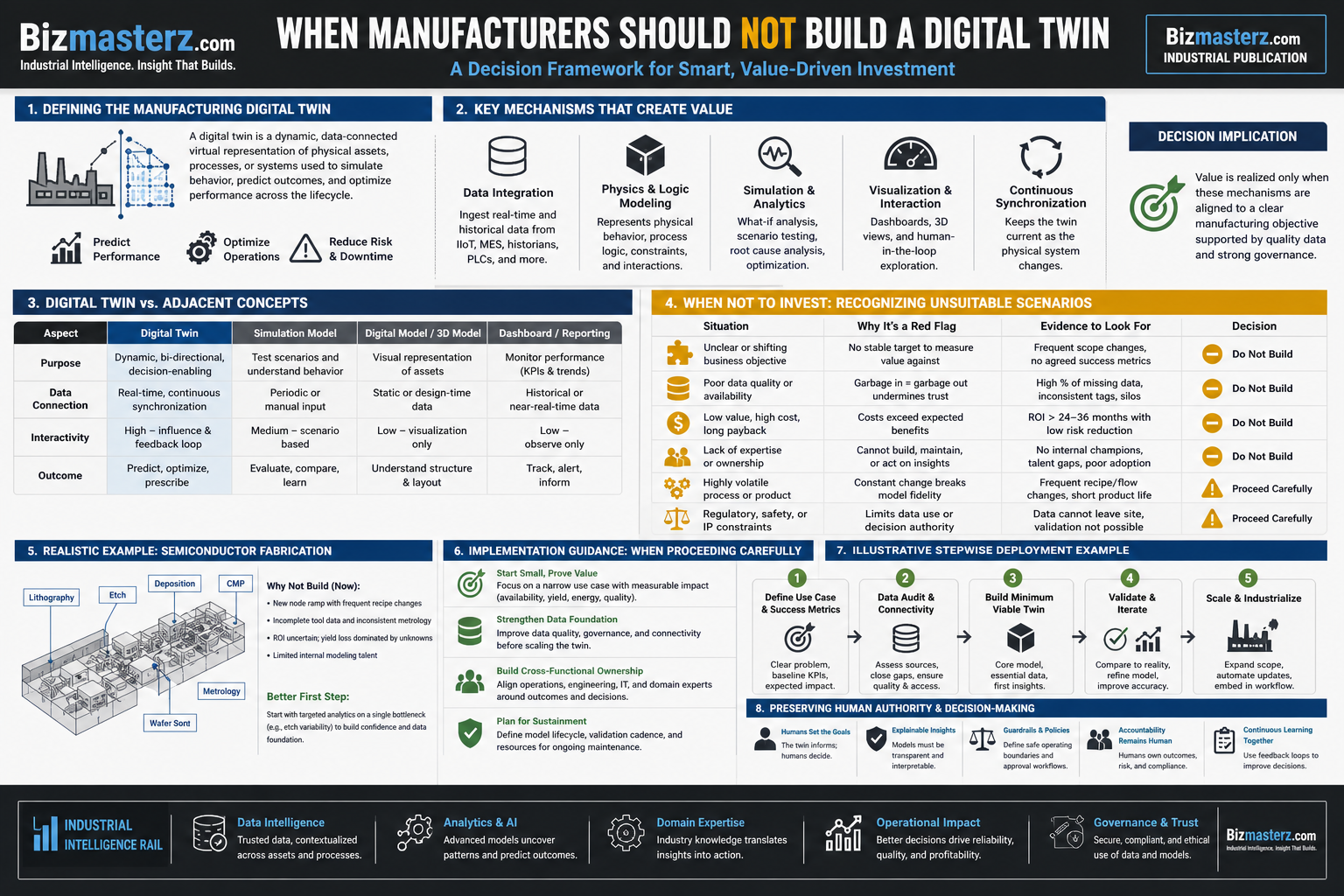 Explains When Manufacturers Should Not Build a Digital Twin.
When Not to Invest: Recognizing Unsuitable Scenarios
Despite its potential, there are operational contexts where building a digital twin may be redundant, risky, or cost-ineffective. Examples include:
- Stable, Simple Processes: Manufacturing lines with low variability and predictable performance where gains from complex, adaptive models are minimal.
- Insufficient Data Infrastructure: Where sensorization, data integrity, or IT systems lag and cannot support continuous data streams required for synchronization.
- High Complexity with Sparse Observability: Processes where many variables are unmeasurable or too stochastic, limiting model accuracy and trustworthiness.
- Regulatory or Security Restrictions: Industries where digital replication may expose sensitive or proprietary information, increasing cybersecurity risks.
- Misaligned Business Objectives: When the organization seeks short-term solutions and lacks long-term commitment to digital transformation.
In these cases, alternative incremental digital improvements or pilot efforts may offer more pragmatic benefits.
Realistic Manufacturing Example: Semiconductor Fabrication
Consider a semiconductor fabrication plant, which involves complex processes like photolithography, etching, and deposition. While a digital twin could theoretically model entire wafer fabrication for yield optimization, practical challenges arise: equipment variability, uncontrollable particle contamination, and incomplete sensor coverage impede model fidelity.
For such environments, a fully mature digital twin remains aspirational or limited to specific subprocesses (e.g., tool condition monitoring). Pushing for a plant-wide twin without high-resolution data sources and robust integration could yield misleading insights, operational risk, and high cost.
Implementation Guidance: When Proceeding Carefully
For manufacturers deciding to build a digital twin, especially in constrained environments, the following guidance is critical:
- Scope Definition: Focus on discrete assets, subprocesses, or stages where sufficient data exists and measurable benefits are clear.
- Data Maturity Assessment: Gauge sensor quality, completeness, and latency to assess the feasibility of real-time synchronization.
- Modular Design: Create incremental digital twins that can be integrated progressively rather than full-system replicas from inception.
- Stakeholder Collaboration: Engage operators, engineers, IT, and management to balance expectations and technical feasibility.
- Validation & Calibration: Continuously verify twin predictions versus physical outcomes to maintain trust and utility.
Illustrative Stepwise Deployment Example
Imagine a mid-sized automotive parts manufacturer considering a digital twin for their stamping press line. Instead of replicating the entire plant, they begin with a focused twin of a critical hydraulic press:
- Sensor Installation: Attach vibration, temperature, and pressure sensors to capture real-time performance data.
- Data Integration: Establish a reliable IoT infrastructure to stream data to a cloud-based analytics platform.
- Model Development: Collaborate with process engineers to build a physics-informed model simulating press dynamics.
- Predictive Analytics: Use historical failure data and sensor data to forecast maintenance needs.
- Operator Interface: Develop a user-friendly dashboard that delivers actionable insights while preserving operator control over decision-making.
- Scale-up Plan: After demonstrating measurable downtime reduction, plan a gradual extension across other machines.
This approach balances investment risk, maximizes learning, and integrates human expertise at every step.
Preserving Human Authority and Decision-Making
Manufacturing digital twins offer decision support but do not replace human judgment. Human expertise remains paramount in:
- Interpreting twin outputs and identifying when model behavior deviates from reality.
- Overriding automated recommendations based on contextual knowledge, safety considerations, or external factors.
- Dealing with anomalies or black swan events not captured by the twin’s underlying logic.
Integrating digital twins as augmentative tools rather than autonomous controllers preserves accountability and aligns with operational realities.
Addressing Limitations of Manufacturing Digital Twins
Recognizing inherent limitations strengthens strategic decisions:
- Modeling Complexity: Accurately replicating physical phenomena requires deep domain knowledge and advanced modeling expertise.
- Data Quality Dependency: Poor sensor data degrades twin accuracy and leads to questionable recommendations.
- Infrastructure Costs: High initial investment in sensors, networking, and computational resources can be prohibitive.
- Diminishing Returns: For mature, steady-state processes, incremental improvements may not justify twin complexity.
- Security Risks: Cyber threats can exploit digital twins connected to critical manufacturing control systems.
Balancing these limitations against potential gains helps avoid costly missteps and defines realistic objectives.
Clear Boundaries with Adjacent Concepts
Understanding what a digital twin is not helps manufacturers allocate resources wisely. Some related but distinct concepts include:
- Digital Thread: A communication framework that connects data flows and lifecycle stages across the product and manufacturing value chain, but isn’t a real-time mirrored simulation.
- Enterprise Resource Planning (ERP) Systems: Manage business-level functions rather than real-time manufacturing state.
- Manufacturing Execution Systems (MES): Handle production scheduling and execution but usually don’t simulate or predict system behavior dynamically.
A digital twin relies on integration with these systems but cannot substitute their fundamental roles.
Industrial Intelligence Connection: Digital Twins as a Foundational Element
Digital twins form a cornerstone of Industrial Intelligence, a framework in which manufacturing data, advanced analytics, and human expertise converge to holistically optimize operations. When built and applied appropriately, digital twins enable:
- Real-time visibility into complex system states across the factory floor.
- Predictive maintenance scheduling to reduce downtime.
- Process optimization through scenario testing and “what-if” analyses.
- Integration with enterprise systems for end-to-end supply chain intelligence.
As framed in the NIST Manufacturing Digital Twin Standards and the standardized framework, the digital twin is not an isolated artifact but an evolving component within a broader digital manufacturing transformation. Leaders must decide pragmatically when to employ this technology within their Industrial Intelligence journey and when alternative solutions or stepwise approaches better serve their operational goals.
Frequently Asked Questions
What are the primary data requirements for a manufacturing digital twin?
A robust digital twin requires continuous, high-quality, real-time data from sensors embedded in physical assets, complemented by historical data and contextual information from enterprise systems. The data must be reliable, timely, and comprehensive enough to accurately represent relevant system behaviors. Without this, the twin may produce misleading insights.
How do digital twins differ from traditional simulations in manufacturing?
Traditional simulations are generally static or run offline for specific scenarios with fixed parameters, whereas digital twins provide a continuously updated, real-time virtual replica of physical systems. Digital twins maintain bi-directional synchronization, enabling dynamic scenario testing and operational decision support within live manufacturing environments.
Can a digital twin replace human operators on the factory floor?
No, digital twins serve as decision-support tools augmenting human expertise. Operators and engineers retain full responsibility for interpreting the twin’s data, making contextualized judgments, and managing unforeseen events that the twin cannot anticipate or simulate effectively.
When is it more appropriate to avoid building a digital twin?
If manufacturing processes are stable and simple, sensor infrastructure is inadequate, processes are too complex without sufficient observability, or cybersecurity risks outweigh benefits, investing in a digital twin is likely not justified. Organizations with a short-term focus or weak digital maturity may also derive better value from incremental digital improvements.
What steps can improve trust in digital twin outputs?
Regular validation and calibration against actual physical outcomes are essential. Engaging cross-disciplinary teams—including process engineers, data scientists, and operators—to review twin predictions helps identify discrepancies early and refine models continually to maintain reliability and trustworthiness.


