

How Can AI Help Prepare an ISO 9001 Internal Audit?
For manufacturing leaders, an ISO 9001 internal audit requires a competent auditor to examine processes, records, and other evidence against defined audit criteria. Preparation therefore begins with a practical management problem: locating the current, approved information that the auditor may need without treating document retrieval as proof of conformity.
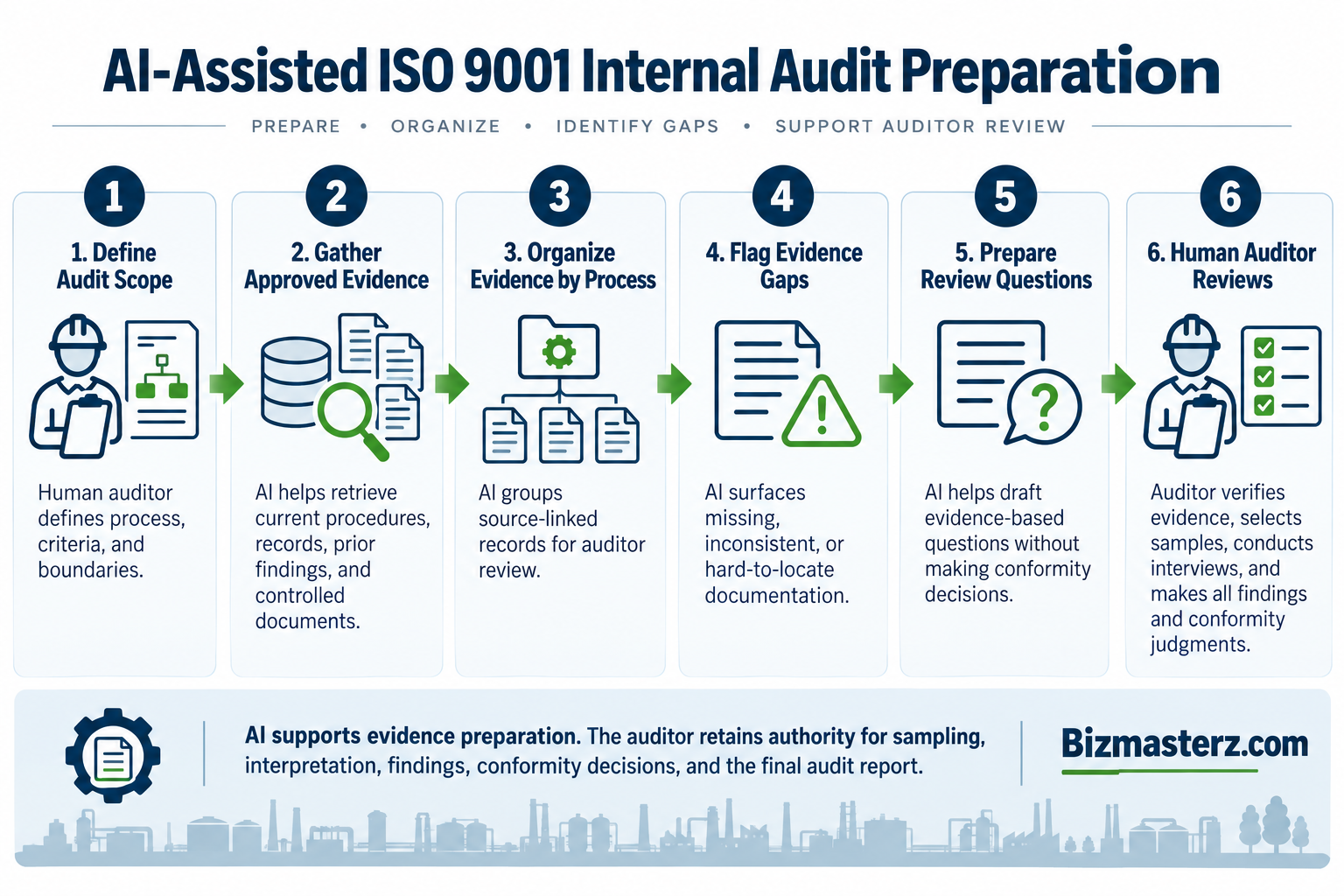
The evidence may be distributed across a quality management system, ERP or maintenance applications, controlled file repositories, paper records, and individual departments. Artificial Intelligence (AI) can support preparation by locating candidate records, organizing their source details, and surfacing missing or inconsistent documentation for human review.
This article provides manufacturing leaders and audit professionals with a detailed roadmap on how AI can assist in the preparation phase of an ISO 9001 internal audit—exactly what AI can and cannot do, boundaries with human auditor authority, how it fits within quality management workflows, and a realistic manufacturing example to ground the discussion. We also discuss practical implementation guidance, AI’s limitations, governance considerations, and a Frequently Asked Questions section to clarify common concerns.
Understanding ISO 9001 Internal Audit Preparation and AI’s Assistive Role
ISO 9001 internal audits verify that an organization’s quality management system:
- Conforms to the ISO 9001:2015 standard requirements.
- Is effectively implemented and maintained.
- Supports continual improvement through objective evaluation.
The internal audit preparation phase includes several key human-led activities:
- Defining the audit scope—what processes, sites, or functions will be audited.
- Selecting audit criteria—the relevant parts of ISO 9001 and internal procedures.
- Reviewing previous audit findings, corrective actions, and change logs.
- Identifying the documented information (policies, procedures, work instructions) relevant to the audit scope.
- Determining available objective evidence—records, reports, calibration certificates, logs, etc.
- Planning interviews, observations, and sampling strategy.
AI’s assistive role is limited to organizing and assembling preparatory materials from approved sources. This can include:
- Indexing and categorizing controlled documents and records.
- Flagging recent changes to processes, documents, or equipment.
- Aggregating prior audit findings relevant to the scope.
- Identifying potential evidence locations and gaps in documentation.
Importantly, AI does not replace the auditor’s professional judgment or authority and does not make conformity decisions, sampling choices, or findings. The auditor must actively prepare by confirming, supplementing, and interpreting AI outputs before and during audit execution.
This boundary is consistent with the ISO 9001 Auditing Practices Group Guidance on Evidence Collection, which emphasizes that competent auditors prepare by knowing what evidence to seek rather than expecting it to be “served on a plate.” The guidance is informative and non-normative. AI can help present candidate source material, but the auditor still decides what to seek and how to evaluate it.
Key Mechanisms by Which AI Supports Audit Preparation
Within the preparation-only boundary, several technical capabilities can support a traceable evidence packet:
- Document indexing and classification: AI can scan quality manuals, procedures, process flows, records, and policies, then associate them with an auditor-approved process and criteria map. It must not create an authoritative interpretation of ISO 9001.
- Change detection and audit history integration: By analyzing document versioning, change management logs, and prior audit data, AI highlights areas where processes or documentation underwent recent changes or had prior findings.
- Candidate evidence mapping: AI can attach auditor-defined criteria references to candidate records in repositories such as ERP, CMMS, and inspection systems while preserving the source location for verification.
- Gap analysis and assumption documentation: AI generates checklists that indicate missing documents, incomplete records, unclear ownership, or inconsistencies that humans must address before audit execution.
The outcome is a pre-audit evidence packet which includes an organized scope, lists of relevant documents and process owners, prior findings summaries, identified candidate evidence, and explicit listings of assumptions and gaps.
This packet serves preparatory purposes only. It is not in itself audit evidence nor an indicator of conformity. The auditor must examine and verify the content, decide evidence sufficiency, and maintain full control of on-site audit decisions.
Differentiating AI Preparation from Adjacent Audit Functions
To prevent misunderstandings and policy breaches, it is critical to distinguish AI use in audit preparation from other audit-related AI applications, which differ significantly in scope and responsibility:
- AI in evidence evaluation (outside scope): This workflow does not authorize AI to judge evidence sufficiency, conduct the auditor’s risk assessment, or determine conformity.
- AI in findings or conclusion drafting (outside scope): The preparation packet does not generate nonconformities or audit conclusions. Those decisions remain with the competent auditor.
- AI in continual improvement or management review: AI may assist quality improvement workflows or data visualization, but governance boundaries differ as decisions often implicate management roles rather than audit authority.
The overarching principle is clear: AI organizes information in support of human decision-making. Final evidence selection, interpretation, sampling, and audit judgments remain with the human auditor in control of the process.
Practical Manufacturing Example: Preparing an Internal Audit for a Machining Cell
Consider a mid-sized manufacturer preparing an ISO 9001 internal audit focused on a machining cell producing precision components.
The audit scope includes process control, equipment calibration, tool wear monitoring, employee training documentation, and maintenance schedules—corresponding to several ISO 9001 clauses on operational control, monitoring and measurement, and competence.
The AI system assists by:
- Indexing and linking relevant controlled documents such as tooling procedures, calibration certificates for coordinate measuring machines (CMM), maintenance logs, and staff training records.
- Highlighting recent process changes—e.g., a newly implemented tool monitoring system or updated maintenance schedule introduced since the last audit.
- Identifying missing calibration certificates for a critical measuring device flagged in prior audit nonconformances.
- Aggregating prior audit findings related to machining quality or equipment maintenance for auditor review.
The audit lead receives a draft pre-audit packet containing source-linked documents, unresolved evidence gaps, named record owners, and candidate questions. The auditor decides which records to request, which people to interview, and where additional attention is warranted.
During the audit, the auditor retains authority to adjust scope dynamically, validate AI-identified items, gather complementary evidence in the field, and ultimately formulate findings and recommendations.
Implementation Guidance: Integrating AI Into ISO 9001 Audit Preparation Workflows
Manufacturing organizations should consider the following best practices when integrating AI to augment ISO 9001 internal audit preparation:
- Clearly define audit scope and criteria before AI use: Auditors or quality managers must articulate audit boundaries and relevant clauses to focus AI scanning and evidence assembly effectively.
- Connect only approved data sources: Limit retrieval to governed QMS repositories, ERP systems, CMMS records, digital logs, and audit history sources whose ownership and access rules are known.
- Audit team training on AI outputs and limitations: Ensure auditors understand AI-generated packets are drafts needing human validation, not final evidence or decisions.
- Establish clear human-AI handoff and governance protocols: Define who approves source access, verifies retrieved records, corrects packet errors, and makes every audit decision.
- Control retrieval changes: Record changes to repositories, prompts, criteria maps, and packet templates so the auditor can understand how the preparation artifact was assembled.
- Use audit guidance within its stated role: Treat the ISO 9001 Auditing Practices Group Guidance on Evidence Collection as informative audit-practice guidance, not as normative ISO 9001 text or authorization for AI judgment.
Human Auditor Authority and Governance Boundaries
Human auditors retain exclusive authority over all activities involving audit execution and outcome determination:
- Defining and adjusting audit scope mid-process.
- Deciding sample sizes and test selection methods.
- Conducting interviews, observations, and field verification.
- Evaluating collected evidence and determining conformity.
- Drafting findings, corrective action requests, and audit reports.
- Approving final audit conclusions and certification maintenance recommendations.
AI’s role is confined to organizing and highlighting potential evidence in the preparation phase—activities such as indexing controlled records, drafting preliminary evidence request lists, mapping process owners, and revealing data gaps or assumptions.
This delineation keeps the preparation artifact separate from the audit decision. AI may organize candidate information; the auditor owns the inquiry, verifies the original records, and reaches the conclusions.
Limitations and Risks of Using AI for ISO 9001 Internal Audit Preparation
Manufacturing leaders should be aware of several inherent limitations when deploying AI to assist audit preparation:
- AI cannot replace human judgment and auditing expertise: AI-generated materials are only as good as the inputs and algorithms; auditors must critically evaluate all AI outputs.
- Data quality and completeness constraints: AI effectiveness depends heavily on up-to-date, accurate, and well-organized QMS document repositories and digital logs.
- Scope limitations: AI focuses on document and record assembly. Dynamic audit activities such as process observation, interviews, and real-time evidence gathering remain human tasks.
- Retrieval errors and omissions: A packet may include an irrelevant record or miss information stored under an unexpected name or location. The auditor must inspect the cited source and investigate material gaps.
- Non-normative guidance: The Auditing Practices Group evidence guidance is informative and does not prescribe an AI method. It cannot be used as an authoritative interpretation of ISO 9001 requirements.
These constraints should be visible in the packet itself. Each item should retain its source, owner, revision or record date, retrieval time, and any unresolved assumption or gap so the auditor can verify the original information.
Embedding AI within an Industrial Intelligence Framework for Quality Management
Integrating AI into ISO 9001 audit preparation fits within a broader concept of Industrial Intelligence, where manufacturing organizations deploy systems for sensing, deciding, acting, and learning across operations and quality workflows.
Within this framework:
- AI acts as an organizing layer, surfacing candidate quality management system records for pre-audit review.
- Governance structures define roles and decision rights, ensuring humans retain control over audit scope, sampling, evidence evaluation, and reporting.
- Corrections made during auditor review can be documented so future packet preparation uses the approved source identity and current record location.
This holistic view reinforces that AI is a tool augmenting human capability rather than replacing the professional expertise central to quality system auditing.
Summary
AI can support ISO 9001 internal-audit preparation by locating approved records, organizing source references, assembling prior findings and changes, and making assumptions or missing documentation visible. The resulting packet is a review artifact, not audit evidence by itself and not a conformity conclusion.
The competent internal auditor maintains authority over scope, sampling, interviews, observation, evidence evaluation, findings, conclusions, and reporting. A useful packet therefore makes every source traceable and every gap explicit rather than presenting AI output as an answer.
Within an Industrial Intelligence management system, the preparation workflow remains subordinate to documented decision rights. When a candidate record later informs an audit finding, the finding-to-objective-evidence chain must still be reviewed and accepted by the auditor.
Frequently Asked Questions
Can AI conduct an ISO 9001 internal audit by itself?
No. In this workflow, AI is limited to preparing a traceable packet of candidate records, source references, assumptions, and gaps. The competent auditor defines the scope, selects samples, conducts interviews and observations, evaluates evidence, determines conformity, writes findings, and approves the audit report.
What audit evidence can AI help organize before an internal audit?
AI can help locate approved procedures, work instructions, process records, prior findings, change records, calibration documentation, training records, and named record owners. Each item should preserve its source location, revision or record date, and ownership so the auditor can verify the original rather than relying on an AI summary.
How should an auditor verify information retrieved by AI?
The auditor should open the cited source, confirm that the record is current and approved, check its identity and relevant date, and compare any summary with the original content. Missing, inconsistent, inaccessible, or ambiguously owned records should remain explicit gaps until a qualified person resolves them.
Can AI decide whether a process conforms to ISO 9001?
No. A retrieved document or generated summary does not establish conformity or nonconformity. AI may organize candidate information against an auditor-approved criteria map, but interpretation, evidence sufficiency, findings, and conclusions remain the responsibility of the competent auditor.
What should an AI-assisted pre-audit evidence packet contain?
The packet should contain the auditor-defined scope, a process and owner map, controlled-document references, prior findings, relevant changes, candidate evidence locations, record identity details, assumptions, unresolved gaps, and draft review questions. It should also identify the repositories searched, packet date, reviewer, and corrections. It must not contain automated findings or claims that the process conforms.


