
Manufacturing leaders face a critical decision before embarking on artificial intelligence (AI) adoption: should the company authorize a no-purchase discovery effort to explore AI opportunities first? This decision occurs well before evaluating specific AI candidates, vendors, or procurement strategies. With limited internal AI expertise and concerns about unclear needs commonly cited as barriers, this early-stage choice shapes how AI will integrate with existing operational workflows.
Rather than rushing into tool purchases, a bounded no-purchase discovery phase offers an evidence-driven approach to clarify business priorities and assess AI’s actual relevance. This article outlines a structured path manufacturing management can follow to initiate responsible AI exploration while preserving full authority over subsequent funding, procurement, and implementation.
Starting AI in Manufacturing Without New Tool Purchases: Management’s Initial Challenge
Manufacturing companies often confront uncertainty about where or how AI can realistically improve operations. Pursuing AI procurement prematurely risks misaligned projects, wasted resources, and frustrated stakeholders. Leaders must decide if investing time and effort in a no-purchase discovery phase—focused purely on knowledge gathering and context setting—is warranted before proceeding to vendor evaluation or workflow redesign. This early decision acts as a strategic filter that balances curiosity and caution, preserving budget discipline while fostering innovation. It is a management prerogative that precedes any AI technology considerations and is critical to long-term success.
Understanding the Need for a No-Purchase AI Discovery Phase
Research from the UK’s Department for Science, Innovation and Technology (DSIT) highlights two predominant inhibitors to AI adoption: absence of an identified business need and insufficient AI skills within organizations. Manufacturing companies frequently encounter these challenges, reflected in unclear AI opportunity contexts and apprehensions around technology complexity. The National Institute of Standards and Technology’s (NIST) AI Risk Management Framework (AI RMF) encourages initial contextual mapping to evaluate whether AI solutions are appropriate or necessary compared to simpler, non-AI alternatives.
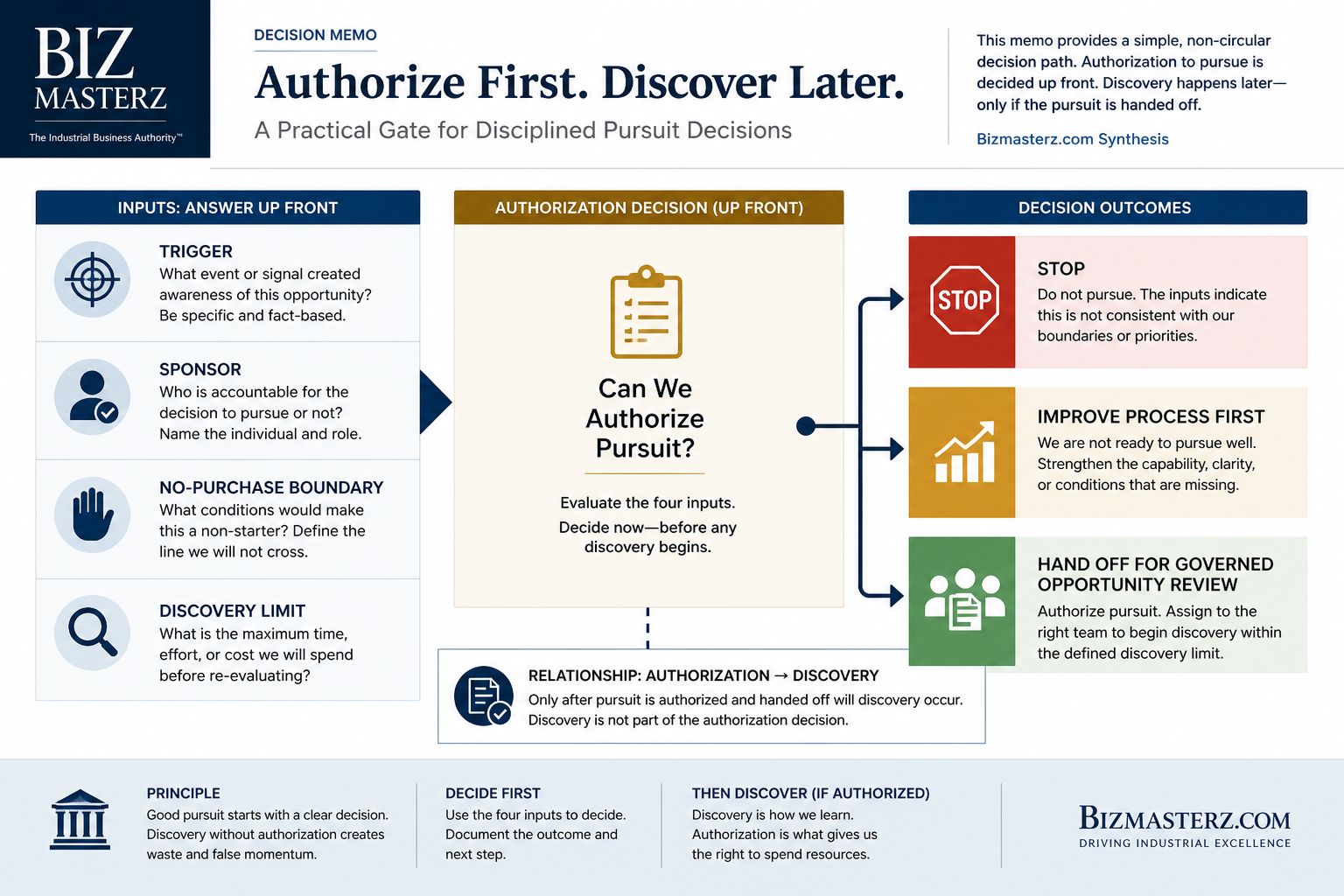
This foundational assessment is essential before selecting new AI tools. Instead of jumping directly to product demonstrations or supplier pitches, establishing whether the potential AI use cases align with strategic goals helps avoid wasted investment and resource distraction. Leaders are tasked with defining clear discovery boundaries and stop conditions, ensuring investigations stay confined to identifying genuine value rather than premature technology procurement.
Setting Boundaries and Sponsorship for the Discovery Effort
Effective no-purchase AI discovery demands explicit leadership sponsorship and governance. A senior leader should be appointed as the project sponsor to ensure alignment with broader business objectives and the authority to engage cross-functional teams. Management must also specify what the no-purchase boundary entails—such as restricting activities to internal process analysis, workflow mapping, and use-case identification without vendor engagement or data sharing outside the company.
Moreover, defining stop conditions—criteria for halting the discovery if insufficient value or readiness emerges—is critical to prevent the initiative from consuming resources indefinitely. Clear metrics or thresholds for progress evaluation help maintain focus and accountability. For example, a stop condition might be failure to identify at least three viable AI use cases supported by operational data or a lack of cross-departmental consensus on priority challenges AI could address.
Conducting Workflow Discovery Without New AI Tools
The discovery phase should begin with detailed workflow and process analyses to identify operational bottlenecks, quality issues, or data patterns that could benefit from intelligent automation or decision support. This approach employs existing systems, human expertise, and manual data evaluation rather than acquiring AI software prematurely.
For instance, a manufacturing firm might map its quality inspection processes, noting recurring error types and points needing human intervention. Teams can then deliberate on whether AI-powered image recognition or anomaly detection might amplify accuracy or throughput. Without purchasing tooling upfront, the focus remains on understanding existing capabilities and the nature of problems rather than jumping to AI product conclusions.
Evaluating AI Use Cases and Business Impact Without Procurement
With workflow insights in hand, management and teams develop and rank AI use cases by feasibility, impact potential, and alignment with strategic priorities. Tools such as multi-criteria decision matrices or scoring frameworks can organize this evaluation transparently. However, it is crucial that no procurement decisions or vendor interactions occur during this phase to maintain the no-purchase commitment.
This use-case prioritization process helps decision-makers understand where AI might add value, identify dependencies on data or infrastructure, and recognize training needs. The goal is a well-documented opportunity brief that objectively describes potential AI applications, associated risks, and unresolved questions—equipping leadership for an informed go/no-go procurement decision.
Balancing AI Opportunities with Process Improvement First
Sometimes, process improvements alone can deliver significant gains without AI investments. The discovery phase should not aim to force AI solutions but rather include non-AI alternatives as potential responses to identified challenges. NIST’s AI RMF specifically recognizes viable risk management options beyond AI capabilities, such as workflow redesign, enhanced training, or advanced statistical methods.
Manufacturing leadership must be open to the possibility that AI may not be the right next step and that continued operational excellence initiatives might yield better returns. This balanced perspective fosters responsible innovation and avoids the common pitfall of technology-driven projects detached from actual business impact.
Maintaining Clear Human Accountability and Authority
Throughout discovery and beyond, human leadership retains full accountability for decisions. AI tools or analyses serve only to inform and enrich management perspectives without substituting executive judgment. The sponsor and designated decision-makers—such as process owners or innovation committees—consolidate discovery findings and determine if an AI opportunity brief warrants further development or procurement.
This organizational clarity ensures ethical oversight and governance. No AI assessment should bypass human approval, especially concerning data use, budget allocation, or technology selection. Clear roles and responsibilities within teams support transparent handoff once discovery is complete.
Practical Manufacturing Example: Quality Control Improvement Discovery
Consider a mid-sized manufacturer facing repeated defects in final product inspection, causing rework delays. Instead of purchasing AI inspection cameras immediately, management initiates a no-purchase discovery charter. A cross-functional team maps current inspection workflows, identifying variation sources and data quality. They explore potential AI use cases such as automated visual defect detection versus improved manual inspection training.
During discovery, they consult existing image data, interview line supervisors, and rank options without involving vendors. Findings highlight that standardizing lighting conditions and operator checklists could first reduce error rates, suggesting process improvements precede AI tool acquisition. Leadership uses this evidence to either extend discovery toward AI evaluation carefully or halt due to insufficient readiness, demonstrating disciplined decision-making with full human accountability.
Implementation Guidance for Authorizing No-Purchase AI Discovery
- Define clear objectives: Specify what discovery aims to achieve, focusing on learning and defining business needs rather than technology selection.
- Appoint a sponsor: Assign a senior leader with authority to guide the discovery effort and ensure alignment with strategic goals.
- Set strict no-purchase rules: Communicate and enforce boundaries forbidding vendor contact or technology trials at this stage.
- Outline stop conditions: Agree on criteria for terminating discovery if value or readiness thresholds are not met.
- Engage multidisciplinary teams: Include operations, IT, quality, and business analysts to capture diverse insights.
- Document findings diligently: Produce detailed but concise reports that highlight potential use cases, data gaps, risks, and alternatives.
- Review and decide: Leadership evaluates results against strategic priorities to choose STOP, PROCESS_IMPROVEMENT_FIRST, or HANDOFF_TO_GOVERNED_OPPORTUNITY_BRIEF.
Limitations and Risks of Skipping a No-Purchase Discovery Phase
Forgoing a bounded no-purchase discovery effort risks rushing into AI procurement without thoroughly understanding business impact or needs. This can lead to acquiring solutions that are poorly suited, underutilized, or incompatible with existing workflows, resulting in wasted budget and morale damage. Inadequate contextual analysis may overlook simpler, less costly process improvements. Additionally, premature vendor engagements can bias internal teams or prematurely commit resources.
Without a disciplined exploratory phase, organizations may lack clear stop conditions or governance, resulting in scope creep and loss of accountability. Skipping this step conflicts with NIST AI RMF guidance to consider risk management alternatives beyond AI. Therefore, leadership should weigh managerial benefits of structured discovery against pressures for fast technological adoption.
Next Steps: From Discovery to AI Opportunity Brief and Decision
If the no-purchase discovery identifies promising AI use cases aligned with strategic objectives, leadership can then authorize the development of a governed opportunity brief. This document details workflows, data availability, integration requirements, estimated impacts, and risks to form a structured procurement and implementation plan.
Should discovery conclude without clear AI candidates, management may choose to stop further investment or prioritize process improvements first, avoiding premature tool acquisition. Either path preserves flexibility while emphasizing evidence-based decisions controlled by company leadership.
For additional guidance on prioritizing AI initiatives through operational excellence, manufacturing leaders can refer to the resource How To Prioritize AI Use Cases In Operational Excellence. For a deeper understanding of starting industrial intelligence efforts responsibly, see The First Steps To Industrial Intelligence: How Manufacturers Should Begin.
Frequently Asked Questions
Why should manufacturing companies consider a no-purchase AI discovery phase?
A no-purchase discovery phase helps manufacturing leaders identify genuine AI needs and viable use cases without buying tools prematurely. This helps prevent costly investments in solutions that don’t address prioritized business problems and ensures leadership maintains control over decisions and resources.
What does a stop condition mean in the context of AI discovery?
A stop condition defines specific criteria under which the no-purchase discovery effort should be halted, such as lack of identified use cases or insufficient data maturity. This prevents ongoing resource expenditure on exploratory activities that are unlikely to yield valuable AI opportunities.
How can AI team sponsors maintain clear human accountability during discovery?
By owning decision-making authority, defining clear boundaries for discovery activities, and ensuring AI tools are used solely as informational aids, sponsors uphold transparent oversight and ethical governance. No procurement or final decisions happen without explicit human approval.
What alternatives to AI might emerge from a discovery phase?
Non-AI process improvements, workflow redesign, operator training, and enhanced data management often appear as first-line solutions during discovery. These may offer risk-managed, cost-effective ways to tackle challenges before considering AI investments, in line with recommended frameworks.
How does initial workflow discovery support later AI adoption?
Mapping workflows uncovers operational challenges, data flows, and decision points that contextualize possible AI applications. This understanding informs realistic use cases, integration needs, and risk assessments, forming the basis for a strong business case and procurement strategy.