
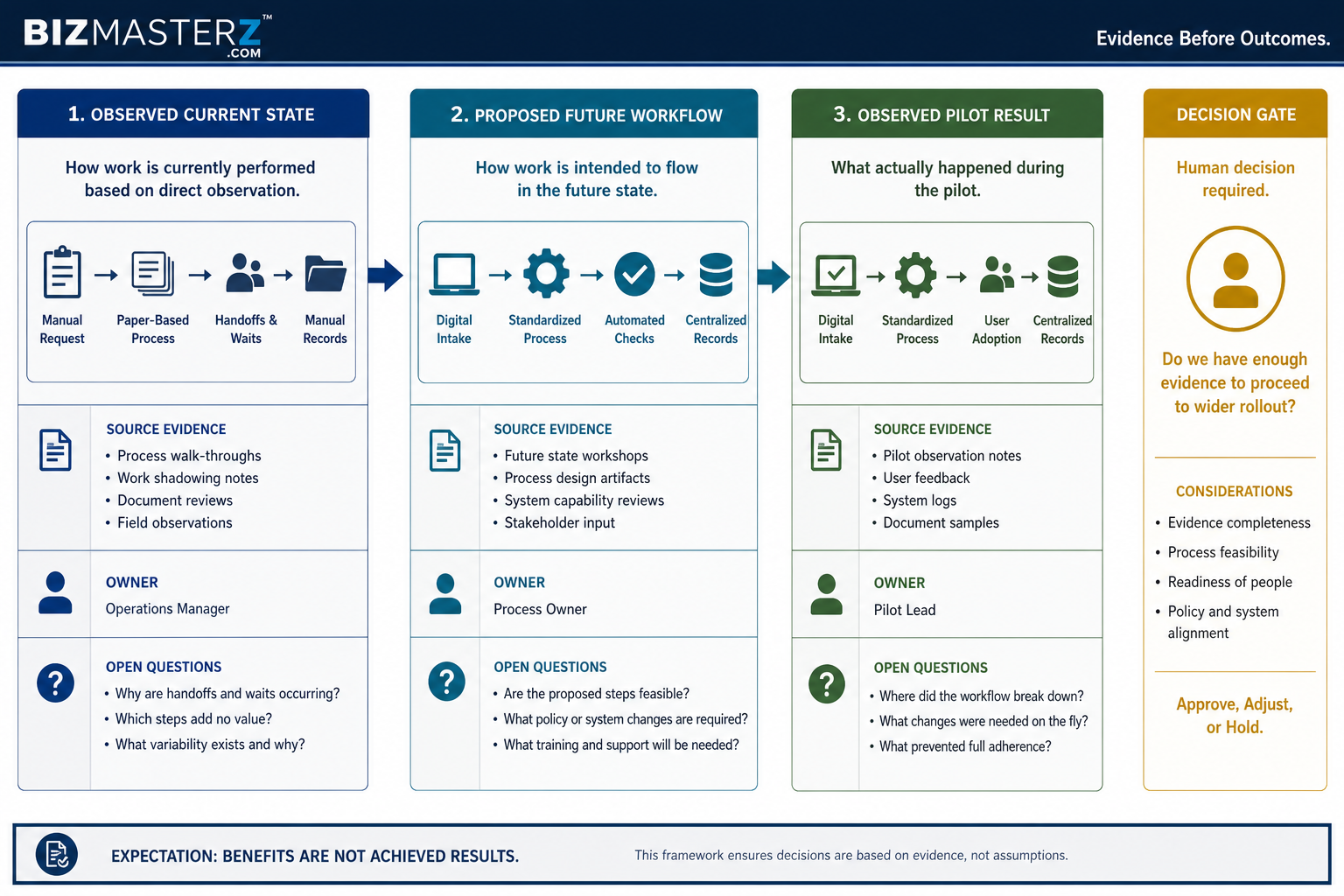
Manufacturing leaders embarking on AI pilots must decide whether a proposed AI-driven workflow warrants testing, redesign, or outright rejection before committing more resources. A rigorous Current-Future-Pilot Evidence Record provides a structured, matched comparison of the observed current-state baseline, a carefully designed AI-enabled future-state workflow, and later data collected from the pilot.
This methodical approach ensures decisions at Gate 1 (TEST, REDESIGN, REJECT) and subsequent pilot evaluation (ADOPT, REVISE, STOP, EXTEND_LEARNING) rest on concrete evidence rather than expectation or unqualified enthusiasm. Documenting the business-as-usual scenario precisely aligns with UK AI impact-evaluation guidelines, while the EPA’s value stream mapping framework informs how current and future states capture material and information flows. The essential point is that AI supports evidence organization and highlights gaps but does not replace human validation, approval, or accountability.
Setting the Stage: Why Compare Current and Future States in an AI Pilot?
Before introducing AI-driven changes in manufacturing, it is vital to establish a clear, evidence-based understanding of current operational workflows and conditions. Comparing these with a well-defined future state allows teams to identify exactly what changes the AI intervention will introduce and prepare for measurable pilot evaluation. This comparison underpins informed managerial decisions, ensuring pilot resources address realistic, context-aware opportunities rather than speculative improvements. The Current-Future-Pilot Evidence Record organizes this comparison transparently and builds management confidence in stepwise innovation alignment.
Understanding and Documenting the Current State
The process owner takes primary responsibility for accurately and completely validating the current state. This baseline must represent the actual work conditions before AI intervention, capturing relevant operational metrics, workflows, data flows, and workforce interactions. Methods like value stream mapping or Makigami can be leveraged to depict current information and material flows clearly—tools endorsed by the EPA for environmental and lean manufacturing contexts. The current state serves as the control for later comparison, so omitting or inaccurately documenting any baseline aspect may undermine pilot evaluation integrity.
Clear documentation includes physical and digital workflow sequences, handoffs between teams, cycle times or lead times, and variations or exceptions encountered in daily operations. It should also catalog data inputs, storage points, and reporting hierarchies relevant to the planned AI workflow. The workforce dimension is equally important, noting skill levels, roles, communication patterns, and resource constraints that may influence pilot execution.
Designing the Future State: Collaboration Across Functional Owners
Designing a future state that integrates AI requires cross-functional collaboration. Improvement owners propose workflow changes, risk owners assess new vulnerabilities or compliance implications, data owners verify data quality and availability, and workforce owners consider impacts on roles and skill sets. The accountable sponsor approves moving forward with testing. This structured human ecosystem generates a plausible workflow option that AI algorithms or tools might assist with but does not autonomously decide. Such interdisciplinary scrutiny ensures the future state is realistic, addresses known risks, and is aligned with organizational capabilities and culture.
The team debates and documents all assumptions about AI software readiness, data flows, process adjustments, and workforce retraining. This transparency ensures that the future state represents more than a hopeful redesign; it reflects consensus-driven scenarios open to pilot verification. Governance should explicitly define owner roles, pilot resources, and success criteria that guide subsequent decisions at Gate 1 and beyond.
Role of AI in Preparing the Current-Future-Pilot Evidence Record
AI’s authorized role includes organizing and aligning matched comparison fields across current and future workflows, flagging missing baselines or needed control variables, and drafting formal future-state options for human review. AI can help by consolidating data streams, detecting inconsistencies, and standardizing documentation formats to streamline human decision-making. However, AI must not diagnose root causes, claim or assume gains, or make final pilot approval recommendations.
In practice, AI can automate the correlation of operational metrics between current and future states, identify incomplete data fields, and generate preliminary reports that human owners then interrogate and refine. By doing so, AI serves as a powerful assistant for clarity and completeness, reducing administrative burden and enabling management to focus on strategic validation and risk assessment. Still, the process owner and cross-functional team remain responsible for verifying accuracy, assumptions, and alignment with corporate standards.
Implementing a Realistic Manufacturing Example: AI in Predictive Maintenance
Consider a factory implementing an AI pilot to enhance predictive maintenance scheduling. The current state may involve reactive maintenance based on time intervals or machine operator alerts, documented through value stream mapping of workflows, decision points, and breakdown frequency. The future state proposes AI-driven condition monitoring with anomaly detection to trigger maintenance proactively.
In designing this future state, improvement owners test AI algorithm readiness, risk owners evaluate safety impacts of automated alerts, data owners validate sensor data integrity, and workforce owners plan technician training. The AI system aggregates sensor data, flags anomalies, and organizes matched records of maintenance events. After the pilot runs, observed evidence on system alerts versus actual failures completes the record for decision-making at the post-pilot gate.
Evaluating Limitations and Challenges in the Comparison Process
Despite its rigor, the Current-Future-Pilot Evidence Record approach has limits. Discrepancies in data granularity or availability between current and proposed workflows can create comparison gaps requiring careful human judgment. Complex AI outputs sometimes resist straightforward matching to previous metrics. Organizational readiness, workforce acceptance, and unanticipated operational variations also impose challenges.
Document these factors as limitations or risk considerations to prevent premature or unsupported decisions. In some cases, the future state may require redesign or additional baseline data collection before proceeding to pilot testing. Recognizing these challenges early supports iterative improvement, enabling an adaptive approach aligned with real-world manufacturing complexity.
Human Accountability and Decision Gate Framework
Human owners retain all responsibility for validating documentation, challenging assumptions, testing pilot alignment, and final decision-making. At Gate 1, the accountable sponsor, supported by validation from process, improvement, risk, data, and workforce owners, chooses to TEST, REDESIGN, or REJECT the proposed workflow. After pilot observation, the group reconvenes to decide whether to ADOPT, REVISE, STOP, or EXTEND_LEARNING based strictly on the recorded evidence, never on hoped-for outcomes.
This disciplined accountability structure emphasizes that technology supports management choices without supplanting them. Explicit roles and decision authorities must be established to prevent unclear responsibility or automated decision-making without human oversight. This transparency ensures governance compliance and preserves organizational learning.
Linking to Operational Excellence and Workflow Prioritization
Manufacturing leaders can integrate this evidence record within a broader operational excellence framework by prioritizing AI use cases aligned with value streams showing the greatest bottlenecks or waste. Resources like AI for Value Stream Management demonstrate how mapping current versus proposed states ties directly into prioritized improvement actions.
Similarly, linking future state design to operational priorities benefits from frameworks discussed in How to Prioritize AI Use Cases in Operational Excellence, while mapping methods like Makigami versus value stream mapping provide complementary perspectives (comparison article).
Integrating the Current-Future-Pilot Evidence Record into these broader management systems promotes a consistent decision pathway from strategic prioritization through detailed pilot evaluation and implementation.
Best Practices for Maintaining a Robust Evidence Record
- Consistent Data Collection: Define and follow standard measurement protocols for current, future, and pilot states.
- Transparent Documentation: Maintain clear records of assumptions, decision rationales, and identified limitations.
- Iterative Reviews: Schedule periodic reviews involving all functional owners to update the evidence record as new data arrives or contexts change.
- Change Control: Manage modifications to workflows or pilot parameters through controlled processes to preserve evidence integrity.
- Human-Centric Decision Points: Reinforce that all gate decisions remain human-led despite AI-supported evidence analysis.
Final Considerations
Comparing current and future states rigorously within a single matched evidence record offers manufacturing leaders a clear, data-based foundation for AI pilot decisions. It enforces process discipline aligned with recognized evaluation guidance and keeps AI supportive rather than determinative. By embedding human ownership, transparent documentation, and structured gate decisions, the approach balances enthusiasm for innovation with operational prudence. This process ultimately empowers leaders to harness AI effectively—testing, learning, and adapting within the realities of manufacturing environments.
Frequently Asked Questions
What key elements should be documented in the current state before an AI pilot?
The current state should include detailed workflows, information and material flows, data quality and sources, workforce roles, and operational metrics that reflect normal business-as-usual conditions. This complete baseline is essential for valid comparison post-AI implementation.
Who is responsible for validating the future state design in an AI pilot?
Improvement, risk, data, and workforce owners validate the future state design collaboratively, with final approval from an accountable sponsor. This ensures all relevant perspectives—process, safety, data integrity, and personnel—are considered before testing. This collaborative approach aligns with value stream mapping principles to ensure a comprehensive understanding of process and information flows.
Can AI alone decide whether to adopt or stop an AI pilot?
No, AI supports organizing evidence and flagging gaps but does not replace human decision-making. Responsible named individuals evaluate all matched current, future, and pilot data before making adopt, revise, stop, or extend learning decisions. Human evaluation remains essential to interpret AI findings within the broader organizational context and objectives.
How does value stream mapping help in comparing current and future states?
Value stream mapping systematically documents all value-adding and non-value-adding steps in a process, including material and information flow. This clarity helps precisely define current baselines and visualize proposed improvements in the future state, as recognized by the EPA’s lean environment toolkit.
What are common limitations when comparing current and future workflows in AI pilots?
Limitations include data mismatches, evolving operational conditions, workforce skill gaps, and complexity in interpreting AI outputs. Recognizing and documenting these enables more informed human decision-making and reduces risks of premature conclusions. Acknowledging these limitations facilitates clearer communication and better planning during the evaluation process.