
As artificial intelligence (AI) technologies migrate from pilot stages toward broader business implementation, stakeholders frequently seek to understand the degree to which AI deployments influence operational performance. To form reliable evaluations of any AI-related changes, organizations must first establish a clear, objective baseline of current system performance before applying the AI intervention. Without such groundwork, it becomes difficult or impossible to differentiate improvement caused by AI from natural variation, process evolution, or other external factors. A well-defined baseline frames meaningful comparison and risk assessment, enabling decision-makers to interpret observed changes accurately, avoid overstating benefits, and appropriately manage expectations.
Understanding the Purpose of a Baseline in AI Initiatives
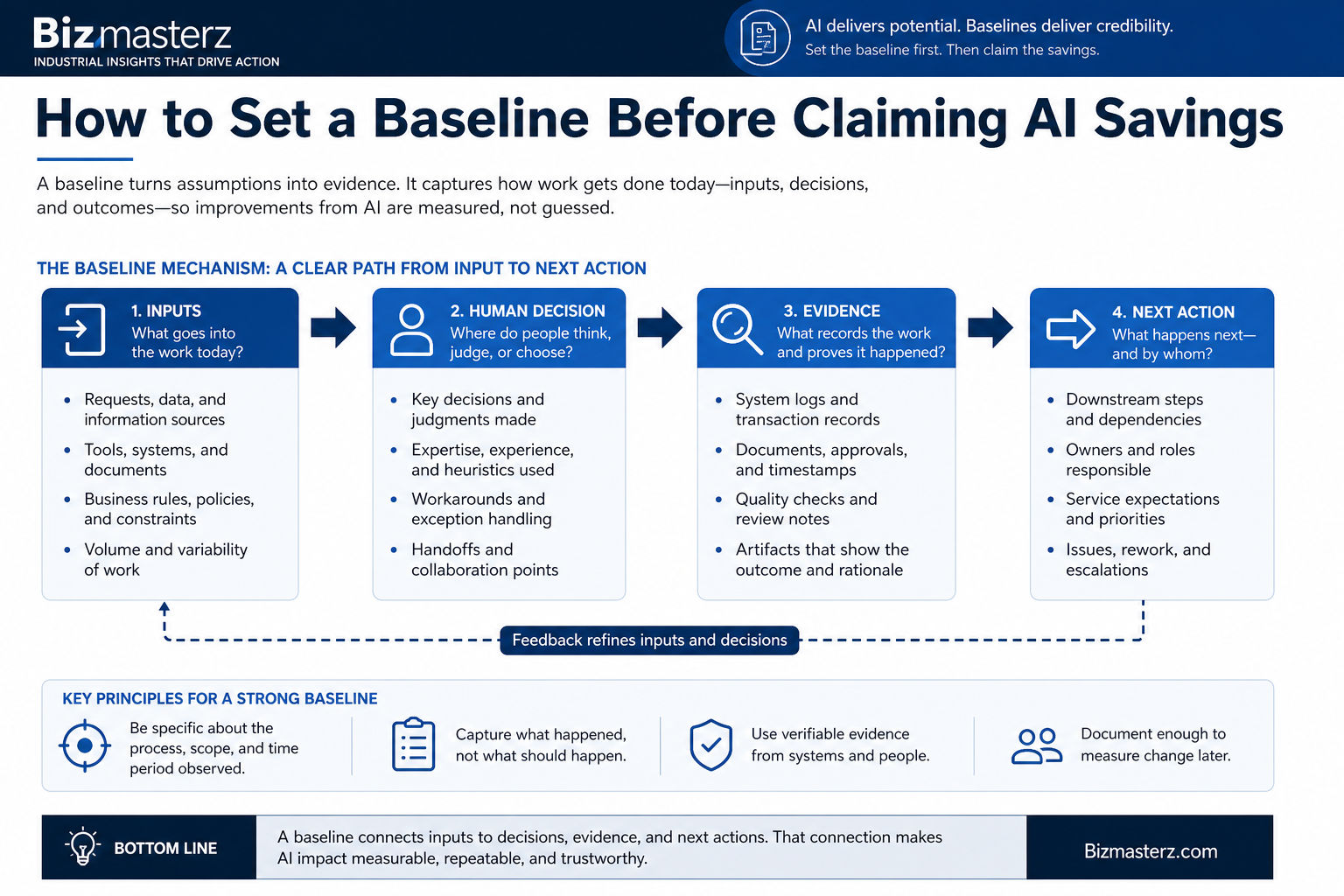
A baseline represents a snapshot of relevant performance, effort, or risk metrics collected prior to AI system deployment. It captures the operational status quo against which the AI’s eventual impact can be measured. Rather than serving as a financial or return on investment metric itself, a baseline ensures that any post-implementation analysis rests on consistent, well-documented foundations. The National Institute of Standards and Technology (NIST) Artificial Intelligence Risk Management Framework (AI RMF) underscores the importance of baseline metrics, particularly when AI systems replace or augment human decision-making. It states:
“Risk management of AI systems that are intended to augment or replace human activity […] requires some form of baseline metrics for comparison.”
While NIST’s focus is on risk comparison rather than financial savings validation, the principle applies broadly: tracking relevant baseline metrics helps organizations monitor risk and performance, avoid attributing unrelated fluctuations to AI effects, and strengthen governance oversight.
Key Elements to Include When Setting a Baseline
Establishing a baseline requires deliberate planning tailored to the AI use case and desired outcomes. The following considerations can guide the development of an effective baseline:
1. Define Clear, Relevant Metrics
Select metrics that directly relate to the AI system’s intended function. Examples include:
- For AI augmenting human workflows: Time spent per task, error or defect rates, decision accuracy, or case volume processed.
- For process automation AI: Manual effort hours, throughput, cycle time, or number of rework cycles.
- For risk management AI: Incident frequency and severity, compliance deviations, or detection accuracy rates.
Metrics should be quantitatively defined, reliably measurable, and collectible without the AI in operation.
2. Capture Representative Data Over an Adequate Observation Window
Short observation periods risk misrepresenting typical operations due to inherent variation or cyclical patterns such as seasonality or periodic business events. Collect baseline data over a sufficiently long and stable window to smooth out such variability. Depending on process complexity and volume, this may range from several weeks to multiple months.
3. Specify and Control the Work Unit and Case Mix
Establish a consistent definition of the work unit (e.g., an invoice processed, a support ticket resolved) to ensure that measurement is standardized. It’s also important to characterize the case mix—the variety and complexity of work instances—since changes in case variety during or after AI deployment can influence results independently of the AI’s impact. Documenting baseline case mix supports fair comparisons.
4. Document Quality Attributes and Rework Rates
Baseline measurement should include quality indicators and the frequency or extent of rework or corrective efforts. These aspects affect total effort and cost and provide context to raw performance metrics like throughput or cycle time. Baseline quality data also help detect whether AI introduction affects outcomes positively or negatively.
5. Record Review Effort and Overhead Activities
In many knowledge work settings, review or verification activities consume significant effort. Baseline data should detail not only frontline task execution time but also the effort spent on review, approval, or exception handling. This helps identify if AI introduces shifts in effort allocation rather than absolute reductions.
6. Capture Costs Separately from Effort Metrics
Where feasible, quantify costs associated with work activities, distinguishing labor, software, and overhead expenses. Baseline cost accounting allows alignment with financial planning and supports later comparison, though cost attribution to AI should remain cautious without extensive financial validation.
7. Document External and Contextual Variables
Record any known or anticipated external factors during the baseline period that might impact operations. These include staffing changes, system upgrades unrelated to AI, policy shifts, or market fluctuations. Such documentation aids in controlling confounding variables during post-implementation analysis.
8. Engage Stakeholders and Secure Finance Sign-Off
Involve process owners, frontline teams, data analysts, and finance representatives early to determine baseline scope and validation criteria. Financial stakeholders provide necessary oversight on cost data and ensure that baseline definitions meet organizational accounting standards. Broad engagement reinforces shared understanding and credibility.
9. Define a Stopping Rule for Baseline Collection
Set criteria that determine when baseline data collection is sufficient to represent steady-state operations. This may involve minimum data volume, acceptable variability thresholds, or elapsed time benchmarks. Clear stopping rules prevent collecting insufficient data or unnecessarily prolonging pre-AI activities.
Practical Steps for Conducting a Baseline Measurement
Below is an expanded operational framework to guide baseline establishment:
- Clarify AI Pilot Objectives and Hypotheses
Before gathering baseline data, document specific hypotheses about expected AI impacts and which metrics correspond to those goals. This ensures measurement efforts focus on meaningful indicators rather than generic data collection. - Develop a Baseline Worksheet (Original Bizmasterz Synthesis)
Create a structured worksheet that itemizes each relevant metric along with measurement definitions, data sources, collection frequency, data responsibilities, and quality checks. Note that this worksheet is a methodology to support consistent baseline measurement rather than a validated AI return-on-investment (ROI) framework. Using such a tool promotes thoroughness and repeatability across teams. - Implement Data Collection Aligned with Observed Work Practices
Collect data in a manner consistent with daily operating realities, using system logs, time studies, surveys, or observational methods as appropriate. Emphasize accuracy and completeness to avoid bias. - Perform Baseline Data Quality Reviews
Periodically audit data for anomalies, gaps, or inconsistencies. Consult with frontline workers and data owners to validate interpretations. Document any corrective actions taken during baseline period. - Analyze Baseline Data and Report Findings
Prepare summary reports including averages, ranges, distributional characteristics, and variance over time for each metric. Include qualitative context such as noted process variations, user feedback, and external factors. - Socialize Findings and Obtain Alignment
Present baseline reports to all relevant stakeholders and governance committees to confirm shared understanding and agreement on baseline definitions before AI implementation. Address questions or concerns proactively. - Design Comparable Post-Implementation Measurement Protocols
Establish data collection plans for during and after AI deployment that mirror baseline methods to enable valid “apples-to-apples” comparisons. Anticipate potential shifts in data sources or quality issues to prepare mitigation strategies.
Interpreting Baseline Data in the Context of AI-Related Effort Changes
Recent qualitative research on professional users of generative AI, such as the study published by Springer Fachmedien Wiesbaden, reveals that many users do not simply reduce their total effort with AI tools. Instead, they may strategically reallocate effort across different activities or sometimes increase overall effort to achieve higher quality, scope, or complexity. This underscores that effort differences observed post-AI implementation do not inherently equal cost savings and must be interpreted within broader operational context informed by a solid baseline.
Baseline data on effort distributions—including routine execution, review cycles, rework, and overhead—establishes a reference that helps distinguish between real efficiency gains, effort shifting, or task expansion influenced by AI. Organizations should expect nuanced outcomes and integrate baseline insights into continuous monitoring and adaptive management strategies.
Baseline Integration with AI Risk and Compliance Frameworks
Beyond productivity or cost considerations, baseline performance and risk metrics are integral to responsible AI governance. The NIST AI RMF emphasizes that understanding baseline human performance enables organizations to better identify where AI systems may introduce new risks or fail to meet standards. Baseline risk profiles establish a point of comparison for operational safety, fairness, and robustness assessments.
Aligning baseline measurement methods with compliance, audit, and risk management processes strengthens governance and organizational confidence. Baseline establishment should be considered a foundational element of AI program management, rather than an optional or secondary activity.
Use Case Illustrations
Customer Service Automation
A company introducing AI chatbots for customer support first measures baseline metrics such as average handle time, customer satisfaction ratings, and call complexity mix. This comprehensive measurement approach allows the company to later analyze how chatbot deployment changes workload distribution and customer outcomes. Without baseline context, shifts in call type or seasonal demand could be mistaken for AI-driven performance effects.
Marketing Content Generation
Marketing teams deploying generative AI to assist with copywriting record initial staff hours devoted to content creation and revision, along with qualitative notes on rework cycles and decision review effort. Capturing this detailed baseline enables comparison after AI introduction, providing insight into where AI reduces repetitive drafting versus where it may increase workload by generating greater content volume requiring more creative refinement—a nuanced picture not captured by simple time-savings claims.
Set a Baseline Before Claiming AI Savings
Establishing a well-defined, context-sensitive baseline prior to AI system deployment is indispensable for any organization pursuing credible claims of AI-driven improvements. Such baselines provide clarity and rigor to performance comparisons, minimize risks of erroneous attribution, and support managed AI risk governance as promoted by authorities like NIST. Focusing first on the baseline human or process performance equips organizations to conduct transparent, evidence-based assessments of AI impacts—encompassing cost, effort, quality, and risk dimensions with balanced interpretation.
Frequently Asked Questions
Why is it important to set a baseline before implementing AI?
Setting a baseline is critical because it captures the pre-AI state of processes or activities, which acts as a reference for evaluating AI’s true impact. Without this, any observed changes post-implementation could result from normal variation, unrelated process adjustments, or external factors. Baselines enable meaningful, transparent comparison and credible evidence of AI effects.
How do I decide how long to collect baseline data?
The collection period should be long enough to capture typical process variability and cyclical patterns. For routine, stable tasks, a few weeks of data may suffice, but for operations affected by seasonality, cyclical demand, or periodic events, multiple months might be necessary. The goal is to accumulate enough data to establish statistically and operationally representative metrics.
What should be included besides quantitative metrics in a baseline?
Besides quantitative KPIs, it is valuable to collect qualitative context such as narratives of workflow steps, descriptions of user effort allocation, observations about process bottlenecks, and any known disruptions or environmental factors. This information enriches interpretation and better informs later comparative analysis of AI effects.
If professional users sometimes increase effort with AI, how should savings be assessed?
Recognizing that AI may reallocate or increase effort in some dimensions, savings assessments should go beyond aggregate time measures to include detailed effort mapping by activity and quality outcomes. Baseline data that captures these dimensions supports nuanced understanding of where AI adds value and where it may require additional oversight or adjustment to optimize net benefits.
Where can I find official guidance on establishing AI baseline metrics?
The NIST AI Risk Management Framework (AI RMF) provides authoritative discussion of baseline metrics within its risk management context. While it does not validate financial savings claims, it offers foundational principles and terminology useful for structuring baseline measurement efforts.