

For manufacturing leaders managing complex customer feedback and quality assurance processes, effectively sorting and prioritizing quality complaints is a critical yet time-consuming challenge. Artificial Intelligence (AI) presents a practical opportunity to streamline complaint intake by automatically classifying and tentatively labeling incoming reports, thus focusing human expertise where it adds the most value without substituting managerial authority or regulatory responsibility.
Defining AI-Enabled Complaint Classification in Manufacturing Quality
In the context of manufacturing quality management, AI-enabled complaint classification is the process whereby a machine learning model analyzes free-text or structured complaint data to assign provisional taxonomy labels indicating the likely category, severity, or subject of a customer quality complaint. This automated preliminary classification assists the responsible quality team in efficiently reviewing and routing complaints to proper workflows for investigation or follow-up.
This process is fundamentally an assistive technology: it augments human capability by organizing and highlighting patterns, not replacing human judgment. It is distinct from fully automated complaint resolution or root cause analysis; AI here functions as an aid in early-stage sorting and evidence organization, not as an independent decision maker. The human quality owner retains full authority over final complaint handling, triage, and disposition per regulatory and operational standards.
The Importance of Effective Complaint Management in Manufacturing
Customer quality complaints serve as a critical feedback mechanism in manufacturing, affecting product safety, regulatory compliance, brand reputation, and continuous improvement programs. Poorly managed complaints can delay investigations, allow quality issues to persist undetected, and ultimately impair customer satisfaction.
Traditional complaint intake involves manual review, classification, and routing by quality personnel — often slow and inconsistent when volumes grow or complaint descriptions are ambiguous. This can lead to backlogs, misrouted cases, or overlooked risks. AI classification offers a scalable approach to reducing the burden of manual sorting while maintaining transparency and traceability, enabling quality managers to focus on higher-value tasks such as thorough investigations, corrective action planning, and systemic quality improvements.
Mechanism: How AI Classifies Complaints Using Natural Language Processing
AI complaint classifiers typically rely on Natural Language Processing (NLP) techniques and supervised machine learning models trained on historical complaint datasets. The main technical steps involve:
- Text preprocessing: Normalizing, tokenizing, and cleaning complaint-language input to reduce noise, e.g., fixing spelling errors and standardizing terminology.
- Feature extraction: Deriving relevant linguistic features such as keywords, n-grams (word pairs or triples), semantic embeddings, or domain-specific terms associated with quality issues.
- Model inference: Applying trained classification algorithms — such as convolutional or recurrent neural networks, support vector machines, or transformer-based architectures — to predict probable complaint categories based on input features.
- Provisional labeling: Outputting suggested taxonomy labels and confidence scores along with supporting evidence snippets extracted from the complaint text for human review.
This classification focuses expressly on the intake stage, sorting complaints by their textual content without performing complex root-cause diagnostics, duplicate grouping, or automated disposition decisions.
Scope and Boundaries: What AI Classification Is and Is Not
It is important to clearly delineate AI-enabled complaint classification from related but separate processes:
- Duplicate Detection and Recurrence Grouping: Identifying whether multiple complaints represent the same underlying issue or recurrences requires logic beyond analyzing individual complaint text, such as cross-referencing timelines, product batches, or internal incident reports.
- Triage and Prioritization: Determining complaint urgency, customer impact, or escalation pathways depends on business rules, risk assessments, and operational constraints that cannot be derived from classification alone.
- Root Cause Analysis and Resolution: Investigations and the determination of product or process corrective actions require deep domain expertise, engineering input, and physical evidence beyond AI’s intake-level text classification role.
AI classification outputs should be seen as advisory annotations to support human decision-making. They do not autonomously drive operational workflow routing or regulatory response. The quality team must retain ultimate control and accountability for complaint outcomes.
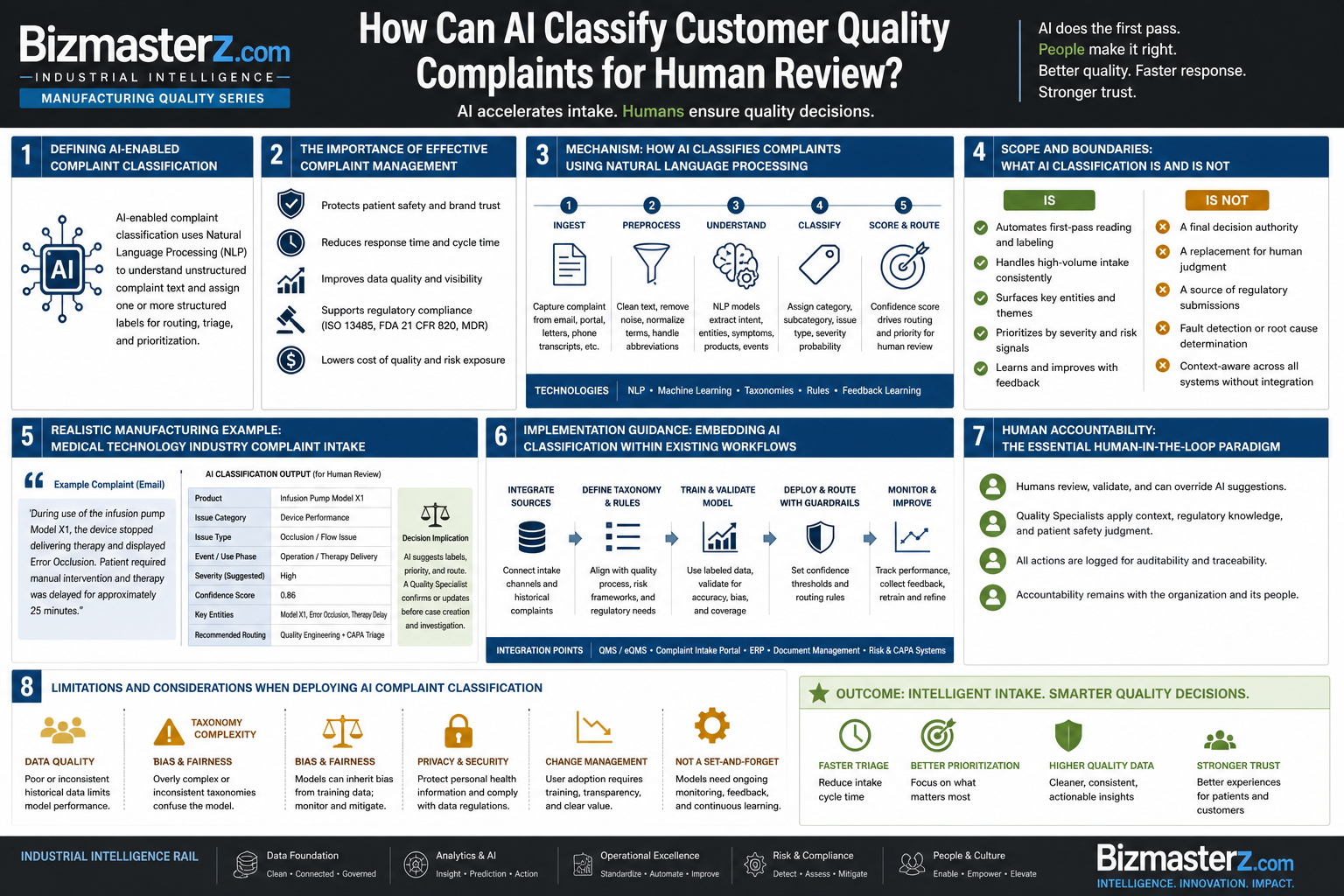 Explains How Can AI Classify Customer Quality Complaints for Human Review?
A Realistic Manufacturing Example: Medical Technology Industry Complaint Intake
Consider a medical technology manufacturer receiving hundreds of customer quality complaints daily through multiple channels, including phone calls, emails, and web forms. Each complaint varies in depth, language, and technical detail. This organization trains a bespoke AI model on years of previously classified complaints, enabling it to process new inputs rapidly and propose provisional labels such as “Device Malfunction,” “Packaging Defect,” “Software Interface Issue,” or “Sterility Problem.” The system highlights textual evidence — for example, phrases like “screen freezes,” “seal leakage,” or “unexpected alarm” — that support the classification.
Human quality analysts review these proposed labels alongside the original complaint text, which is preserved in an intake ledger system. Complaints flagged with low confidence scores or containing multiple plausible categories are routed for mandatory expert review to ensure accuracy. By automating this early step, the company efficiently reduces manual sorting time, shortens response cycles, and uncovers emerging complaint trends earlier — while preserving full human control over investigation, escalation, and regulatory reporting. This approach has been demonstrated in applied research within the medical device sector (Toward Automated Support of Complaint Handling Processes) and reflects practical implementation principles supported by Bizmasterz’s quality management expertise.
Implementation Guidance: Embedding AI Classification Within Existing Quality Complaint Workflows
Manufacturing leaders contemplating AI integration for complaint classification should consider the following implementation roadmap:
- Data Collection and Labeling: Compile and curate a representative historical dataset of complaints with validated labels following your corporate taxonomy. Ensure quality and consistency of labeling to enable effective model training.
- Model Selection and Development: Evaluate machine learning architectures suitable for your data volume, language complexity, and multilingual requirements. Collaborate with AI experts to fine-tune models incorporating domain-specific terminology and slang common in your complaint text.
- Provisional Label Persistency: Design your complaint intake platform or case management system to store AI-generated provisional labels alongside the original unaltered complaint text and evidence snippets, building a traceable intake ledger.
- Flagging Ambiguities and Confidence Thresholds: Implement mechanisms to flag complaints with low-confidence classifications or conflicting label candidates for prioritized human review to avoid misrouting or oversight.
- Workflow Integration: Establish clear handoff points where AI outputs serve as advisory inputs for complaint triage teams, ensuring that AI labels are manually accepted, modified, or rejected before case routing.
- Training and Change Management: Educate quality teams on AI capabilities and limitations, emphasizing continued human oversight. Promote feedback loops in which corrected labels from human reviewers are incorporated back into model retraining cycles for ongoing improvement.
- Compliance and Audit Trails: Maintain detailed logs of AI recommendations, human reviewer decisions, and final complaint dispositions to support quality management system audits and regulatory compliance.
These steps balance technological benefits with practical operational control, avoiding unrealistic expectations for AI autonomy while leveraging its throughput and consistency gains.
Human Accountability: The Essential Human-in-the-Loop Paradigm
Despite AI’s assistance, the human quality process owner or designated quality management personnel remain fully responsible for:
- Validating, accepting, rejecting, or adjusting AI-proposed labels.
- Deciding complaint routing, escalation, and investigation priorities based on operational and regulatory criteria.
- Administering response strategies, disposition, and closure actions consistent with corporate quality standards.
This explicit human-in-the-loop paradigm ensures accountability, preserves regulatory compliance, and safeguards customer safety. AI acts strictly as a preparatory evidence organizer and flagging mechanism. When AI uncertainty is flagged or complaints involve complex, multi-issue content, human judgment is indispensable to prevent misclassification or missed signals.
Limitations and Considerations When Deploying AI Complaint Classification
Manufacturing leaders must recognize several inherent constraints in AI complaint classification:
- Provisional Nature and Error Potential: AI outputs are probabilistic suggestions and may contain errors. Human validation remains mandatory to ensure reliability.
- Scope Limitations: AI classification does not perform duplicate detection, root cause analysis, resolution recommendation, or regulatory reporting.
- Domain and Language Specificity: Models trained on a single manufacturing sub-sector or taxonomy may not generalize well without retraining or adaptation, necessitating continued involvement of domain experts.
- Customer Language Variability: Complaint narratives vary widely in clarity, terminology, and detail; complex, multi-topic complaints can challenge NLP models.
- Data Privacy and Security: Protecting the confidentiality of customer data during AI processing and storage is critical and must adhere to applicable data protection regulations.
By understanding these limits, organizations can calibrate expectations and implementation rigor accordingly.
Connection to Industrial Intelligence and Future Pathways
AI-enabled customer complaint classification exemplifies the broader theme of Industrial Intelligence — the intelligent application of AI and digital technologies to sharpen operational decision-making in manufacturing. Automating foundational activities such as intake sorting and provisional labeling frees skilled quality personnel to focus on deeper analysis, exception handling, and strategic quality improvements. Future advancements could integrate semantic understanding, cross-case correlation, and more refined triage support, but these must co-evolve with human oversight frameworks ensuring governance, transparency, and compliance.
Frequently Asked Questions
What decision should manufacturers make about how AI Can Classify Customer Quality Complaints for human review?
Manufacturers should begin with the operating decision the capability is expected to improve, the evidence needed to support that decision, and the person accountable for the result. This keeps the work tied to a real production constraint and prevents a technology deployment from becoming a substitute for process ownership.
How should a manufacturer implement How Can AI Classify Customer Quality Complaints for Human Review? safely?
Start with one bounded workflow where inputs, operating limits, escalation paths, and verification criteria are understood. Test the workflow with the people who own the process, document exceptions, and expand only after the result is repeatable under actual production conditions. Consequential actions should remain subject to explicit human authority.
How should the results of How Can AI Classify Customer Quality Complaints for Human Review? be validated?
Compare the outcome with a defined baseline and use evidence appropriate to the process, such as quality, reliability, throughput, or response-time measures. Record who reviewed the result, what changed, and whether the improvement held over time. Only verified outcomes should influence future rules, models, or standard work.


